2025년 고2 9월 모의고사 26번 해설 및 분석
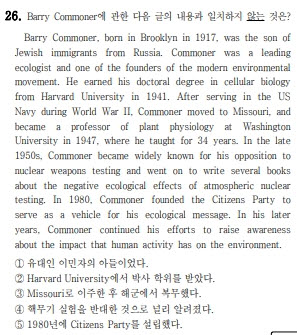
1) 문제 제시 (영어 지문 + 선택지)
Passage (원문 그대로)
Barry Commoner, born in Brooklyn in 1917, was the son of Jewish immigrants from Russia. Commoner was a leading ecologist and one of the founders of the modern environmental movement. He earned his doctoral degree in cellular biology from Harvard University in 1941. After serving in the US Navy during World War II, Commoner moved to Missouri, and became a professor of plant physiology at Washington University in 1947, where he taught for 34 years. In the late 1950s, Commoner became widely known for his opposition to nuclear weapons testing and went on to write several books about the negative ecological effects of atmospheric nuclear testing. In 1980, Commoner founded the Citizens Party to serve as a vehicle for his ecological message. In his later years, Commoner continued his efforts to raise awareness about the impact that human activity has on the environment.
Question | 문제
Barry Commoner에 관한 다음 글의 내용과 일치하지 않는 것은?
Options (영·한 병기)
- He was the son of Jewish immigrants from Russia. — 그는 러시아 출신 유대인 이민자의 아들이었다.
- He earned a doctoral degree in cellular biology. — 그는 세포생물학 박사학위를 받았다.
- He moved to Missouri and then served in the Navy. — 그는 미주리로 이주한 다음 해군에 복무했다. ❌ (정답: 불일치)
- He wrote several books about the ecological harm of atmospheric nuclear tests. — 그는 대기권 핵실험의 생태학적 피해에 관한 책을 여러 권 집필했다.
- He founded the Citizens Party in 1980. — 그는 1980년에 시민당(Citizens Party)을 창당했다.
2) 직독직해 (문장별 어휘·문법 포함)
S1
EN (slash) Barry Commoner, / born in Brooklyn in 1917, / was the son of Jewish immigrants from Russia.
직독 배리 코먼어는 / 1917년 브루클린에서 태어났으며, / 러시아 출신 유대인 이민자의 아들이었다.
자연 해석 배리 코먼어는 1917년 브루클린에서 태어난 러시아계 유대인 이민자의 아들이었다.
Vocab EN↔KR (Syn/Ant/Colloc)
- immigrant 이민자 (Syn: newcomer; Ant: native) | Jewish immigrants 유대인 이민자
- be born in ~ ~에서 태어나다 (Colloc: born in Brooklyn in 1917)
Grammar 포인트 - 분사구 born in Brooklyn in 1917 → 동격·삽입으로 주어 수식(관계절 축약).
- apposition: 이름 뒤 설명 삽입 쉼표 구조.
1. 문장 뼈대
- 주어: Barry Commoner
- 동사: was
- 보어: the son of Jewish immigrants from Russia
👉 “배리 코머너는 러시아에서 온 유대인 이민자의 아들이었다.”
2. 부분 분석
- Barry Commoner,
- 주어 = 인물 이름
- born in Brooklyn in 1917,
- 과거분사 구 → 주어(B. Commoner)를 수식하는 분사구
- born in Brooklyn = 브루클린에서 태어난
- in 1917 = 1917년에
👉 “1917년에 브루클린에서 태어난”
- was the son of Jewish immigrants from Russia.
- was = ~였다
- the son of = ~의 아들
- Jewish immigrants from Russia = 러시아에서 온 유대인 이민자들
👉 “러시아에서 온 유대인 이민자의 아들이었다”
3. 직독직해
- Barry Commoner,
➡ 배리 코머너는, - born in Brooklyn / in 1917,
➡ 브루클린에서 태어난 / 1917년에, - was / the son of / Jewish immigrants / from Russia.
➡ ~였다 / 아들 / 유대인 이민자들의 / 러시아에서 온.
4. 자연스러운 번역
배리 코머너는 1917년 브루클린에서 태어난 러시아 출신 유대인 이민자의 아들이었다.
5. 문법 포인트
- 분사구 (born in …)
- 주어를 꾸며주는 역할
- = who was born in Brooklyn in 1917 (관계절로 바꿀 수 있음)
- the son of ~
- ~의 아들
- 보어 역할
- immigrants from Russia
- 러시아 출신 이민자들
6. 표현 정리 (영 → 한)
| born in Brooklyn | 브루클린에서 태어난 |
| in 1917 | 1917년에 |
| the son of | ~의 아들 |
| Jewish immigrants | 유대인 이민자들 |
| from Russia | 러시아 출신의 |
👉 여기서 born in Brooklyn in 1917은 사실상 삽입부라서, 문장을 더 단순하게 쓰면:
- Barry Commoner was the son of Jewish immigrants from Russia.
- (= Barry Commoner, who was born in Brooklyn in 1917, was …)
S2
EN Commoner was a leading ecologist and one of the founders of the modern environmental movement.
직독 코먼어는 저명한 생태학자였고, 현대 환경운동의 창립자 중 한 명이었다.
자연 그는 선도적 생태학자이자 현대 환경운동의 창립 멤버였다.
Vocab
- leading 저명한·선도적인 (Syn: prominent, eminent)
- ecologist 생태학자 | environmental movement 환경운동
- one of the founders 창립자 중 한 명 (Colloc: one of the + 복수명사)
Grammar - A and B 서술어 병렬(동일 주어).
1. 문장 뼈대
- 주어: Commoner
- 동사: was
- 보어: a leading ecologist and one of the founders of the modern environmental movement
👉 “코머너는 저명한 생태학자였으며 현대 환경 운동의 창립자 중 한 사람이었다.”
2. 부분 분석
- Commoner was a leading ecologist
- Commoner = 배리 코머너
- was = ~였다
- a leading ecologist = 저명한(선도적인) 생태학자
👉 “코머너는 저명한 생태학자였다”
- and one of the founders of the modern environmental movement
- one of the founders = 창립자 중 한 명
- of the modern environmental movement = 현대 환경 운동의
👉 “현대 환경 운동의 창립자 중 한 사람이었다”
3. 직독직해
- Commoner / was / a leading ecologist
➡ 코머너는 / ~였다 / 저명한 생태학자 - and / one of the founders / of the modern environmental movement.
➡ 그리고 / 창립자 중 한 사람 / 현대 환경 운동의.
4. 자연스러운 번역
코머너는 저명한 생태학자였으며, 현대 환경 운동의 창립자 중 한 사람이었다.
5. 문법 포인트
- leading + 직업/분야 명사
- 선도적인, 저명한
- e.g., a leading scientist, a leading expert
- one of the + 복수명사
- ~ 중 한 명
- 뒤에는 반드시 복수형: founders
- environmental movement
- 환경 운동
6. 표현 정리 (영 → 한)
| a leading ecologist | 저명한 생태학자 |
| one of the founders | 창립자 중 한 명 |
| modern environmental movement | 현대 환경 운동 |
S3
EN He earned his doctoral degree in cellular biology from Harvard University in 1941.
직독 그는 1941년 하버드대에서 세포생물학 박사학위를 취득했다.
자연 1941년에 하버드에서 세포생물학 박사학위를 받았다.
Vocab
- earn/receive a doctoral degree 박사학위를 취득하다 (Syn: obtain)
- cellular biology 세포생물학 (Colloc: degree in cellular biology)
Grammar - 전치사 from + 기관: 학위 수여 기관 표시.
1. 문장 뼈대
- 주어: He
- 동사: earned
- 목적어: his doctoral degree in cellular biology
- 전치사구: from Harvard University in 1941
👉 “그는 1941년에 하버드 대학교에서 세포 생물학 박사 학위를 받았다.”
2. 부분 분석
- He earned
- earn = 획득하다, 받다 (특히 노력으로 얻은 것)
👉 “그는 받았다”
- earn = 획득하다, 받다 (특히 노력으로 얻은 것)
- his doctoral degree in cellular biology
- doctoral degree = 박사 학위 (Ph.D.)
- in cellular biology = 세포 생물학 분야에서
👉 “세포 생물학 박사 학위”
- from Harvard University
- 하버드 대학교에서
- in 1941
- 1941년에
3. 직독직해
- He earned / his doctoral degree / in cellular biology / from Harvard University / in 1941.
➡ 그는 받았다 / 그의 박사 학위를 / 세포 생물학에서 / 하버드 대학교에서 / 1941년에.
4. 자연스러운 번역
그는 1941년에 하버드 대학교에서 세포 생물학 박사 학위를 받았다.
5. 문법 포인트
- earn a degree
- 학위를 받다 (특히 노력의 결과로)
- cf) receive/obtain a degree 도 가능
- doctoral degree
- 박사 학위 (= Ph.D.)
- 전치사 in / from
- in + 학문 분야 (전공)
- from + 학교 이름
6. 표현 정리 (영 → 한)
| earn a doctoral degree | 박사 학위를 받다 |
| in cellular biology | 세포 생물학에서 |
| from Harvard University | 하버드 대학교에서 |
| in 1941 | 1941년에 |
S4
EN After serving in the US Navy during World War II, / Commoner moved to Missouri, / and became a professor of plant physiology at Washington University in 1947, / where he taught for 34 years.
직독 제2차 세계대전 동안 미 해군에서 복무한 뒤, / 코먼어는 미주리로 이주했고, / 1947년 워싱턴대학교에서 식물생리학 교수가 되었으며, / 그곳에서 34년간 가르쳤다.
자연 2차 대전 때 미 해군에 복무한 뒤 미주리로 옮겨, 1947년 워싱턴대 식물생리학 교수가 되어 34년 동안 재직했다.
Vocab
- serve in the Navy 해군에서 복무하다 (Colloc: serve in the US Navy)
- plant physiology 식물생리학 | Washington University (in St. Louis) 워싱턴대학교
- teach for ~ years ~년간 가르치다
Grammar (핵심) - After + V-ing(분사구) → 복무 후에 이주. (보기 ③의 순서 뒤바뀜 확인)
- where 관계부사: Washington University를 수식.
1. 문장 뼈대
- 부사절: After serving in the US Navy during World War II
- 주절1: Commoner moved to Missouri
- 주절2: and became a professor of plant physiology at Washington University in 1947
- 관계절: where he taught for 34 years
👉 “제2차 세계대전 동안 미 해군에서 복무한 뒤, 코머너는 미주리로 이주했고, 1947년 워싱턴 대학교에서 식물생리학 교수가 되었으며, 그곳에서 34년 동안 가르쳤다.”
2. 부분 분석
- After serving in the US Navy during World War II
- after + ~ing = ~한 후에
- serving in the US Navy = 미 해군에서 복무하는 것
- during World War II = 제2차 세계대전 동안
👉 “제2차 세계대전 동안 미 해군에서 복무한 후”
- Commoner moved to Missouri
- moved to = ~로 이주했다
👉 “코머너는 미주리로 이주했다”
- moved to = ~로 이주했다
- and became a professor of plant physiology at Washington University in 1947
- became = ~이 되었다
- professor of plant physiology = 식물생리학 교수
- at Washington University = 워싱턴 대학교에서
- in 1947 = 1947년에
👉 “1947년 워싱턴 대학교에서 식물생리학 교수가 되었다”
- where he taught for 34 years
- where = 워싱턴 대학교 (장소를 받음)
- he taught for 34 years = 그는 34년 동안 가르쳤다
👉 “그곳에서 34년 동안 가르쳤다”
3. 직독직해
- After serving in the US Navy / during World War II,
➡ 미 해군에서 복무한 후 / 제2차 세계대전 동안, - Commoner moved / to Missouri,
➡ 코머너는 이주했다 / 미주리로, - and became / a professor of plant physiology / at Washington University / in 1947,
➡ 그리고 되었다 / 식물생리학 교수로 / 워싱턴 대학교에서 / 1947년에, - where / he taught / for 34 years.
➡ 그곳에서 / 그는 가르쳤다 / 34년 동안.
4. 자연스러운 번역
제2차 세계대전 동안 미 해군에서 복무한 뒤, 코머너는 미주리로 이주했고, 1947년 워싱턴 대학교에서 식물생리학 교수가 되었으며, 그곳에서 34년 동안 가르쳤다.
5. 문법 포인트
- After ~ing
- ~한 후에 (시간의 부사절 표현)
- After serving … = After he served …
- moved to / became
- move to = ~로 이주하다
- become = ~이 되다
- professor of ~
- ~학 교수
- e.g., professor of biology, professor of history
- where he taught for 34 years
- 관계부사 where = 장소(대학)를 수식
- = “at which he taught for 34 years”
6. 표현 정리 (영 → 한)
| after serving in the US Navy | 미 해군에서 복무한 후 |
| during World War II | 제2차 세계대전 동안 |
| move to Missouri | 미주리로 이주하다 |
| become a professor of plant physiology | 식물생리학 교수가 되다 |
| at Washington University | 워싱턴 대학교에서 |
| where he taught for 34 years | 그곳에서 34년 동안 가르쳤다 |
S5
EN In the late 1950s, Commoner became widely known for his opposition to nuclear weapons testing / and went on to write several books / about the negative ecological effects of atmospheric nuclear testing.
직독 1950년대 후반에 코먼어는 핵무기 실험에 반대한 것으로 널리 알려지게 되었고, / 이어 여러 권의 책을 집필했으며, / 대기권 핵실험의 생태학적 부정적 영향에 대해 다루었다.
자연 50년대 후반 그는 핵실험 반대로 유명해졌고, 대기권 핵실험의 생태 피해를 다룬 책을 여러 권 썼다.
Vocab
- become widely known 널리 알려지다 (Syn: gain prominence)
- opposition to ~ ~에 대한 반대
- go on to + V 이어서 ~하다 (Colloc: go on to write/say)
- ecological effects 생태학적 영향 | atmospheric 대기권의
Grammar - 병렬: became… and went on to write….
1. 문장 뼈대
- 부사구: In the late 1950s
- 주어: Commoner
- 동사1: became widely known for his opposition to nuclear weapons testing
- 동사2: and went on to write several books about the negative ecological effects of atmospheric nuclear testing
👉 “1950년대 후반, 코머너는 핵무기 실험 반대 운동으로 널리 알려지게 되었고, 이어서 대기 핵실험의 부정적인 생태학적 영향에 관한 여러 책을 집필했다.”
2. 부분 분석
- In the late 1950s
- 1950년대 후반에
- Commoner became widely known
- become known = 알려지다
- widely = 널리
👉 “코머너는 널리 알려지게 되었다”
- for his opposition to nuclear weapons testing
- for = ~로 인해
- opposition to = ~에 대한 반대
- nuclear weapons testing = 핵무기 실험
👉 “핵무기 실험 반대로 인해”
- and went on to write several books
- go on to + 동사 = 이어서 ~하다
👉 “이어 여러 권의 책을 집필했다”
- go on to + 동사 = 이어서 ~하다
- about the negative ecological effects of atmospheric nuclear testing
- negative = 부정적인
- ecological effects = 생태학적 영향
- atmospheric nuclear testing = 대기 핵실험
👉 “대기 핵실험의 부정적인 생태학적 영향에 관한”
3. 직독직해
- In the late 1950s,
➡ 1950년대 후반에, - Commoner became / widely known / for his opposition / to nuclear weapons testing,
➡ 코머너는 되었다 / 널리 알려진 / 그의 반대로 인해 / 핵무기 실험에 대한, - and went on to write / several books
➡ 그리고 이어서 집필했다 / 여러 권의 책을, - about / the negative ecological effects / of atmospheric nuclear testing.
➡ 관한 / 부정적인 생태학적 영향 / 대기 핵실험의.
4. 자연스러운 번역
1950년대 후반, 코머너는 핵무기 실험 반대로 널리 알려지게 되었고, 이어서 대기 핵실험의 부정적인 생태학적 영향에 관한 여러 권의 책을 집필했다.
5. 문법 포인트
- become widely known for ~
- ~로 널리 알려지다
- opposition to + 명사
- ~에 대한 반대 (to는 전치사)
- go on to + 동사원형
- 이어서 ~하다
- cf) go on ~ing = 계속 ~하다 (차이 주의)
- about the negative ecological effects of ~
- ~의 부정적인 생태학적 영향에 관한
6. 표현 정리 (영 → 한)
| in the late 1950s | 1950년대 후반에 |
| become widely known for ~ | ~로 널리 알려지다 |
| opposition to nuclear weapons testing | 핵무기 실험에 대한 반대 |
| go on to write several books | 이어서 여러 권의 책을 집필하다 |
| negative ecological effects | 부정적인 생태학적 영향 |
| atmospheric nuclear testing | 대기 핵실험 |
S6
EN In 1980, Commoner founded the Citizens Party / to serve as a vehicle for his ecological message.
직독 1980년에, 코먼어는 시민당을 창당했으며 / 자신의 환경 메시지를 전달하는 수단으로 활용하려 했다.
자연 1980년 그는 시민당을 창당해 환경 메시지를 전할 정치적 플랫폼으로 삼았다.
Vocab
- found (a party) 창당하다 (Syn: establish)
- serve as a vehicle for ~ ~을 전달하는 수단이 되다 (Colloc: vehicle for reform/ideas)
Grammar - to부정사(목적): to serve as….
1. 문장 뼈대
- 부사구: In 1980
- 주어: Commoner
- 동사: founded
- 목적어: the Citizens Party
- 부정사 목적구: to serve as a vehicle for his ecological message
👉 “1980년에 코머너는 자신의 생태학적 메시지를 전달하기 위한 수단으로 시민당을 창당했다.”
2. 부분 분석
- In 1980
- 1980년에
- Commoner founded the Citizens Party
- founded = 창립했다, 세웠다
- the Citizens Party = 시민당 (그의 정치 활동 기반)
👉 “코머너는 시민당을 창당했다”
- to serve as a vehicle for his ecological message
- to serve as = ~의 역할을 하다
- a vehicle for = ~의 수단, 매개체
- his ecological message = 그의 생태학적 메시지
👉 “그의 생태학적 메시지를 전달하는 수단으로”
3. 직독직해
- In 1980,
➡ 1980년에, - Commoner founded / the Citizens Party
➡ 코머너는 창당했다 / 시민당을, - to serve / as a vehicle / for his ecological message.
➡ 역할을 하기 위해 / 수단으로 / 그의 생태학적 메시지를 위한.
4. 자연스러운 번역
1980년에 코머너는 자신의 생태학적 메시지를 전달하는 수단으로 시민당을 창당했다.
5. 문법 포인트
- found vs. establish vs. set up
- found = 공식적으로 창립하다 (정당, 조직, 기관 등)
- establish = 확립하다, 설립하다 (더 격식적)
- set up = 설립하다 (비교적 구어체)
- to serve as ~
- 목적 부정사: “~의 역할을 하기 위해”
- a vehicle for ~
- 비유적 표현: “~의 수단, 매개체”
- vehicle = 본래 ‘차량’이지만, 여기서는 비유적으로 사용됨
6. 표현 정리 (영 → 한)
| found a party | 정당을 창당하다 |
| to serve as a vehicle for ~ | ~의 수단/매개체 역할을 하다 |
| ecological message | 생태학적 메시지 |
S7
EN In his later years, Commoner continued his efforts / to raise awareness about the impact that human activity has on the environment.
직독 말년에 코먼어는 노력을 계속했다 / 인간 활동이 환경에 미치는 영향에 대한 인식을 높이기 위해.
자연 생애 말년까지도 인간 활동의 환경 영향에 대한 대중 인식 제고에 힘썼다.
Vocab
- raise awareness 인식을 높이다 (Syn: increase public awareness)
- impact (on) ~에 대한 영향 (Syn: effect)
Grammar - that절: impact that human activity has on the environment (관계 대명사 that 생략 가능).
1. 문장 뼈대
- 부사구: In his later years
- 주어: Commoner
- 동사: continued
- 목적어: his efforts
- 목적 보충어 (부정사): to raise awareness about the impact that human activity has on the environment
👉 “말년에 코머너는 인간 활동이 환경에 미치는 영향에 대한 인식을 높이기 위해 노력을 계속했다.”
2. 부분 분석
- In his later years
- 그의 말년에
- Commoner continued his efforts
- continued = 계속했다
- his efforts = 그의 노력
👉 “코머너는 노력을 계속했다”
- to raise awareness
- raise awareness = 인식을 높이다
👉 “인식을 높이기 위해”
- raise awareness = 인식을 높이다
- about the impact
- 영향에 대한
- that human activity has on the environment
- 관계사절 (that) → the impact 수식
- human activity = 인간 활동
- has on the environment = 환경에 미친다
👉 “인간 활동이 환경에 미치는 영향”
3. 직독직해
- In his later years,
➡ 그의 말년에, - Commoner continued / his efforts
➡ 코머너는 계속했다 / 그의 노력을, - to raise awareness / about the impact
➡ 인식을 높이기 위해 / 그 영향에 대하여, - that human activity has / on the environment.
➡ 인간 활동이 미치는 / 환경에.
4. 자연스러운 번역
코머너는 말년에 인간 활동이 환경에 미치는 영향에 대한 인식을 높이기 위해 노력을 계속했다.
5. 문법 포인트
- continue + 명사/동명사
- continue efforts = 노력을 계속하다
- to raise awareness (부정사 목적 표현)
- 노력의 목적을 설명
- awareness about ~
- ~에 대한 인식
- impact that A has on B
- A가 B에 미치는 영향
- have the impact on ~에 영향을 미치다
6. 표현 정리 (영 → 한)
| in his later years | 그의 말년에 |
| continue one’s efforts | 노력을 계속하다 |
| raise awareness | 인식을 높이다 |
| the impact that A has on B | A가 B에 미치는 영향 |
| human activity on the environment | 환경에 대한 인간 활동 |
3) 자연스러운 전체 문단 해석
배리 코먼어는 1917년 브루클린에서 태어난 러시아계 유대인 이민자의 아들이었다. 그는 선도적 생태학자이자 현대 환경운동의 창립자 중 한 명이다. 1941년 하버드에서 세포생물학 박사학위를 받았다. 제2차 세계대전 동안 미 해군에 복무한 뒤 미주리로 옮겨, 1947년 워싱턴대학교 식물생리학 교수가 되어 34년간 가르쳤다. 1950년대 후반에는 핵무기 실험 반대로 널리 알려졌고, 대기권 핵실험의 생태 피해에 관한 책들을 여러 권 집필했다. 1980년에는 시민당을 창당하여 자신의 환경 메시지를 전할 정치적 수단으로 삼았다. 말년에도 인간 활동의 환경 영향에 대한 대중 인식을 높이려는 노력을 계속했다.
4) 문제 풀이법 (How to Solve)
- 출제 의도: 사실·연대 파악(인물 연표)과 순서 관계 확인.
- 핵심 단서 & 타임라인
- 1917 출생 → 1941 박사 → WWII 해군 복무 → (이후) 미주리 이주 → 1947 교수 → 1950s 반핵 활동·저술 → 1980 시민당 창당 → 말년 인식 제고.
- 보기 검증
- 유대인 이민자의 아들 — 일치(S1).
- 세포생물학 박사 — 일치(S3).
- 미주리 이주 후 해군 복무 — 역순(S4: 해군 복무 후 이주) → 불일치(정답).
- 대기권 핵실험 생태 피해 책 출간 — 일치(S5).
- 1980 시민당 창당 — 일치(S6).
- 정답: ③
5) 제목 · 주제 · 요약문 (수능 스타일)
- Title (EN/KR): Barry Commoner: Scientist, Activist, and Political Messenger / 배리 코먼어: 과학자·운동가·정치적 전달자
- Topic (EN/KR): A concise biography emphasizing timeline and environmental advocacy / 연표 중심의 전기 + 환경 옹호
- Summary (EN): Commoner rose from a Harvard-trained cellular biologist to a leading environmentalist, opposing nuclear tests, writing influential books, and founding the Citizens Party in 1980. A key timeline fact: he served in the Navy before moving to Missouri.
요약(한글): 하버드에서 박사학위를 받은 코먼어는 핵실험 반대와 저술로 명성을 얻고 1980년에 시민당을 창당했다. 핵심 연표: 미주리 이주보다 해군 복무가 먼저였다.
6) 연습문제 (내신 변형)
- 순서 배열
(a) Founded Citizens Party (b) Served in US Navy (c) Became professor at Washington Univ. (d) Wrote books on atmospheric nuclear testing
→ (b) → (c) → (d) → (a) - 빈칸
After ______ in the US Navy during WWII, Commoner moved to Missouri and became a professor.
→ serving - OX
“Commoner moved to Missouri and then served in the Navy.” → X (순서 반대)

'고2 > 고2 9월 모의고사' 카테고리의 다른 글
| 2025년 고2 9월 모의고사 28번 해설 및 분석 (0) | 2025.09.06 |
|---|---|
| 2025년 고2 9월 모의고사 27번 해설 및 분석 (0) | 2025.09.06 |
| 2025년 고2 9월 모의고사 25번 해설 및 분석 (0) | 2025.09.06 |
| 2025년 고2 9월 모의고사 24번 해설 및 분석 (0) | 2025.09.05 |
| 2025년 고2 9월 모의고사 23번 해설 및 분석 (0) | 2025.09.05 |