2025년 고1 9월 모의고사 영어 40번 해설 및 분석
1) 문제 제시
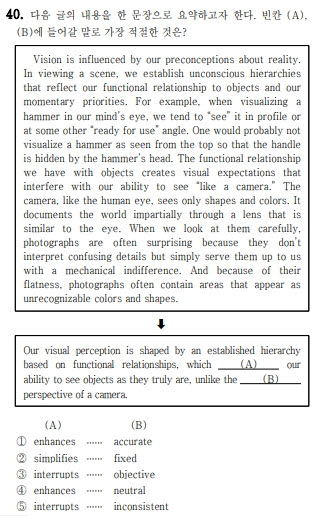
Vision is influenced by our preconceptions about reality. In viewing a scene, we establish unconscious hierarchies that reflect our functional relationship to objects and our momentary priorities. For example, when visualizing a hammer in our mind’s eye, we tend to “see” it in profile or at some other “ready for use” angle. One would probably not visualize a hammer as seen from the top so that the handle is hidden by the hammer’s head. The functional relationships we have with objects creates visual expectations that interfere with our ability to see “like a camera.” The camera, like the human eye, sees only shapes and colors. It documents the world impartially through a lens that is similar to the eye. When we look at them carefully, photographs are often surprising because they don't interpret confusing details but simply serve them up to us with a mechanical indifference. And because of their flatness, photographs often contain areas that appear as unrecognizable colors and shapes.
Our visual perception is shaped by an established hierarchy based on functional relationships, which (A) our ability to see objects as they truly are, unlike the (B) perspective of a camera.
우리의 시지각은 기능적 관계에 기반한 확립된 위계에 의해 형성되며, 이는 사물을 있는 그대로 보는 능력을 방해한다. 이는 카메라의 편향된 시각과는 다르다.
(A) ① enhances(향상시킨다) ② simplifies(단순화한다) ③ interrupts(방해한다) ④ enriches(풍부하게 한다) ⑤ enhances/others(지문에 맞춰 해석)
(B) ① accurate(정확한) ② objective(객관적인) ③ biased(편향된) ④ neutral(중립적인) ⑤ inconsistent(일관성 없는)
2) 지문 단어뜻
- Vision(시지각/시각)은 our preconceptions(선입견/선개념) about reality(현실)에 의해 influenced(영향을 받는다).
시지각은 현실에 대한 우리의 선입견의 영향을 받는다. - In viewing(장면을 볼 때) a scene(풍경/장면), we establish(형성한다) unconscious hierarchies(무의식적 위계) that reflect(반영하다) our functional relationship(기능적 관계) to objects(사물들) and our momentary priorities(그 순간의 우선순위).
한 장면을 볼 때 우리는 사물과의 기능적 관계와 순간적 우선순위를 반영하는 무의식적 위계를 형성한다. - For example(예를 들어), when visualizing(마음속으로 그리다) a hammer(망치) in our mind’s eye(마음의 눈/상상 속), we tend to(~하는 경향이 있다) “see” it in profile(측면으로) or at some other “ready for use”(사용 준비된) angle(각도).
예컨대 마음속에서 망치를 떠올릴 때 우리는 보통 옆모습이나 ‘바로 사용할 수 있는’ 각도로 본다. - One would probably not(아마 ~하지 않을 것이다) visualize(그려 보지 않을 것이다) a hammer as seen from the top(위에서 내려다본 모습) so that the handle(손잡이) is hidden by(~에 가려지다) the hammer’s head(머리 부분).
손잡이가 망치머리에 가려지는 위에서 내려다본 모습으로 망치를 떠올리지는 않을 것이다. - The functional relationships(기능적 관계) we have with objects(사물들) creates(만든다) visual expectations(시각적 기대) that interfere with(방해하다) our ability to see(보는 능력) “like a camera”(카메라처럼).
사물과의 기능적 관계는 우리가 ‘카메라처럼’ 보는 능력을 방해하는 시각적 기대를 만들어낸다. - The camera(카메라)는, like(~처럼) the human eye(인간의 눈), sees only(오직 ~만 본다) shapes and colors(형태와 색).
카메라는 인간의 눈처럼 형태와 색만 본다. - It documents(기록한다) the world(세상)을 impartially(객관적으로/치우침 없이) through a lens(렌즈)를 that is similar to(~와 유사한) the eye(눈).
카메라는 눈과 유사한 렌즈를 통해 세상을 객관적으로 기록한다. - When we look at(자세히 보다) them carefully(주의 깊게), photographs(사진)은 often(종종) surprising(놀랍다) because(~하기 때문에) they don't interpret(해석하지 않는다) confusing details(혼란스러운 디테일) but simply serve them up(그대로 제시하다) to us with a mechanical indifference(기계적 무감각).
사진은 혼란스러운 세부를 해석하지 않고 기계적 무감각으로 그대로 제시하기 때문에 자세히 보면 종종 놀랍다. - And because of(~ 때문에) their flatness(평면성), photographs(사진) often contain(종종 포함한다) areas(부분들) that appear as(~처럼 보이는) unrecognizable colors and shapes(알아보기 힘든 색과 형태).
또 사진의 평면성 때문에, 알아보기 힘든 색과 형태처럼 보이는 부분들이 종종 존재한다.
2) 전체 자연스러운 해석
우리의 시지각은 현실에 대한 선입견의 영향을 받는다. 장면을 볼 때 우리는 사물과의 기능적 관계와 그 순간의 우선순위를 반영하는 무의식적 위계를 만든다.
예를 들어 마음속에서 망치를 떠올리면 보통 옆모습이나 곧 사용할 수 있는 각도로 보게 된다. 손잡이가 망치머리에 가려지는 위쪽 시점으로 상상하는 경우는 거의 없다.
이렇게 사물과 맺는 기능적 관계가 ‘카메라처럼’ 보는 능력을 방해하는 시각적 기대를 만들어낸다. 카메라는 인간의 눈처럼 형태와 색만을 본다. 렌즈를 통해 세상을 치우침 없이 기록하기 때문에, 사진을 자세히 들여다보면 혼란스러운 세부를 해석하지 않고 그대로 보여 주어 종종 놀라움을 준다.
또한 사진은 평면적이라서 알아보기 어려운 색과 형태처럼 보이는 부분이 자주 생긴다.
글의 구조
- I. 핵심 주장 — 시각은 선입견의 영향 〈S1〉
- S1
- S2
- S3
- S4
- S5
- S6
- S7
- S8
3) 제목 · 주제 · 요약문
Title (EN): Functional Hierarchies Distort What We See
제목 (KO): 기능적 위계가 우리의 보기 방식을 왜곡한다
Topic (EN): Unconscious, function-based hierarchies shape perception and hinder camera-like objectivity.
주제 (KO): 기능에 근거한 무의식적 위계가 지각을 형성하여 카메라 같은 객관성을 방해한다.
Summary (EN):
We carry preconceptions that build unconscious hierarchies tied to use and priorities. These expectations interfere with seeing “like a camera,” whose perspective is objective/indifferent to our meanings.
요약 (KO):
사용·우선순위에 묶인 무의식적 위계가 생겨 카메라처럼 객관적으로 보는 것을 방해한다.
4) 직독직해
- S1 [주장 도입] Vision / is influenced / by our preconceptions / about reality.
→ 우리의 시각은 / 영향받는다 / 우리의 선입견에 / 현실에 대한.
→ 우리의 보기 방식은 현실에 대한 선입견의 영향을 받는다.
1) 문법·표현 + 콜로케이션
- vision (n.) = 시지각/시각; (비유) 관점
- Syn: perception (지각), visual perception (시각적 지각)
- Colloc/Pattern: human vision is influenced by ~ (인간의 시지각은 ~의 영향을 받는다)
- be influenced by + N (passive) = ~의 영향을 받다
- 변형: be shaped by (~에 의해 형성되다), be affected by (~의 영향을 받다)
- Ant: be independent of (~와 무관하다)
- Colloc/Pattern: is influenced by prior beliefs (선행 신념의 영향을 받는다)
- preconception(s) (n.) = 선입견/선개념
- Syn: preconceived notion (선입견), bias (편향), assumption (가정)
- Ant: open-mindedness (개방성), impartiality (공정성)
- Colloc/Pattern: our preconceptions about ~ (우리의 ~에 대한 선입견)
- about + N (prep.) = ~에 대한
- 변형: regarding (~에 관하여), concerning (~에 관해)
- Colloc/Pattern: about reality / about the world (현실/세상에 대한)
- reality (n.) = 현실/실재
- Syn: the real world (현실 세계), actuality (현실성)
- Ant: illusion (환상), appearance (겉모습)
- Colloc/Pattern: beliefs about reality (현실에 대한 신념)
2) 문장 뼈대
- S(주어): Vision → 시지각(시각)은
- V(동사: 수동태): is influenced → 영향을 받는다
- 부가(전치사구): by our preconceptions about reality → 현실에 대한 우리의 선입견에 의해
➡ 한국어 풀해석: 시지각은 현실에 대한 우리의 선입견의 영향을 받는다.
3) 직독·자연 번역
Vision / is influenced / by our preconceptions / about reality.
시지각은 / 영향을 받는다 / 우리의 선입견에 / 현실에 대한.
자연 번역: 우리가 현실을 어떻게 미리 생각하느냐에 따라, 시지각은 그 영향을 받는다.
4) 문장의 의미 설명
핵심 메시지: 보는 행위는 중립적 기록이 아니라, ‘현실에 대한 선입견’이라는 인지 필터를 통과한 결과다. 문법적으로 be influenced by는 수동태로 원인(전치사구)을 강조하며, about reality는 preconceptions를 수식해 선입견의 대상이 ‘현실’임을 명확히 한다.
5) 단어 시험
문제
① vision = __________
② be influenced by = __________
③ preconception(s) = __________
④ preconceived notion = __________
⑤ bias = __________
⑥ about + N = __________
⑦ reality = __________
⑧ be independent of = __________
정답
① vision = 시지각/시각
② be influenced by = ~의 영향을 받다
③ preconception(s) = 선입견/선개념
④ preconceived notion = 선입견
⑤ bias = 편향
⑥ about + N = ~에 대한
⑦ reality = 현실/실재
⑧ be independent of = ~와 무관하다
6) 실전 예문
🔑 예문에 쓰이는 주요 표현
- vision = 시지각
- be influenced by = ~의 영향을 받다
- preconceptions about ~ = ~에 대한 선입견
- reality = 현실
EN: Vision is influenced by preconceptions about reality, especially in ambiguous images.
➡ KO: 특히 애매한 그림에서는 시지각이 현실에 대한 선입견의 영향을 받는다.
EN: Our preconceptions about expertise can influence how we judge what we see.
➡ KO: 전문성에 대한 선입견이 우리가 보는 것을 평가하는 방식에 영향을 줄 수 있다.
EN: Training helps vision rely less on preconceptions and more on evidence from reality.
➡ KO: 훈련은 시지각이 선입견에 덜 의존하고 현실의 근거에 더 의존하도록 돕는다.
- S2 [설명] In viewing a scene, / we establish / unconscious hierarchies / that reflect / our functional relationship to objects / and our momentary priorities.
→ 장면을 볼 때, / 우리는 세운다 / 무의식적 위계를 / 반영하는 / 사물과의 기능적 관계와 / 순간적 우선순위를.
→ 우리는 기능·우선순위를 반영하는 무의식적 위계를 만든다.
1) 문법·표현 + 콜로케이션
- in viewing (a scene) (전치사구/동명사) = (장면을) 볼 때
- 변형: when viewing (볼 때), in observing (관찰할 때)
- Syn: while looking at (보는 동안), in perceiving (지각할 때)
- Ant: without looking (보지 않고)
- Colloc/Pattern: in + -ing (상황/배경 제시)
- establish (동사) = 확립하다, 형성하다
- 변형: established (확립된), establishing (확립하는 중)
- Syn: form (형성하다), set up (세우다)
- Ant: dismantle (해체하다), undermine (약화하다)
- Colloc/Pattern: establish + system/hierarchy/norm (~을 확립하다)
- unconscious (형용사) = 무의식적인
- 변형: subconscious (잠재의식의)
- Syn: automatic (자동적인), implicit (암묵적인)
- Ant: conscious (의식적인), deliberate (의도적인)
- Colloc/Pattern: unconscious bias/processing (무의식적 편향/처리)
- hierarchy (명사) = 위계(체계)
- 변형: hierarchies (복수), hierarchical (위계적인)
- Syn: ranking (서열), order (질서)
- Ant: flatness (평면성/수평 구조), egalitarianism (평등주의)
- Colloc/Pattern: visual/attentional hierarchy (시각/주의 위계)
- that reflect (형용사절 주격 관계대명사) = ~을 반영하는
- 변형: which reflect (관계대명사 변형)
- Syn: that mirror (반영하다), that reveal (드러내다)
- Ant: that obscure (가리다)
- Colloc/Pattern: N + that reflect + N (관계절로 설명)
- functional relationship (to/with) objects (명사구) = 사물과의 기능적 관계
- 변형: functional relations (기능적 관계들)
- Syn: pragmatic relation (실용적 관계), use-oriented link (사용 지향적 연결)
- Ant: aesthetic-only relation (심미성만의 관계)
- Colloc/Pattern: relationship to/with + objects (~와의 관계)
- momentary priorities (명사구) = 순간적/일시적 우선순위
- 변형: immediate priorities (즉각적 우선순위), current priorities (현재 우선순위)
- Syn: short-term goals (단기 목표), pressing needs (시급한 필요)
- Ant: long-term priorities (장기 우선순위)
- Colloc/Pattern: set/shift + priorities (우선순위를 정하다/바꾸다)
2) 문장 뼈대
- 부가(배경): In viewing a scene → 한 장면을 볼 때
- S(주어): we → 우리는
- V(동사): establish → 확립한다/형성한다
- O(목적어): unconscious hierarchies → 무의식적 위계(체계)
- 부가(관계절): that reflect our functional relationship to objects and our momentary priorities → 사물과의 기능적 관계와 순간적 우선순위를 반영하는
➡ 한국어 풀해석: 한 장면을 볼 때 우리는 사물과의 기능적 관계와 그 순간의 우선순위를 반영하는 무의식적 위계를 형성한다.
3) 직독·자연 번역
In viewing a scene, / we establish / unconscious hierarchies / that reflect / our functional relationship to objects / and our momentary priorities.
한 장면을 볼 때, / 우리는 형성한다 / 무의식적 위계를 / 그것은 반영한다 / 사물과의 기능적 관계를 / 그리고 우리의 순간적 우선순위를.
자연스럽게: 우리는 어떤 장면을 볼 때, 사물과의 사용 관계와 그 순간의 우선순위에 따라 무의식적인 ‘중요도 서열’을 매기게 된다.
4) 문장의 의미 설명
핵심 메시지: 시각 인지는 중립적이기보다 목적 지향적이며, 필요와 과업에 따라 무엇을 더 중요하게 볼지 자동으로 서열화한다.
효과/의도: 배경구(동명사구)로 상황을 제시하고, 관계절로 위계가 무엇을 기준으로 형성되는지를 명확히 한다.
주의점(문법·스타일): in + -ing는 ‘~할 때’의 담화 표지. **hierarchies that reflect …**에서 that은 unconscious hierarchies를 선행사로 받는다.
5) 단어 시험
문제
① in viewing = __________
② establish = __________
③ unconscious = __________
④ hierarchy = __________
⑤ functional relationship (to/with) = __________
⑥ momentary priorities = __________
정답
① in viewing = 볼 때
② establish = 확립하다/형성하다
③ unconscious = 무의식적인
④ hierarchy = 위계(체계)
⑤ functional relationship (to/with) = (~와의) 기능적 관계
⑥ momentary priorities = 순간적/일시적 우선순위
6) 실전 예문
🔑 예문에 쓰이는 주요 표현
- establish a hierarchy = 위계를 형성하다
- functional relationship to objects = 사물과의 기능적 관계
- momentary priorities = 순간적 우선순위
- reflect = 반영하다
EN: Shoppers establish a hierarchy of products that reflects price, quality, and momentary priorities.
➡ KO: 소비자들은 가격·품질·그 순간의 우선순위를 반영하는 제품 위계를 형성한다.
EN: In emergencies, our functional relationship to objects shifts, elevating tools over décor.
➡ KO: 긴급 상황에서는 사물과의 기능적 관계가 바뀌어, 장식보다 도구의 중요도가 올라간다.
EN: Designers arrange interfaces to reflect users’ momentary priorities.
➡ KO: 디자이너들은 사용자의 순간적 우선순위를 반영하도록 인터페이스를 배열한다.
- S3 [예시1] For example, / when visualizing a hammer / in our mind’s eye, / we tend to “see” it / in profile / or at some other “ready for use” angle.
→ 예컨대 / 망치를 떠올릴 때 / 마음속 눈으로, / 우리는 그것을 보려는 경향이 있다 / 측면에서 / 또는 ‘바로 쓸’ 각도에서.
→ 망치는 보통 측면/사용 각도로 떠올린다.
1) 문법·표현 + 콜로케이션
- for example (disc. adv.) = 예를 들어
- Syn: for instance (예를 들면), to illustrate (예시하자면)
- Ant: in general (일반적으로), on the whole (대체로)
- Colloc/Pattern: For example, S V … (예를 들어, S가 V하다)
- visualize (v.) = 마음속에 그리다/심상화하다
- 변형: visualization (심상화), visualizable (심상화 가능한)
- Syn: imagine (상상하다), picture (머릿속에 그리다)
- Ant: overlook (간과하다), ignore (무시하다)
- Colloc/Pattern: visualize a hammer/tool (망치/도구를 마음속에 그리다)
- in one’s mind’s eye (idiom) = 마음의 눈으로, 머릿속으로
- Syn: mentally (정신적으로/머릿속으로), in imagination (상상 속에서)
- Ant: with one’s own eyes (자신의 눈으로 실제로)
- Colloc/Pattern: see/visualize in your mind’s eye (마음의 눈으로 보다/그리다)
- tend to + V (v. pattern) = ~하는 경향이 있다
- 변형: tendency (경향), be inclined to + V (~하는 성향이 있다)
- Syn: be apt to + V (~하기 쉽다)
- Ant: be unlikely to + V (~할 가능성이 낮다)
- Colloc/Pattern: tend to “see” N (N을 ‘보는’ 경향이 있다)
- “see” (mentally) (v.) = (마음속으로) 보다/떠올리다
- 변형: see as (~로 보다), perceive (지각하다)
- Syn: envision (상상 속에 그리다)
- Ant: fail to notice (눈치채지 못하다)
- Colloc/Pattern: “see” it as B (그것을 B로 ‘보다’)
- in profile = 옆모습으로/옆에서 본 모습
- Syn: in side view (옆면에서), profile view (프로필 뷰)
- Ant: front-on (정면으로), head-on (정면에서)
- Colloc/Pattern: see N in profile (N을 옆모습으로 보다)
- angle (n.) = 각도
- 변형: at an angle (비스듬히), angle of view (시야각)
- Syn: orientation (방향/배치), position (위치)
- Ant: alignment (정렬)
- Colloc/Pattern: at a “ready-for-use” angle (‘사용 준비’ 각도로)
- ready for use (adj. phr.) = 사용하기 좋은/준비된
- 변형: ready-to-use (즉시 사용 가능한)
- Syn: operational (작동 가능한), handy (쓰기 편한)
- Ant: unready (준비 안 된), inoperable (작동 불가)
- Colloc/Pattern: a tool held at a ready-for-use angle (도구를 사용하기 좋은 각도로 쥔)
2) 문장 뼈대
- 부가(담화 표지): For example → 예를 들어
- 부사절(시간/상황): when visualizing a hammer in our mind’s eye → 마음의 눈으로 망치를 떠올릴 때
- S(주어): we → 우리는
- V(동사): tend to “see” → ‘보는’ 경향이 있다
- O/C(보어류): it in profile or at some other “ready for use” angle → 그것을 옆모습이나 다른 ‘사용하기 좋은’ 각도로
➡ 한국어 풀해석: 예를 들어, 마음의 눈으로 망치를 떠올릴 때 우리는 그것을 옆모습이나 다른 ‘사용하기 좋은’ 각도로 보는 경향이 있다.
3) 직독·자연 번역
For example, / when visualizing a hammer / in our mind’s eye, / we tend to “see” it / in profile / or at some other “ready for use” angle.
예를 들어, / 망치를 떠올릴 때 / 마음의 눈으로, / 우리는 그것을 ‘보는’ 경향이 있다 / 옆모습으로 / 또는 다른 ‘사용하기 좋은’ 각도로.
자연스러운 번역: 예를 들어, 마음속으로 망치를 그려 보면 우리는 대개 그것을 옆모습이나 다른 ‘바로 쓰기 좋은’ 각도로 떠올리게 된다.
4) 문장의 의미 설명
핵심 메시지: 도구를 상상할 때 사람들은 사용 맥락에 맞는 자세/각도(옆모습, 집을 수 있는 각도)로 떠올리는 인지적 경향이 있다.
효과/의도: when + V-ing로 조건을 제시하고, tend to + V로 일반적 성향을 기술한다. in profile / at … angle 같은 전치사구로 시각적 배치를 구체화한다.
주의점(문법·스타일): mind’s eye는 관용구(직역 금지). “see” 표기는 물리적 ‘보다’가 아닌 심상적 보기를 강조하기 위한 따옴표 사용이다.
5) 단어 시험
문제
① for example = __________
② visualize = __________
③ in one’s mind’s eye = __________
④ tend to + V = __________
⑤ “see” (mentally) = __________
⑥ in profile = __________
⑦ angle = __________
⑧ ready for use = __________
정답
① for example = 예를 들어
② visualize = 마음속에 그리다/심상화하다
③ in one’s mind’s eye = 마음의 눈으로/머릿속으로
④ tend to + V = ~하는 경향이 있다
⑤ “see” (mentally) = (마음속으로) 보다/떠올리다
⑥ in profile = 옆모습으로/옆에서 본
⑦ angle = 각도
⑧ ready for use = 사용하기 좋은/준비된
6) 실전 예문
🔑 예문에 쓰이는 주요 표현
- visualize = 마음속에 그리다
- in one’s mind’s eye = 마음의 눈으로
- tend to = ~하는 경향이 있다
- in profile / ready for use = 옆모습으로 / 사용하기 좋은
EN: Close your eyes and visualize the scene in your mind’s eye.
➡ KO: 눈을 감고 그 장면을 마음의 눈으로 그려 보라.
EN: We tend to picture tools in profile at a ready-for-use angle.
➡ KO: 우리는 도구를 옆모습에 바로 쓰기 좋은 각도로 그려 보는 경향이 있다.
EN: Designers ask users to visualize handles in their mind’s eye before testing grips.
➡ KO: 디자이너들은 그립을 시험하기 전에 손잡이를 마음의 눈으로 떠올려 보라고 요청한다.
- S4 [반예시] One would probably not visualize / a hammer / as seen from the top / so that / the handle is hidden / by the hammer’s head.
→ 아마 떠올리지 않을 것이다 / 망치를 / 위에서 본 모습으로 / 그래서 / 손잡이가 가려지는 / 망치머리에 의해.
→ 위에서 본, 손잡이가 가려진 모습은 잘 떠올리지 않는다.
1) 문법·표현 + 콜로케이션
- one would probably not + V = 아마 ~하지 않을 것이다
- 변형: would likely not (아마 ~하지 않을 것), would seldom (좀처럼 ~하지 않을 것)
- Syn: would hardly (거의 ~하지 않을 것) / Ant: would likely (아마 ~할 것)
- Colloc/Pattern: one would probably not visualize … (아마 …을 떠올리지 않을 것이다)
- visualize (v.) = (머릿속에) 그려 보다/심상화하다
- 변형: visualization (심상화), visualize A as B (A를 B로 그리다)
- Syn: picture (마음속에 그리다), imagine (상상하다) / Ant: fail to imagine (상상하지 못하다)
- Colloc/Pattern: visualize an object from … (~의 시점에서 사물을 그리다)
- hammer (n.) = 망치
- 변형: hammer’s head (망치 머리), handle (손잡이)
- Syn: mallet (나무망치) / Ant: —
- Colloc/Pattern: head and handle of a hammer (망치의 머리와 손잡이)
- as seen from + 장소 (reduced passive) = ~에서 보인(보이는) 대로/처럼
- 변형: as viewed from (…에서 본 대로)
- Syn: as observed from (…에서 관찰된 대로) / Ant: as seen from below/side (아래/옆에서 본 것과 대비)
- Colloc/Pattern: as seen from the top (위에서 본 대로)
- from the top (prep. phr.) = 위에서/상방에서
- 변형: top-down view (탑다운 시점)
- Syn: bird’s-eye view (조감도/하천조감) / Ant: side view (측면도), front view (정면도)
- Colloc/Pattern: view from the top (위에서 본 모습)
- so that + 완전한 문장 (result) = 그 결과 ~하도록/그래서 ~하다
- 변형: so … that … (너무 …해서 …하다)
- Syn: with the result that (그 결과 ~하다) / Ant: even though (비록 ~일지라도)
- Colloc/Pattern: so that S V (result) (결과 용법; 목적 용법과 구분)
- be hidden (by N) (passive) = (N에) 가려지다/숨겨지다
- 변형: hide (숨기다/가리다), hidden (숨겨진)
- Syn: be obscured (by N) (…에 의해 가려지다) / Ant: be visible (보이다), be exposed (드러나다)
- Colloc/Pattern: be hidden by the head (머리에 가려지다)
- handle (n.) = 손잡이
- 변형: hammer handle (망치 손잡이)
- Syn: grip (잡는 부분) / Ant: —
- Colloc/Pattern: the handle is hidden (손잡이가 가려지다)
- head (of a tool) (n.) = (도구의) 머리/타격부
- 변형: hammer’s head (망치 머리)
- Syn: striking head (타격부) / Ant: tail (꼬리; 해당 없음)
- Colloc/Pattern: hide the handle with the head (머리 부분이 손잡이를 가리다)
2) 문장 뼈대
- S: One → 사람은(누구든)
- V: would probably not visualize → 아마 …을 떠올리지 않을 것이다
- O: a hammer → 망치를
- 부가(방식): as seen from the top → 위에서 본 모습으로
- 부가(결과): so that the handle is hidden by the hammer’s head → 그 결과 손잡이가 망치 머리에 가려지도록
- 보어: —
➡ 한국어 풀해석: 사람은 아마 망치를 위에서 본 모습으로—그래서 손잡이가 망치 머리에 가려지도록—떠올리지는 않을 것이다.
3) 직독·자연 번역
One would probably not visualize / a hammer / as seen from the top / so that / the handle is hidden / by the hammer’s head.
사람은 아마 떠올리지 않을 것이다 / 망치를 / 위에서 본 모습으로 / 그래서 / 손잡이가 가려지도록 / 망치 머리에.
자연스러운 한국어: 우리는 보통 망치를 위에서 내려다본 모습, 즉 손잡이가 망치 머리에 가려 보이는 각도로 떠올리지는 않는다.
4) 문장의 의미 설명
핵심 메시지: 사물을 마음속에 그릴 때 사람들은 기능·식별에 유리한 전형적 시점(측면 등)을 선호하며, 정보가 숨겨지는 상방 시점은 잘 선택하지 않는다는 점을 말한다.
효과/의도: **as seen from …**로 시점을 제한하고, **so that (result)**로 그 시점의 결과(핸들이 가려짐)를 명확히 제시해 ‘왜 그 시점이 비전형적인지’를 설명한다.
주의점(문법·스타일): **as seen …**는 reduced passive(축약 수동: as it is seen)이고, so that은 목적이 아닌 결과 용법이다.
5) 단어 시험
문제
① one would probably not + V = __________
② visualize = __________
③ as seen from the top = __________
④ so that (result) = __________
⑤ be hidden (by N) = __________
⑥ handle = __________
⑦ hammer’s head = __________
정답
① one would probably not + V = 아마 ~하지 않을 것이다
② visualize = (머릿속에) 그려 보다/심상화하다
③ as seen from the top = 위에서 본 모습으로/위에서 보인 대로
④ so that (result) = 그 결과 ~하도록/그래서 ~하다
⑤ be hidden (by N) = (N에) 가려지다/숨겨지다
⑥ handle = 손잡이
⑦ hammer’s head = 망치 머리(타격부)
6) 실전 예문
🔑 예문에 쓰이는 주요 표현
- visualize = (머릿속에) 그려 보다
- as seen from the top = 위에서 본 모습으로
- so that (result) = 그 결과 ~하도록
- be hidden (by N) = (N에) 가려지다
EN: Designers visualize the device as seen from the top so that the ports are hidden by the bezel.
➡ KO: 디자이너들은 상단 시점으로 기기를 그려, 그 결과 포트가 베젤에 가려지게 한다.
EN: When you visualize a cup as seen from the top, the handle may be hidden behind the rim.
➡ KO: 컵을 위에서 본 모습으로 그리면, 손잡이가 테두리 뒤에 가려질 수 있다.
EN: For clarity, don’t visualize tools as seen from the top so that key parts are hidden.
➡ KO: 명확성을 위해, 핵심 부품이 가려지도록 도구를 위에서 본 모습으로 그리지 말라.
- S5 [핵심 원인] The functional relationships / we have with objects / creates visual expectations / that interfere with / our ability / to see “like a camera.”
→ 우리가 사물과 맺는 기능적 관계가 / 만들어낸다 시각적 기대를 / 그것이 방해한다 / 우리의 능력을 / ‘카메라처럼’ 보려는.
→ 기능적 관계가 ‘카메라처럼’ 보는 능력을 방해한다.
1) 문법·표현 + 콜로케이션
- functional relationship(s) (n.) = 기능적 관계(성)
- 변형: functionality (기능성), relational (관계적인)
- Syn: pragmatic relation (실용적 관계), use-oriented relation (사용지향 관계)
- Colloc/Pattern: functional relationships with objects (사물과의 기능적 관계)
- objects (n.) = 사물/대상물
- 변형: everyday objects (일상 사물)
- Syn: items (물건), artifacts (인공물)
- have a relationship with ~ (v.구) = ~와 관계를 맺다
- Syn: relate to ~ (~와 관련되다)
- Colloc/Pattern: we have a relationship with tools/objects (우리는 도구/사물과 관계를 맺는다)
- create visual expectations (v.+n.) = 시각적 기대를 만들어 내다
- 변형: visual expectation(s) (시각적 기대), expectancy (기대성)
- Syn: form perceptual priors (지각 선험/사전 기대를 형성하다)
- Ant: suspend expectations (기대를 보류하다)
- Colloc/Pattern: create strong visual expectations about ~ (~에 대한 강한 시각적 기대를 만들다)
- interfere with ~ (v.) = ~을 방해하다/간섭하다
- Syn: impair ~ (~을 저해하다), disrupt ~ (~을 교란하다)
- Ant: facilitate ~ (~을 촉진하다), support ~ (~을 돕다)
- Colloc/Pattern: interfere with perception/ability (지각/능력을 방해하다)
- ability to + V = ~하는 능력
- Colloc/Pattern: ability to see objectively (객관적으로 보는 능력)
- see “like a camera” (idiom/metaphor) = ‘카메라처럼’ 보다(편견/기능적 해석 없이 기록하듯 보다)
- Syn: see objectively (객관적으로 보다), see without preconceptions (선입견 없이 보다)
- 주어-동사 수 일치
- Note: relationships (pl.) → create (not creates) (복수 주어에는 create가 맞음)
2) 문장 뼈대
- S(주어): The functional relationships we have with objects → 우리가 사물과 맺는 기능적 관계가
- V(동사): create(s) → 만들어 낸다 (수 일치상 create가 적절)
- O(목적어): visual expectations → 시각적 기대를
- 부가(관계절): that interfere with our ability → (그 기대가) 우리의 능력을 방해하는
- 보충(부정사 목적): to see “like a camera.” → ‘카메라처럼’ 보도록 하는 (능력)
➡ 한국어 풀해석: 우리가 사물과 맺는 기능적 관계는 시각적 기대를 만들어 내고, 그 기대는 우리가 ‘카메라처럼’ 세상을 볼 수 있는 능력을 방해한다.
3) 직독·자연 번역
The functional relationships / we have with objects / creates visual expectations / that interfere with / our ability / to see “like a camera.”
우리가 사물과 맺는 기능적 관계가 / (우리가) 사물과 맺는 / 시각적 기대를 만들어 내고 / 그것이 방해한다 / 우리의 능력을 / ‘카메라처럼’ 보도록.
자연 번역: 우리가 사물을 어떻게 쓰는가라는 기능적 관계가 시각적 기대를 형성하고, 그 기대가 우리가 카메라처럼 객관적으로 보는 능력을 방해한다.
4) 문장의 의미 설명
핵심 메시지: 사용성·목적(‘무엇을 위해 쓰는가’)이 지각을 선행 규정하여, 사물을 중립적으로 보기보다 용도 중심으로 보게 만든다는 주장이다.
효과/의도: “카메라처럼”은 ‘무가치적·기록적 시선’의 메타포로, 일상적 기능 관계가 만드는 상향식(bottom-up) 지각의 방해를 강조한다.
주의점(문법·스타일): 주어의 핵은 relationships이므로 동사는 create가 문법적으로 맞다. that절은 앞선 visual expectations를 수식하며 결과(방해)를 설명한다.
5) 단어 시험
문제
① functional relationships = __________
② create visual expectations = __________
③ interfere with ~ = __________
④ ability to + V = __________
⑤ see “like a camera” = __________
⑥ subject–verb agreement = __________
정답
① functional relationships = 기능적 관계(성)
② create visual expectations = 시각적 기대를 만들어 내다
③ interfere with ~ = ~을 방해하다/간섭하다
④ ability to + V = ~하는 능력
⑤ see “like a camera” = ‘카메라처럼’(편견 없이) 보다
⑥ subject–verb agreement = 주어-동사 수 일치
6) 실전 예문
🔑 예문에 쓰이는 주요 표현
- functional relationships = 기능적 관계
- create visual expectations = 시각적 기대를 만들어 내다
- interfere with ~ = ~을 방해하다
- see “like a camera” = 카메라처럼 보다
EN: Our functional relationships with tools create visual expectations that interfere with attempts to see “like a camera.”
➡ KO: 도구와의 기능적 관계는 시각적 기대를 만들어, 카메라처럼 보려는 시도를 방해한다.
EN: Brand cues create visual expectations that interfere with our ability to see “like a camera.”
➡ KO: 브랜드 단서는 시각적 기대를 만들어 우리가 카메라처럼 볼 능력을 방해한다.
EN: To see “like a camera,” designers must strip away functional relationships that create visual expectations.
➡ KO: 카메라처럼 보려면, 디자이너는 시각적 기대를 만드는 기능적 관계를 걷어 내야 한다.
- S6 [대조: 카메라] The camera, / like the human eye, / sees only shapes and colors. / It documents the world / impartially / through a lens / that is similar to the eye.
→ 카메라는 / 인간의 눈처럼 / 오직 형태와 색깔만 본다. 그것은 / 세상을 기록한다 / 공정하게 / 렌즈를 통해 / 눈과 유사한.
→ 카메라는 인간의 눈처럼 형태와 색깔만을 감지한다. 또한 눈과 닮은 렌즈를 통해 세상을 공정하게 기록한다.
1) 문법·표현 + 콜로케이션
- camera (n.) = 카메라
- 변형: cameraman (카메라맨), camcorder (캠코더)
- Syn: photographic device (사진기), recorder (기록 장치)
- Colloc/Pattern: digital camera (디지털 카메라), security camera (보안 카메라)
- like (prep.) = …처럼, …와 비슷하게
- Syn: similar to (…와 비슷한), as if (마치 …인 것처럼)
- Ant: unlike (…와 달리), different from (…와 다른)
- Colloc/Pattern: act like (…처럼 행동하다), feel like (…같이 느끼다)
- sees only (v.+adv.) = 오직 …만 본다
- Syn: perceives only (오직 …만 인식한다)
- Ant: sees everything (모든 것을 본다)
- Colloc/Pattern: see only the surface (겉모습만 보다)
- shapes and colors (n. pl.) = 형태와 색깔
- Colloc/Pattern: geometric shapes (기하학적 형태), bright colors (밝은 색)
- document (v.) = 기록하다, 문서화하다
- 변형: documentation (문서화), documented (기록된)
- Syn: record (기록하다), capture (포착하다)
- Ant: ignore (무시하다), conceal (감추다)
- Colloc/Pattern: document the evidence (증거를 기록하다)
- impartially (adv.) = 공정하게, 치우침 없이
- 변형: impartial (공정한/형용사), impartiality (공정성/명사)
- Syn: fairly (공정하게), objectively (객관적으로)
- Ant: partially (부분적으로), subjectively (주관적으로)
- Colloc/Pattern: judge impartially (공정하게 판단하다)
- lens (n.) = 렌즈
- 변형: lenses (복수형)
- Syn: optical glass (광학 렌즈), scope (렌즈·망원경)
- Ant: naked eye (육안)
- Colloc/Pattern: camera lens (카메라 렌즈), wide-angle lens (광각 렌즈)
- similar to 명사 = …와 유사한
- 변형: similarity (유사성/명사), similarly (비슷하게/부사)
- Syn: akin to (…와 유사한), comparable to (…와 비슷한)
- Ant: different from (…와 다른), contrasted with (…와 대조되는)
- Colloc/Pattern: similar to the eye (눈과 유사한), strikingly similar (놀라울 만큼 비슷한)
2) 문장 뼈대
- S(주어): The camera → 카메라는
- 부가(비교): like the human eye → 인간의 눈처럼
- V(동사): sees → 본다
- O(목적어): only shapes and colors → 오직 형태와 색깔만
- S(주어): It → 그것은
- V(동사): documents → 기록한다
- O(목적어): the world → 세상을
- 부가: impartially → 공정하게
- 부가: through a lens that is similar to the eye → 눈과 유사한 렌즈를 통해
➡ 한국어 풀해석: 카메라는 인간의 눈처럼 오직 형태와 색깔만 본다. 그것은 눈과 비슷한 렌즈를 통해 세상을 공정하게 기록한다.
3) 직독·자연 번역
The camera, / like the human eye, / sees only shapes and colors.
카메라는 / 인간의 눈처럼 / 오직 형태와 색깔만 본다.
It / documents the world / impartially / through a lens / that is similar to the eye.
그것은 / 세상을 기록한다 / 공정하게 / 렌즈를 통해 / 눈과 유사한.
자연스러운 번역: 카메라는 인간의 눈처럼 형태와 색깔만을 감지한다. 또한 눈과 닮은 렌즈를 통해 세상을 공정하게 기록한다.
4) 문장의 의미 설명
핵심 메시지: 카메라는 인간의 눈과 유사하게 기능하며, 세계를 객관적이고 공정하게 기록한다.
효과/의도: 카메라와 눈의 기능적 유사성을 강조하면서도, 카메라의 객관적 기록 기능을 부각한다.
주의점(문법·스타일): “like the human eye”는 비교 구문으로 삽입되어 주어에 대한 설명을 보충한다. 관계사절 “that is similar to the eye”는 앞의 lens를 수식한다.
5) 단어 시험
문제
① camera = __________
② like = __________
③ sees only = __________
④ shapes and colors = __________
⑤ document = __________
⑥ impartially = __________
⑦ lens = __________
⑧ similar to = __________
정답
① camera = 카메라
② like = …처럼
③ sees only = 오직 …만 본다
④ shapes and colors = 형태와 색깔
⑤ document = 기록하다
⑥ impartially = 공정하게
⑦ lens = 렌즈
⑧ similar to = …와 유사한
6) 실전 예문
🔑 예문에 쓰이는 주요 표현
- camera = 카메라
- document = 기록하다
- impartially = 공정하게
- similar to = …와 유사한
EN: A digital camera can document events impartially.
➡ KO: 디지털 카메라는 사건들을 공정하게 기록할 수 있다.
EN: His style is similar to that of classical composers.
➡ KO: 그의 스타일은 고전 작곡가들의 것과 유사하다.
EN: The journalist tried to write impartially about the conflict.
➡ KO: 기자는 그 분쟁에 대해 공정하게 쓰려고 노력했다.
- S7 [효과1] When we look at them carefully, / photographs often seem surprising / because they don't interpret confusing details but simply serve them up to us with a mechanical indifference.
→우리가 그것들을 자세히 보면, / 사진은 종종 놀랍게 보인다 / (사진은) 혼란스러운 세부를 해석하지 않기 때문에 / 다만 그것들을 우리에게 그대로 내놓고 / 기계적인 무관심으로.
→ 우리가 사진을 자세히 들여다보면, 사진은 종종 놀랍게 보인다. 사진은 혼란스러운 세부를 해석하지 않고, 기계적인 무관심으로 그것들을 우리에게 있는 그대로 내놓기 때문이다.
1) 문법·표현 + 콜로케이션
- When S V, (subordinator) = ~할 때(시간절)
- 변형: Whenever S V (S가 V할 때마다), While S V (~하는 동안)
- Syn: As (~할 때/~함에 따라)
- Ant: If S V (만약 ~하면: 조건)
- Colloc/Pattern: When we look at ~ (~을 볼 때)
- look at A carefully (v.) = A를 자세히 보다/유심히 관찰하다
- 변형: closely (면밀히), intently (집중해서)
- Syn: examine (검토하다), inspect (점검하다)
- Ant: glance at (흘끗 보다)
- Colloc/Pattern: look carefully at details (세부를 자세히 보다)
- seem + adj (linking v.) = ~처럼 보이다/느껴지다
- 변형: appear + adj (~처럼 보이다), look + adj (~하게 보이다)
- Syn: feel/sound + adj (그렇게 느껴지다/들리다)
- Ant: be + adj (~이다: 단정)
- Colloc/Pattern: seem surprising/strange (놀랍게/이상하게 보이다)
- interpret A (v.) = A를 해석하다/의미를 부여하다
- 변형: interpretation (해석), interpretive (해석의)
- Syn: explain (설명하다), construe (해석하다)
- Ant: ignore (무시하다), leave unmediated (중개 없이 두다)
- Colloc/Pattern: interpret details/signs (세부/징후를 해석하다)
- confusing details (n. pl.) = 혼란스러운 세부(사항)들
- 변형: ambiguous details (모호한 세부), messy details (뒤얽힌 세부)
- Syn: puzzling elements (난해한 요소들)
- Ant: clear essentials (명확한 핵심)
- Colloc/Pattern: confusing details in a photo (사진 속 혼란스러운 세부들)
- serve A up to B = A를 B에게 내놓다/제공하다(있는 그대로 툭 내밀다 뉘앙스)
- 변형: serve up facts/images (사실/이미지를 내놓다)
- Syn: present (제시하다), dish up (툭 내놓다)
- Ant: filter (거르다), mediate (중재/가공하다)
- Colloc/Pattern: simply serve them up to us (그것들을 우리에게 그냥 내놓다)
- with + N (manner) (prep.) = N한 태도로/방식으로
- 변형: with care/with bias (주의를 기울여/편향을 가지고)
- Syn: in a … manner (~한 방식으로)
- Ant: without N (N 없이)
- Colloc/Pattern: with a mechanical indifference (기계적인 무관심으로)
- mechanical indifference (n.) = 기계적인 무관심/무정함(감정·해석 개입 없음)
- 변형: mechanical neutrality (기계적 중립성), objective detachment (객관적 거리두기)
- Syn: impartiality (공평무사), objectivity (객관성)
- Ant: emotional engagement (감정 개입), interpretive bias (해석 편향)
- Colloc/Pattern: the camera’s mechanical indifference (카메라의 기계적 무관심)
- they / them (pron.) = they=photographs(사진들) / them=confusing details(혼란스러운 세부들)(맥락상)
- 변형: —
- Syn: these images / those details (이 이미지들/그 세부들)
- Ant: —
- Colloc/Pattern: serve them up에서 them=details (대명사 지시 주의)
2) 문장 뼈대
- 부가(시간절): When we look at them carefully → 우리가 그것들(사진들)을 자세히 볼 때
- S: photographs → 사진은
- V/C: often seem surprising → 종종 놀랍게 보인다
- 부가(이유절1): because they don't interpret confusing details → (왜냐하면) 그것들(사진)은 혼란스러운 세부를 해석하지 않고
- 부가(이유절2): but simply serve them up to us with a mechanical indifference → 다만 기계적인 무관심으로 그것들을 우리에게 그대로 내놓기 때문이다
➡ 한국어 풀해석: 우리가 사진을 자세히 들여다보면, 사진은 종종 놀랍게 보인다. 왜냐하면 사진은 혼란스러운 세부를 해석해 주지 않고, 기계적인 무관심으로 그것들을 우리에게 있는 그대로 내놓기 때문이다.
3) 직독·자연 번역
When we look at them carefully, / photographs often seem surprising / because they don't interpret confusing details / but simply serve them up to us / with a mechanical indifference.
우리가 그것들을 자세히 보면, / 사진은 종종 놀랍게 보인다 / (사진은) 혼란스러운 세부를 해석하지 않기 때문에 / 다만 그것들을 우리에게 그대로 내놓고 / 기계적인 무관심으로.
자연스러운 번역: 우리가 사진을 자세히 들여다보면, 사진은 종종 놀랍게 보인다. 사진은 혼란스러운 세부를 해석하지 않고, 기계적인 무관심으로 그것들을 우리에게 있는 그대로 내놓기 때문이다.
4) 문장의 의미 설명
핵심 메시지: 사진은 해석을 덧입히지 않고 가공되지 않은 세부를 그대로 전달하기 때문에, 자세히 볼수록 오히려 낯설고 놀랍게 느껴질 수 있다.
효과/의도: 시간절-주절-이유절의 계단식 구조로 관찰(look carefully) → 지각(seem surprising) → 원인(해석 부재 + 기계적 제시)을 논리적으로 연결한다. ‘mechanical indifference’는 기계적 기록매체의 무감정성을 강조하는 표현이다.
주의점(문법·스타일): seem + adj는 판단의 주관성, serve A up to B는 ‘가공 없이 내놓다’의 뉘앙스. 첫 them은 photographs, 두 번째 them은 confusing details를 가리키므로 지시 대상 혼동에 유의.
5) 단어 시험
문제
① seem + adj = __________
② interpret (details) = __________
③ serve A up to B = __________
④ mechanical indifference = __________
⑤ look at A carefully = __________
⑥ confusing details = __________
정답
① seem + adj = ~처럼 보이다/느껴지다
② interpret (details) = (세부를) 해석하다/의미를 부여하다
③ serve A up to B = A를 B에게 (있는 그대로) 내놓다/제공하다
④ mechanical indifference = 기계적인 무관심/무정함
⑤ look at A carefully = A를 자세히 보다/유심히 관찰하다
⑥ confusing details = 혼란스러운 세부(사항)들
6) 실전 예문
🔑 예문에 쓰이는 주요 표현
- seem + adj = ~처럼 보이다
- interpret = 해석하다
- serve A up to B = A를 B에게 내놓다
- mechanical indifference = 기계적인 무관심
EN: Under harsh light, ordinary scenes seem strange, because cameras don’t interpret shadows but serve them up with mechanical indifference.
➡ KO: 거친 조명에서는 평범한 장면도 이상해 보이는데, 카메라는 그림자를 해석하지 않고 기계적인 무관심으로 그대로 내놓기 때문이다.
EN: Scientific images often serve up raw data with mechanical indifference, leaving viewers to interpret it.
➡ KO: 과학 이미지들은 흔히 기계적 무관심으로 가공되지 않은 데이터를 그대로 내놓아, 보는 이가 스스로 해석하게 만든다.
EN: When we look carefully at archival photos, small anomalies seem surprising because no curator tried to interpret them away.
➡ KO: 옛 사진을 자세히 보면, 작은 이상들이 놀랍게 보이는데, 큐레이터가 그것들을 억지로 해석해 없애지 않았기 때문이다.
- S8 [효과2] And because of their flatness, / photographs often contain areas / that appear as / unrecognizable colors and shapes.
→ 그리고 그들의 평면성 때문에, / 사진에는 종종 영역들이 포함되고 / (그 영역들이) ~처럼 보인다 / 알아볼 수 없는 색과 형태로.
→ 사진은 평면적이기 때문에, 종종 어떤 부분들이 알아볼 수 없는 색과 형태처럼 보이기도 한다.
1) 문법·표현 + 콜로케이션
- because of + N (prep.) = ~때문에
- 변형: due to + N (~로 인해), owing to + N (~로 인해)
- Ant: in spite of + N (~에도 불구하고)
- Colloc/Pattern: because of their flatness (그들의 평면성 때문에)
- flatness (n.) = 평면성, 평평함
- 변형: flat (평평한/평면의), flatten (평평하게 하다)
- Colloc/Pattern: the flatness of photographs (사진의 평면성)
- photograph(s) (n.) = 사진(들)
- 변형: photo/picture (사진)
- Colloc/Pattern: digital photographs (디지털 사진)
- often (adv.) = 종종, 자주
- Syn: frequently (빈번히) / Ant: rarely (드물게)
- Colloc/Pattern: often contain (종종 포함하다)
- contain (v.) = 포함하다
- 변형: contains/contained/containing (포함한다/포함된/포함하는)
- Syn: include (포함하다) / Ant: lack (부족하다/없다)
- Colloc/Pattern: contain areas (영역을 포함하다)
- area(s) (n.) = 영역, 부분
- Colloc/Pattern: bright/dark areas (밝은/어두운 영역)
- appear as + N = ~로 보이다/나타나다
- 변형: appear + adj. (형용사 보어로 “~해 보이다”), seem (처럼 보이다)
- Colloc/Pattern: appear as shapes/colors (형태/색으로 보이다)
- unrecognizable (adj.) = 알아볼 수 없는
- 변형: recognizable (알아볼 수 있는), recognition (인식)
- Colloc/Pattern: unrecognizable colors and shapes (알아볼 수 없는 색과 형태)
- colors and shapes (n.) = 색과 형태
- Colloc/Pattern: abstract colors and shapes (추상적 색과 형태)
2) 문장 뼈대
- 부가(접속·전치사구): And because of their flatness → 그리고 그들의 평면성 때문에
- S(주어): photographs → 사진은
- V(동사): often contain → 종종 포함한다
- O(목적어): areas → 영역들을
- 부가(관계절): that appear as unrecognizable colors and shapes → 알아볼 수 없는 색과 형태처럼 보이는
➡ 한국어 풀해석: 그리고 사진의 평면성 때문에, 사진에는 종종 알아볼 수 없는 색과 형태처럼 보이는 영역들이 있다(포함된다).
3) 직독·자연 번역
And because of their flatness, / photographs often contain areas / that appear as / unrecognizable colors and shapes.
그리고 그들의 평면성 때문에, / 사진에는 종종 영역들이 포함되고 / (그 영역들이) ~처럼 보인다 / 알아볼 수 없는 색과 형태로.
사진은 평면적이기 때문에, 종종 어떤 부분들이 알아볼 수 없는 색과 형태처럼 보이기도 한다.
4) 문장의 의미 설명
핵심 메시지: 사진의 평면적 특성 때문에 어떤 부분은 실제 사물과의 대응이 흐려져 색·형태 덩어리로만 인지된다는 진술이다.
효과/의도: 문두 because of 구로 원인을 먼저 제시해 뒤의 현상(사진 속 일부 영역의 비식별성)을 설득력 있게 연결한다. that appear as + 명사는 관계절로서 ‘영역’의 외관을 기술하며, 필요에 따라 appear + 형용사(예: appear unrecognizable)로 더 간결하게도 표현 가능하다. their의 선행사는 바로 뒤 주어 photographs로 해석된다.
5) 단어 시험
문제
① because of + N = __________
② flatness = __________
③ photographs = __________
④ often = __________
⑤ contain = __________
⑥ area(s) = __________
⑦ appear as + N = __________
⑧ unrecognizable = __________
정답
① because of + N = ~때문에
② flatness = 평면성/평평함
③ photographs = 사진(들)
④ often = 종종/자주
⑤ contain = 포함하다
⑥ area(s) = 영역/부분
⑦ appear as + N = ~로 보이다/나타나다
⑧ unrecognizable = 알아볼 수 없는
6) 실전 예문
🔑 예문에 쓰이는 주요 표현 (
- because of = ~때문에
- appear as = ~로 보이다/나타나다
- unrecognizable = 알아볼 수 없는
- flatness = 평면성
EN: Because of glare, the text appears as unrecognizable smudges in the scan.
➡ KO: 눈부심 때문에, 스캔된 문자들이 알아볼 수 없는 얼룩처럼 보인다.
EN: Posters on a wall can appear as unrecognizable blocks from afar because of perspective and flatness.
➡ KO: 벽의 포스터는 원근과 평면성 때문에 멀리서 알아볼 수 없는 덩어리처럼 보일 수 있다.
EN: Because of compression, faces sometimes appear as unrecognizable patches.
➡ KO: 압축 때문에 얼굴이 때로는 알아볼 수 없는 얼룩 조각처럼 보인다.
5) 문제 풀이법 (How to Solve)
- (A) 단서: S5 “expectations that interfere with our ability to see ‘like a camera.’”
→ (A) = interrupts/impedes (방해한다). 정답: ③ interrupts - (B) 단서: S6 “documents the world impartially … lens indifferent to our meanings.”
→ 카메라의 관점 = objective/neutral. 가장 자연스러운 요약어는 objective. 정답: ② objective - 결론: (A) interrupts, (B) objective → (A) ③ / (B) ②
'고1 > 고1 9월 모의고사' 카테고리의 다른 글
| 2023년 고1 9월 모의고사 영어 18번 해설 및 분석 (0) | 2025.09.23 |
|---|---|
| 2025년 고1 9월 모의고사 영어 4142번 해설 및 분석 (0) | 2025.09.20 |
| 2025년 고1 9월 모의고사 영어 39번 해설 및 분석 (0) | 2025.09.19 |
| 2025년 고1 9월 모의고사 영어 38번 해설 및 분석 (0) | 2025.09.19 |
| 2025년 고1 9월 모의고사 영어 37번 해설 및 분석 (1) | 2025.09.17 |