2025년 고1 9월 모의고사 영어 38번 해설 및 분석
1) 문제 제시
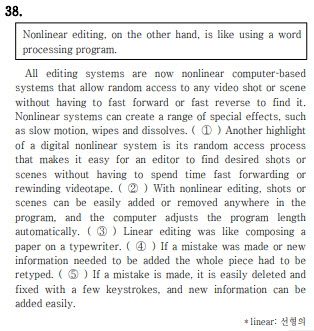
Nonlinear editing, on the other hand, is like using a word processing program.
All editing systems are now nonlinear computer-based systems that allow random access to any video shot or scene without having to fast forward or fast reverse to find it. Nonlinear systems can create a range of special effects, such as slow motion, wipes and dissolves. ( ① ) Another highlight of a digital nonlinear system is its random access process that makes it easy for an editor to find desired shots or scenes without having to spend time fast forwarding or rewinding videotape. ( ② ) With nonlinear editing, shots or scenes can be easily added or removed anywhere in the program, and the computer adjusts the program length automatically. ( ③ ) Linear editing was like composing a paper on a typewriter. ( ④ ) If a mistake was made or new information needed to be added the whole piece had to be retyped. ( ⑤ ) If a mistake is made, it is easily deleted and fixed with a few keystrokes, and new information can be added easily.
- linear: 선형의
①–⑤의 위치에 들어갈 가장 적절한 문장을 고르시오.
2) 지문 단어뜻
S1. All editing systems are now(이제 모든 편집 시스템은) nonlinear computer-based systems(비선형 컴퓨터 기반 시스템이다) that allow random access(임의 접근을 허용하는) … without having to fast forward or fast reverse(빨리감기·되감기 없이).
모든 편집 시스템은 이제 빨리감기·되감기 없이 임의 접근이 가능한 비선형 컴퓨터 기반 시스템이다.
S2. Nonlinear systems can create(비선형 시스템은 만들 수 있다) a range of special effects(다양한 특수효과를), such as(~와 같은) slow motion, wipes and dissolves(슬로 모션, 와이프, 디졸브).
비선형 시스템은 슬로 모션, 와이프, 디졸브 같은 다양한 특수효과를 만들 수 있다.
S3. (①) Another highlight of a digital nonlinear system(디지털 비선형 시스템의 또 다른 장점은) is its random access process(임의 접근 과정이다) … without … fast forwarding or rewinding videotape(되감기/빨리감기 없이).
(①) 디지털 비선형의 또 다른 장점은 되감기 없이 원하는 장면을 쉽게 찾게 하는 임의 접근 과정이다.
S4. (②) With nonlinear editing(비선형 편집에서는), shots or scenes can be easily added or removed(장면을 쉽게 추가·삭제할 수 있고) … the computer adjusts … automatically(컴퓨터가 자동으로 조정한다).
(②) 비선형에서는 어디서든 장면을 넣고 빼면 컴퓨터가 길이를 자동 조정한다.
S5. (③) Linear editing was like(선형 편집은 ~와 같았다) composing a paper on a typewriter(타자기로 글을 쓰는 것).
(③) 선형 편집은 타자기로 글을 쓰는 것과 같았다.
S6. (④) If a mistake was made … the whole piece had to be retyped(전체를 다시 쳐야 했다).
(④) 실수나 추가 사항이 있으면 전체를 다시 쳐야 했다.
S7. Nonlinear editing, on the other hand(반면 비선형 편집은), is like using a word processing program(워드프로세서를 사용하는 것과 같다).
반면 비선형 편집은 워드프로세서를 쓰는 것과 같다.
S8. If a mistake is made(실수가 생기면), it is easily deleted and fixed(쉽게 삭제·수정된다) … new information can be added easily(새 정보도 쉽게 추가된다).
실수가 나도 몇 번의 키 입력으로 쉽게 고치고 새 정보도 쉽게 추가된다.
자연스러운 전체 문단 해석
현대 편집 시스템은 비선형으로, 빨리감기·되감기 없이 임의 접근이 가능하고 다양한 특수효과를 제공한다. 디지털 비선형의 임의 접근은 원하는 장면을 쉽게 찾게 하며, 장면의 삽입·삭제도 쉽고 길이는 자동으로 조정된다.
반면 선형 편집은 타자기처럼 오류나 추가가 있으면 통째로 다시 쳐야 했다.
이에 비해 비선형 편집은 워드프로세서를 쓰는 것과 같아서, 실수가 나도 몇 번만 눌러 쉽게 수정하고 새 정보도 손쉽게 넣을 수 있다.
글의 구조
I. 현황·정의 — 모든 편집은 비선형 컴퓨터 기반, 임의 접근 가능 〈S1〉
- S1
II. 기능·장점 — 특수효과·임의접근·자동 길이 조정 〈S2–S4〉
- S2 (특수효과 생성)
- S3 (임의 접근의 장점)
- S4 (장면 추가·삭제·자동 조정)
III. 대비 1 — 선형 편집 = 타자기 비유 (수정 시 전체 재작성) 〈S5–S6〉
- S5
- S6
IV. 대비 2 — 비선형 편집 = 워드프로세서 비유 (쉽게 수정·추가) 〈S7–S8〉
- S7
- S8
3) 제목 · 주제 · 요약문
Title (EN): Nonlinear vs. Linear Editing: Word Processor vs. Typewriter
제목 (KO): 비선형 편집과 선형 편집: 워드프로세서 대 타자기
Topic (EN): Nonlinear editing enables random access and easy revision, unlike linear tape-based editing.
주제 (KO): 비선형 편집은 임의 접근과 손쉬운 수정이 가능해 선형 편집과 대조된다.
Summary (EN):
The passage lists nonlinear features (random access, effects, easy insert/delete) and contrasts them with linear editing’s retyping burden. The “word processor” analogy introduces the nonlinear advantage, followed by the sentence about easy correction.
요약 (KO):
비선형의 기능을 제시한 뒤 선형의 불편함을 대조하고, ‘워드프로세서’ 비유로 비선형의 장점을 도입한 다음 간편 수정 문장이 이어진다.
4) 직독직해
- S1 [기능 태그: 정의/기능 설명]
All editing systems / are now / nonlinear computer-based systems / that SX allow random access / to any video shot or scene / without having to fast forward / or fast reverse / to find it.
→ 직독직해: 모든 편집 시스템은 / 이제 / 비선형 컴퓨터 기반 시스템이다 / 임의 접근을 허용하는 / 어떤 영상 샷이나 장면에도 / 빨리감기 / 또는 되감기 / 를 할 필요 없이 / 그것을 찾기 위해.
→ 자연스러운 해석: 모든 편집 시스템은 이제 빨리감기나 되감기 없이 어떤 샷이나 장면이든 임의로 접근할 수 있는 비선형 컴퓨터 기반 시스템이다.
it은 “any video shot or scene”, 즉 찾으려는 특정 영상 샷/장면을 가리킵니다.
1) 문법·표현 + 콜로케이션
- all editing systems (모든 편집 시스템)
- 변형: video/audio editing systems (비디오/오디오 편집 시스템)
- Colloc/Pattern: All editing systems are now ~ (이제 모든 편집 시스템은 ~이다)
- are now (이제 ~이다/현재 ~이다)
- Syn: are currently (현재 ~이다)
- nonlinear (비선형의; 순차 진행에 묶이지 않음)
- Ant: linear (선형/순차적)
- Colloc/Pattern: nonlinear editing (NLE) (비선형 편집)
- computer-based (컴퓨터 기반의)
- Syn: software-based (소프트웨어 기반의)
- (that) allow random access (임의 접근을 허용하다)
- Ant: sequential access (순차 접근)
- Colloc/Pattern: storage allows random access (저장이 임의 접근 허용)
- access to 명사 (~로의 접근)
- to any video shot or scene (어떤 비디오 쇼트나 장면에도)
- 변형: to any frame/clip (임의의 프레임/클립으로)
- Colloc/Pattern: jump to any shot/scene (임의 쇼트/장면으로 점프)
- without having to + V (~할 필요 없이)
- Syn: without needing to + V (~할 필요가 없이)
- fast forward (빨리감기/빨리감기하다)
- Syn: skip ahead (앞으로 건너뛰다)
- Colloc/Pattern: fast forward through footage (영상을 빨리감기로 넘기다)
- fast reverse / rewind (빨리 되감기/되감다; rewind가 표준적)
- Colloc/Pattern: rewind to the beginning (처음으로 되감다)
- to find it (그것을 찾기 위해)
- 변형: to locate the moment (그 순간을 찾기 위해)
2) 문장 뼈대
- S(주어): All editing systems → 모든 편집 시스템은
- V(동사): are now → 이제 ~이다
- C(보어): nonlinear computer-based systems → 비선형 컴퓨터 기반 시스템이다
- 수식(관계절): that allow random access to any video shot or scene → 임의 접근으로 어떤 쇼트나 장면에도 갈 수 있는
- 부가(전치사구): without having to fast forward or fast reverse to find it → 그것을 찾기 위해 빨리감기나 빨리 되감기를 할 필요 없이
➡ 한국어 풀해석: 이제 모든 편집 시스템은 비선형 컴퓨터 기반 시스템이며, 임의 접근으로 어떤 쇼트나 장면에도 곧바로 갈 수 있어 원하는 지점을 찾으려고 빨리감기나 되감기를 할 필요가 없다.
3) 직독·자연 번역
All editing systems / are now / nonlinear computer-based systems / that allow random access / to any video shot or scene / without having to fast forward / or fast reverse / to find it.
이제 모든 편집 시스템은 / 비선형 컴퓨터 기반 시스템이며 / 임의 접근을 허용하고 / 어떤 쇼트나 장면에도 / 곧장 갈 수 있으며 / 빨리감기 / 또는 빨리 되감기 없이 / 그것을 찾을 수 있다.
자연 번역: 이제 편집은 비선형 컴퓨터 기반이라 어떤 쇼트나 장면이든 곧바로 이동할 수 있다. 그래서 원하는 부분을 찾으려고 빨리감기나 되감기를 할 필요가 없다.
4) 문장의 의미 설명
핵심은 테이프 시대의 선형 편집과 달리, 현대 NLE는 임의 접근으로 바로 점프하므로 탐색 시간이 사실상 0에 가깝다는 점이다. **관계절(that allow …)**이 시스템의 능력을 규정하고, to any video shot or scene로 범위를 넓히며, without having to V 구문으로 “필요 없음”을 강조한다. fast reverse는 업계에서 rewind가 통용 표기다.
5) 단어 시험
문제
① nonlinear editing (NLE) = __________
② computer-based = __________
③ allow random access = __________
④ to any video shot or scene = __________
⑤ sequential access = __________
⑥ without having to + V = __________
⑦ fast forward = __________
⑧ rewind (fast reverse) = __________
⑨ to find it = __________
정답
① nonlinear editing (NLE) = 비선형 편집
② computer-based = 컴퓨터 기반의
③ allow random access = 임의 접근을 허용하다
④ to any video shot or scene = 어떤 쇼트나 장면에도(으로)
⑤ sequential access = 순차 접근
⑥ without having to + V = ~할 필요 없이
⑦ fast forward = 빨리감기(하다)
⑧ rewind (fast reverse) = 빨리 되감기/되감다
⑨ to find it = 그것을 찾기 위해
6) 실전 예문
🔑 주요 표현
- allow random access = 임의 접근을 허용하다
- to any video shot or scene = 어떤 쇼트/장면에도
- without having to fast forward / rewind = 빨리감기/되감기할 필요 없이
EN: Modern timelines allow random access to any video shot or scene, without having to fast forward through long reels.
➡ KO: 최신 타임라인은 긴 릴을 빨리감기하지 않고도, 어떤 쇼트나 장면에도 임의 접근할 수 있다.
EN: Editors jump to any scene using markers, without having to rewind repeatedly.
➡ KO: 편집자는 마커를 이용해 반복해서 되감지 않고도 어떤 장면으로든 즉시 이동한다.
EN: Tape workflows were linear, so you needed to fast forward and rewind to cue shots.
➡ KO: 테이프 워크플로는 선형이어서, 샷을 맞추려면 빨리감기와 되감기가 필요했다.
- S2 [기능 태그: 특징—특수효과]
Nonlinear systems / can create / a range of special effects, / such as / slow motion, / wipes / and dissolves.
→ 직독직해: 비선형 시스템은 / 만들어 낼 수 있다 / 다양한 특수효과를, / 예를 들어 / 슬로 모션, / 와이프 / 그리고 디졸브를.
→ 자연스러운 해석: 비선형 시스템은 슬로 모션, 와이프, 디졸브 같은 다양한 특수효과를 만들 수 있다.
1) 문법·표현 + 콜로케이션
- nonlinear systems (명사구) = 비선형 시스템
- 변형: linear systems (선형 시스템), digital systems (디지털 시스템)
- Syn: non-sequential systems (비순차적 시스템)
- Ant: linear systems (선형 시스템)
- Colloc/Pattern: nonlinear + editing/approach/method (비선형 편집/접근/방법)
- create (동사) = 만들다, 창출하다
- 변형: creates/created/creating (만들다의 다른 형태)
- Syn: produce (생산하다), generate (생성하다)
- Ant: destroy (파괴하다), eliminate (제거하다)
- Colloc/Pattern: create + effect/opportunity/idea (~을 만들다)
- a range of (구) = 다양한, 여러 가지의
- 변형: a variety of (다양한), an array of (다채로운)
- Syn: several (여러), numerous (많은)
- Ant: a single (하나의), a few (적은)
- Colloc/Pattern: a range of + N(pl.) (여러 가지 ~)
- special effects (명사구) = 특수 효과
- 변형: SFX (특수 효과 약칭), visual effects (시각 효과)
- Syn: FX (효과), cinematic effects (영화 효과)
- Ant: ordinary visuals (일반 영상), plain footage (단순 영상)
- Colloc/Pattern: special effects in films (영화의 특수 효과)
- such as (구) = ~와 같은, 예를 들어
- 변형: for example (예를 들어), like (~와 같은)
- Syn: including (~을 포함한)
- Ant: —
- Colloc/Pattern: such as + N (~와 같은)
- slow motion (명사구) = 슬로 모션
- 변형: slow-mo (줄임말)
- Syn: time stretching (시간 늘리기), frame reduction (프레임 줄이기)
- Ant: fast motion (빠른 모션)
- Colloc/Pattern: in slow motion (슬로 모션으로)
- wipes (명사) = 와이프(장면 전환 효과)
- 변형: wipe transition (와이프 전환)
- Syn: slide transition (슬라이드 전환)
- Ant: cut (컷 전환)
- Colloc/Pattern: use/apply + wipes (와이프 효과를 사용하다)
- dissolves (명사) = 디졸브(장면 겹치기 전환 효과)
- 변형: dissolve transition (디졸브 전환)
- Syn: fade (페이드), cross dissolve (크로스 디졸브)
- Ant: hard cut (단절 컷)
- Colloc/Pattern: add + dissolves (디졸브 효과를 추가하다)
2) 문장 뼈대
- S(주어): Nonlinear systems → 비선형 시스템
- V(동사): can create → 만들어낼 수 있다
- O(목적어): a range of special effects → 다양한 특수 효과
- 부가(전치사구/예시): such as slow motion, wipes and dissolves → 예를 들어 슬로 모션, 와이프, 디졸브 같은 것들
➡ 한국어 풀해석: 비선형 시스템은 슬로 모션, 와이프, 디졸브와 같은 다양한 특수 효과를 만들어낼 수 있다.
3) 직독·자연 번역
Nonlinear systems / can create / a range of special effects, / such as / slow motion, / wipes / and dissolves.
비선형 시스템은 / 만들어낼 수 있다 / 다양한 특수 효과를, / 예를 들어 / 슬로 모션, / 와이프, / 디졸브 등을.
자연스럽게: 비선형 시스템은 슬로 모션, 와이프, 디졸브와 같은 다양한 특수 효과를 구현할 수 있다.
4) 문장의 의미 설명
핵심 메시지: 비선형 시스템의 기능은 단순 편집을 넘어서 다양한 영상 효과까지 구현할 수 있다는 점을 강조한다.
효과/의도: 구체적인 예시(슬로 모션, 와이프, 디졸브)를 제시하여 독자가 직관적으로 이해하도록 돕는다.
주의점(문법·스타일): such as는 예시 도입 구문으로, 쉼표 뒤에 병렬 나열이 이어진다.
5) 단어 시험
문제
① nonlinear systems = __________
② create = __________
③ a range of = __________
④ special effects = __________
⑤ such as = __________
⑥ slow motion = __________
⑦ wipes = __________
⑧ dissolves = __________
정답
① nonlinear systems = 비선형 시스템
② create = 만들다, 창출하다
③ a range of = 다양한
④ special effects = 특수 효과
⑤ such as = ~와 같은, 예를 들어
⑥ slow motion = 슬로 모션
⑦ wipes = 와이프(장면 전환 효과)
⑧ dissolves = 디졸브(장면 전환 효과)
6) 실전 예문
🔑 예문에 쓰이는 주요 표현
- nonlinear systems = 비선형 시스템
- create = 만들다
- special effects = 특수 효과
- slow motion = 슬로 모션
EN: Modern nonlinear systems allow editors to create special effects with ease.
➡ KO: 현대 비선형 시스템은 편집자가 손쉽게 특수 효과를 만들 수 있게 해준다.
EN: Directors often use slow motion to highlight dramatic moments.
➡ KO: 감독들은 극적인 순간을 강조하기 위해 종종 슬로 모션을 사용한다.
EN: Transition tools like wipes and dissolves help make scene changes smoother.
➡ KO: 와이프와 디졸브 같은 전환 도구는 장면 전환을 더 부드럽게 만든다.
- S3 (①) [기능 태그: 특징—임의 접근(탐색 편의)]
Another highlight / of a digital nonlinear system / is / its random access process / that SX makes it easy / for an editor / to find desired shots or scenes / without having to spend time / fast forwarding / or rewinding videotape.
→ 직독직해: 또 하나의 장점은 / 디지털 비선형 시스템의 / ~이다 / 그 임의 접근 과정으로 / 쉽게 만들어 준다 / 편집자가 / 원하는 샷이나 장면을 찾도록 / 시간을 들일 필요 없이 / 빨리감기 / 또는 비디오테이프 되감기에.
→ 자연스러운 해석: 디지털 비선형 시스템의 또 다른 장점은 임의 접근 과정으로, 편집자가 비디오테이프를 빨리 감거나 되감느라 시간을 쓰지 않고도 원하는 장면을 쉽게 찾게 해 준다는 점이다.
1) 문법·표현 + 콜로케이션
- another highlight (n.) = 또 다른 장점/강점
- 변형: a highlight (하이라이트/강점), one highlight (한 가지 장점)
- Syn: advantage (이점), strength (강점)
- Ant: drawback (단점), weakness (약점)
- Colloc/Pattern: another highlight of ~ (~의 또 다른 장점)
- digital nonlinear system (n.) = 디지털 비선형 시스템(비순차 편집 체계)
- 변형: nonlinear editing (NLE) (비선형 편집), non-linear system (비선형 시스템)
- Syn: file-based system (파일 기반 시스템)
- Ant: linear tape system (선형 테이프 시스템)
- Colloc/Pattern: a digital nonlinear system enables random access (디지털 비선형 시스템이 임의 접근을 가능케 한다)
- random access (n./adj.) = 임의 접근(무순차 접근)
- 변형: random-access process (임의 접근 과정)
- Syn: direct access (직접 접근), non-sequential access (비순차 접근)
- Ant: sequential access (순차 접근)
- Colloc/Pattern: random access to shots/scenes (쇼트/장면에 임의 접근)
- make it easy for A to V (v. pattern) = A가 V하기 쉽게 해 주다
- 변형: make it possible for A to V (A가 V할 수 있게 하다)
- Syn: enable A to V (A가 V하도록 가능케 하다), allow A to V (A가 V하도록 허용하다)
- Ant: make it hard for A to V (A가 V하기 어렵게 하다), prevent A from V-ing (A가 V하지 못하게 하다)
- Colloc/Pattern: process that makes it easy for editors to locate clips (편집자가 클립을 찾기 쉽게 해 주는 과정)
- editor (n.) = 편집자
- 변형: video editor (영상 편집자), film editor (영화 편집자)
- Syn: cutter (편집자, 구어), post-production specialist (후반 작업 전문가)
- Ant: —
- Colloc/Pattern: for an editor to find ~ (편집자가 ~을 찾도록)
- desired shot(s)/scene(s) (n.) = 원하는 쇼트/장면
- 변형: target shot (목표 쇼트), selected scene (선택 장면)
- Syn: specific shot (특정 쇼트)
- Ant: random shot (임의의 쇼트), irrelevant scene (관련 없는 장면)
- Colloc/Pattern: find desired shots or scenes (원하는 쇼트나 장면을 찾다)
- without having to + V (prep. pattern) = 굳이 V할 필요 없이
- 변형: without V-ing (V하지 않고), no need to + V (V할 필요가 없다)
- Syn: without the necessity of V-ing (V할 필요 없이)
- Ant: by having to + V (V해야만 해서)
- Colloc/Pattern: without having to wait/load/scan (기다리거나/불러오거나/스캔할 필요 없이)
- spend time (in) V-ing (v. pattern) = V하느라 시간을 쓰다
- 변형: spend hours/days V-ing (~시간/며칠을 V하며 보내다)
- Syn: waste time V-ing (V하며 시간을 낭비하다)
- Ant: save time by V-ing (V하여 시간을 절약하다)
- Colloc/Pattern: spend time fast-forwarding/rewinding (빨리 감기/되감기에 시간을 쓰다)
- fast forward / fast-forwarding (v./n.) = (비디오를) 빨리 감다/빨리 감기
- 변형: fast-forward (하이픈 표기), FF (약어)
- Syn: scan forward (앞으로 스캔하다)
- Ant: rewind (되감다)
- Colloc/Pattern: fast forward through tape (테이프를 빨리 감아 넘기다)
- rewind (videotape) / rewinding videotape (v./n.) = (비디오테이프를) 되감다/되감기
- 변형: rewound (되감았다, 과거분사)
- Syn: wind back (되감다)
- Ant: fast forward (빨리 감다)
- Colloc/Pattern: rewind videotape to the start (테이프를 처음으로 되감다)
- videotape (n.) = 비디오테이프
- 변형: tape (테이프), cassette (카세트)
- Syn: magnetic tape (자기 테이프)
- Ant: digital file (디지털 파일), solid-state media (반도체 저장매체)
- Colloc/Pattern: fast forward/rewind videotape (비디오테이프를 빨리 감다/되감다)
2) 문장 뼈대
- S(주어): Another highlight of a digital nonlinear system → 디지털 비선형 시스템의 또 다른 장점은
- V(동사): is → ~이다
- C(보어): its random access process → (그 시스템의) 임의 접근 과정이다
- 부가(관계절): that makes it easy for an editor to find desired shots or scenes → 편집자가 원하는 쇼트나 장면을 쉽게 찾게 해 주는
- 부가(전치사구): without having to spend time fast forwarding or rewinding videotape → 비디오테이프를 빨리 감거나 되감느라 시간을 들일 필요 없이
➡ 한국어 풀해석: 디지털 비선형 시스템의 또 다른 장점은, 편집자가 비디오테이프를 빨리 감거나 되감느라 시간을 들일 필요 없이 원하는 쇼트나 장면을 쉽게 찾게 해 주는 ‘임의 접근 과정’이다.
3) 직독·자연 번역
Another highlight / of a digital nonlinear system / is / its random access process / that makes it easy / for an editor / to find desired shots or scenes / without having to spend time / fast forwarding / or rewinding videotape.
또 다른 장점은 / 디지털 비선형 시스템의 / ~이다 / 임의 접근 과정인데 / 쉽게 만들어 준다 / 편집자가 / 원하는 쇼트나 장면을 찾도록 / 시간을 들일 필요 없이 / 빨리 감기에 / 혹은 비디오테이프 되감기에.
자연 번역: 디지털 비선형 시스템의 또 다른 장점은 ‘임의 접근’이다. 이 과정 덕분에 편집자는 비디오테이프를 빨리 감거나 되감느라 시간을 낭비하지 않고 원하는 쇼트나 장면을 손쉽게 찾을 수 있다.
4) 문장의 의미 설명
핵심 메시지: 비선형 시스템의 임의 접근성이 선형 테이프의 **시간 소모적 탐색(빨리 감기/되감기)**을 없애 주어, 편집자가 원하는 지점을 즉시 찾을 수 있게 한다.
효과/의도: **관계절(that makes it easy …)**이 ‘임의 접근 과정’의 효용을 설명하고, without having to spend time ~으로 ‘회피된 비용(시간)’을 부각한다. 용어적으로 random access는 자료를 순서대로 훑지 않고 직접 건너뛸 수 있음을 뜻해, 편집 워크플로의 효율을 비약적으로 높인다.
5) 단어 시험
문제
① another highlight = __________
② digital nonlinear system = __________
③ random access = __________
④ make it easy for A to V = __________
⑤ editor = __________
⑥ desired shots or scenes = __________
⑦ without having to + V = __________
⑧ spend time V-ing = __________
⑨ fast forward(ing) = __________
⑩ rewind(ing) videotape = __________
정답
① another highlight = 또 다른 장점/강점
② digital nonlinear system = 디지털 비선형 시스템
③ random access = 임의 접근(무순차 접근)
④ make it easy for A to V = A가 V하기 쉽게 해 주다
⑤ editor = 편집자
⑥ desired shots or scenes = 원하는 쇼트/장면
⑦ without having to + V = 굳이 V할 필요 없이
⑧ spend time V-ing = V하느라 시간을 쓰다
⑨ fast forward(ing) = (비디오를) 빨리 감다/빨리 감기
⑩ rewind(ing) videotape = 비디오테이프를 되감다/되감기
6) 실전 예문
🔑 예문에 쓰이는 주요 표현
- random access = 임의 접근
- make it easy for A to V = A가 V하기 쉽게 해 주다
- without having to + V = 굳이 V할 필요 없이
- fast forward / rewind = 빨리 감다 / 되감다
EN: Random access makes it easy for editors to jump to any frame without having to fast forward or rewind.
➡ KO: 임의 접근은 편집자가 어느 프레임이든 빨리 감거나 되돌릴 필요 없이 즉시 이동하도록 쉽게 해 준다.
EN: The new NLE makes it easy for assistants to locate B-roll without having to rewind long tapes.
➡ KO: 새 비선형 편집기는 어시스턴트가 긴 테이프를 되감을 필요 없이 B-롤을 찾도록 쉽게 해 준다.
EN: With random access, reviewers can compare scenes side by side without having to fast forward through hours of footage.
➡ KO: 임의 접근 덕분에 리뷰어는 여러 시간 분량의 영상을 빨리 감지 않아도 장면을 나란히 비교할 수 있다.
- S4 (②) [기능 태그: 특징—삽입·삭제+자동 길이 조정]
With nonlinear editing, / shots or scenes / can be easily added or removed / anywhere in the program, / and the computer / adjusts / the program length / automatically.
→ 직독직해: 비선형 편집에서는, / 샷이나 장면을 / 쉽게 추가하거나 삭제할 수 있고 / 프로그램 어디에서든, / 그리고 컴퓨터가 / 조정한다 / 프로그램 길이를 / 자동으로.
→ 자연스러운 해석: 비선형 편집에서는 프로그램 어디에서든 장면을 쉽게 넣고 뺄 수 있으며, 컴퓨터가 프로그램 길이를 자동으로 조정한다.
1) 문법·표현 + 콜로케이션
- nonlinear editing (NLE) (n.) = 비선형 편집(임의 접근형)
- 변형: digital nonlinear editing (디지털 비선형 편집), non-sequential editing (비순차 편집)
- Syn: random-access editing (임의 접근 편집) / Ant: linear editing (선형 편집), tape-based editing (테이프 기반 편집)
- Colloc/Pattern: with nonlinear editing, S V (비선형 편집에서는 S가 V하다)
- shot / scene (n.) = 쇼트 / 장면
- 변형: clip (클립), take (테이크)
- Syn: segment (구간) / Ant: —
- Colloc/Pattern: add/remove shots or scenes (쇼트/장면을 추가/제거하다)
- can be + past participle (modal passive) = ~될 수 있다(수동 가능)
- 변형: may be + p.p. (될 수도 있다)
- Syn: be able to be + p.p. (~될 수 있다) / Ant: cannot be + p.p. (될 수 없다)
- Colloc/Pattern: can be added/removed (추가/제거될 수 있다)
- easily (adv.) = 쉽게
- Syn: readily (손쉽게) / Ant: hardly (거의 ~아니다)
- Colloc/Pattern: be easily added/removed (쉽게 추가/제거되다)
- anywhere in the program (adv. phr.) = 프로그램 어디에서나
- 변형: at any point in the timeline (타임라인 어느 지점에서든)
- Syn: any position (임의 위치) / Ant: only at the end (끝에서만)
- Colloc/Pattern: insert anywhere in the program (프로그램 어디에나 삽입하다)
- adjust (v.) = 조정하다
- 변형: adjustment (조정), auto-adjust (자동 조정하다)
- Syn: update (업데이트하다), recalculate (재계산하다) / Ant: freeze (고정하다)
- Colloc/Pattern: the computer adjusts X (컴퓨터가 X를 조정하다)
- program length (n.) = 프로그램 길이(총 러닝타임)
- 변형: runtime (러닝타임), duration (재생 시간)
- Syn: total length (총 길이) / Ant: —
- Colloc/Pattern: adjust the program length (프로그램 길이를 조정하다)
- automatically (adv.) = 자동으로
- Syn: on its own (저절로) / Ant: manually (수동으로)
- Colloc/Pattern: update/adjust automatically (자동으로 업데이트/조정하다)
- with + N (prep.) = ~을 이용하면/~인 경우에(환경·수단)
- Colloc/Pattern: with NLE / with software X (NLE/소프트웨어 X에서는)
2) 문장 뼈대
- 부가(환경): With nonlinear editing → 비선형 편집에서는
- S₁: shots or scenes → 쇼트나 장면이
- V₁: can be added or removed → 추가되거나 제거될 수 있고
- 부가₁: easily / anywhere in the program → 쉽게 / 프로그램 어디에서나
- 접속: and → 그리고
- S₂: the computer → 컴퓨터가
- V₂: adjusts → 조정한다
- O₂: the program length → 프로그램 길이를
- 부가₂: automatically → 자동으로
➡ 한국어 풀해석: 비선형 편집에서는 프로그램 어디에서나 쇼트나 장면을 쉽게 추가하거나 제거할 수 있고, 컴퓨터가 프로그램 길이를 자동으로 조정한다.
3) 직독·자연 번역
With nonlinear editing, / shots or scenes / can be easily added or removed / anywhere in the program, / and the computer / adjusts / the program length / automatically.
비선형 편집에서는 / 쇼트나 장면이 / 쉽게 추가되거나 제거될 수 있고 / 프로그램 어디에서나, / 그리고 컴퓨터가 / 조정한다 / 프로그램 길이를 / 자동으로.
자연스러운 한국어: 비선형 편집에서는 프로그램 어디에서나 쇼트나 장면을 손쉽게 넣고 뺄 수 있으며, 컴퓨터가 전체 러닝타임을 자동으로 맞춰 준다.
4) 문장의 의미 설명
핵심 메시지: NLE에서는 타임라인 임의 지점에서 삽입/삭제가 가능하고, 시스템이 전체 길이를 자동 보정해 편집 효율이 극대화된다.
효과/의도: “easily/anywhere/automatically”의 삼박자로 접근성·유연성·자동화를 강조한다.
주의점(문법·스타일): with + N이 조건·환경을, **modal passive(can be + p.p.)**가 가능성과 수동을, and가 두 절(편집 작업 가능 + 시스템 자동 조정)을 병렬로 연결한다.
5) 단어 시험
문제
① nonlinear editing (NLE) = __________
② shot / scene = __________
③ can be added/removed = __________
④ anywhere in the program = __________
⑤ adjust = __________
⑥ program length = __________
⑦ automatically = __________
정답
① nonlinear editing (NLE) = 비선형 편집(임의 접근형)
② shot / scene = 쇼트 / 장면
③ can be added/removed = 추가/제거될 수 있다
④ anywhere in the program = 프로그램 어디에서나
⑤ adjust = 조정하다
⑥ program length = 프로그램 길이(총 러닝타임)
⑦ automatically = 자동으로
6) 실전 예문
🔑 예문에 쓰이는 주요 표현
- nonlinear editing = 비선형 편집
- can be added/removed = 추가/제거될 수 있다
- anywhere in the program = 프로그램 어디에서나
- adjust the program length automatically = 프로그램 길이를 자동으로 조정하다
EN: In nonlinear editing, clips can be added or removed anywhere in the program.
➡ KO: 비선형 편집에서는 클립을 프로그램 어디에서나 추가하거나 제거할 수 있다.
EN: When you cut a scene, the system will adjust the program length automatically.
➡ KO: 장면을 잘라내면 시스템이 프로그램 길이를 자동으로 조정한다.
EN: Titles and music can be added or removed later, and the app adjusts the program length automatically.
➡ KO: 자막과 음악은 나중에 추가·제거할 수 있고, 앱이 전체 길이를 자동으로 맞춰 준다.
- S5 (③) [기능 태그: 대조—선형 편집 비유]
Linear editing / was like / composing a paper / on a typewriter.
→ 직독직해: 선형 편집은 / 같았다 / 글을 쓰는 것과 / 타자기로.
→ 자연스러운 해석: 선형 편집은 타자기로 글을 쓰는 것과 같았다.
1) 문법·표현 + 콜로케이션
- linear editing (n.) = 리니어(순차) 편집
- 변형: tape-based editing (테이프 기반 편집), sequential editing (순차 편집)
- Syn: assembly editing (순차 조립 편집)
- Ant: nonlinear editing (NLE) (논리니어/비선형 편집), random-access editing (임의 접근 편집)
- Colloc/Pattern: linear editing workflow (리니어 편집 작업 흐름), limitations of linear editing (리니어 편집의 한계)
- be like (v.구) = ~와 같다/비슷하다
- 변형: is/was like (~와 같다/같았다)
- Syn: resemble (닮다/유사하다), be similar to (~와 유사하다)
- Ant: differ from (~와 다르다), contrast with (~와 대조되다)
- Colloc/Pattern: X be like Y (X는 Y와 같다/유사하다)
- compose a paper (v.구) = 글/논문을 집필하다
- 변형: compose a draft (초안을 쓰다), compose an essay (에세이를 집필하다)
- Syn: write a paper (논문을 쓰다), draft a paper (논문 초안을 쓰다)
- Ant: abandon a paper (글을 포기하다), scrap a draft (초안을 폐기하다)
- Colloc/Pattern: compose a paper on ~ (~에 관한 글을 집필하다)
- typewriter (n.) = 타자기
- 변형: manual typewriter (수동 타자기), electric typewriter (전동 타자기)
- Syn: typing machine (타자기), portable typewriter (휴대용 타자기)
- Ant: word processor (워드 프로세서), computer keyboard (컴퓨터 키보드)
- Colloc/Pattern: type on a typewriter (타자기로 타이핑하다), pages in a typewriter (타자기에 끼운 종이)
- on a typewriter (prep.구) = 타자기로/타자기를 이용해
- 변형: on a keyboard (키보드로), on paper (종이에)
- Syn: with a typewriter (타자기로), using a typewriter (타자기를 사용하여)
- Ant: by hand (손으로), on a computer (컴퓨터로)
- Colloc/Pattern: compose ~ on a typewriter (타자기로 ~을 쓰다)
2) 문장 뼈대
- S(주어): Linear editing → 리니어(순차) 편집은
- V(동사): was → ~였다
- O/C(보어): like composing a paper on a typewriter → 타자기로 글을 쓰는 것과 같았다
- 부가: —
➡ 한국어 풀해석: 리니어 편집은 타자기로 글(논문)을 쓰는 것과 같은 방식이었다.
3) 직독·자연 번역
Linear editing / was like / composing a paper / on a typewriter.
리니어 편집은 / 같았다 / 글을 쓰는 것과 / 타자기로.
자연스러운 번역: 리니어(순차) 편집은 마치 타자기로 글을 쓰는 것과 같았다.
4) 문장의 의미 설명
핵심 메시지: 리니어 편집의 ‘순차성과 되돌리기 어려움’을 타자기 집필에 비유해 한계(수정의 비효율, 앞부분 수정 시 전체 재작업)를 강조한다.
효과/의도: be like + V-ing 구조의 직유를 사용해 독자의 기존 경험(타자기)으로 추상적 개념(편집 방식)을 직관적으로 이해시키는 설명 전략이다.
주의점(문법·스타일): like 뒤의 composing은 동명사(행위 일반)로 쓰였고, 매체 비유이므로 기술 맥락에서는 nonlinear editing과의 대비가 함축된다.
5) 단어 시험
문제
① linear editing = __________
② be like = __________
③ compose a paper = __________
④ typewriter = __________
⑤ on a typewriter = __________
⑥ nonlinear editing (NLE) = __________
정답
① linear editing = 리니어(순차) 편집
② be like = ~와 같다/비슷하다
③ compose a paper = 글/논문을 집필하다
④ typewriter = 타자기
⑤ on a typewriter = 타자기로/타자기를 이용해
⑥ nonlinear editing (NLE) = 논리니어/비선형 편집
6) 실전 예문
🔑 예문에 쓰이는 주요 표현
- linear editing = 리니어(순차) 편집
- be like = ~와 같다/비슷하다
- compose a paper = 글/논문을 집필하다
- on a typewriter = 타자기로/타자기를 이용해
EN: In tape rooms, linear editing is like splicing film reels by hand.
➡ KO: 테이프 편집실에서 리니어 편집은 수동으로 필름 릴을 이어 붙이는 것과 같다.
EN: For first drafts, some writers compose a paper on a typewriter to avoid digital distractions.
➡ KO: 어떤 작가들은 디지털 방해를 피하려고 초고를 타자기로 글을 쓰기도 한다.
EN: To students raised on NLE, linear editing is like trying to compose a paper on a typewriter without a delete key.
➡ KO: 논리니어 편집에 익숙한 학생들에게 리니어 편집은 삭제 키 없는 타자기로 글을 쓰려는 것과 같다.
- S6 (④) [기능 태그: 문제—선형 편집의 한계]
If a mistake was made / or new information / needed to be added / the whole piece / had to be retyped.
→ 직독직해: 실수가 생기거나 / 새 정보가 / 추가될 필요가 있으면 / 전체 글을 / 다시 쳐야 했다.
→ 자연스러운 해석: 실수가 있거나 새 정보를 추가해야 하면 글 전체를 다시 쳐야 했다.
1) 문법·표현 + 콜로케이션
- make a mistake / a mistake is/was made (구/수동) = 실수를 하다 / 실수가 발생하다
- 변형: made a mistake (과거에 실수했다), mistakes are made (실수는 일어난다)
- Syn: err (실수하다), blunder (큰 실수하다)
- Ant: get it right (정확히 하다), correct an error (오류를 바로잡다)
- Colloc/Pattern: make a mistake in + N (~에서 실수하다)
- new information (명사구) = 새로운 정보
- 변형: additional information (추가 정보), updated information (업데이트된 정보)
- Syn: fresh data (새로운 데이터), latest details (최신 상세)
- Ant: outdated information (구식 정보), missing information (누락 정보)
- Colloc/Pattern: add/include new information (새 정보를 추가/포함하다)
- need to be + p.p. (패턴) = ~될 필요가 있다
- 변형: needed to be + p.p. (과거 필요), need not be + p.p. (될 필요 없다)
- Syn: require + -ing / to be + p.p. (…이 요구되다), must be + p.p. (반드시 ~되어야 한다; 강함)
- Ant: be optional (선택 사항이다), need not (필요 없다)
- Colloc/Pattern: N + needs/needed to be + added/fixed/updated (N이 추가/수정/업데이트될 필요가 있다)
- the whole piece (명사구) = 글 전체/원고 전체
- 변형: the entire article (기사 전체), the entire document (문서 전체)
- Syn: the full text (전체 본문), the complete draft (완전한 초고)
- Ant: a section (일부분), a paragraph (단락)
- Colloc/Pattern: revise/retype the whole piece (글 전체를 수정/다시 타이프하다)
- have to + be + p.p. / had to be + p.p. (의무 수동) = ~되어야 한다 / ~되어야 했다
- 변형: has/have to be + p.p. (현재), will have to be + p.p. (미래 의무)
- Syn: must be + p.p. (반드시 ~되어야 한다), be required to be + p.p. (~하도록 요구되다)
- Ant: don’t have to be + p.p. (~될 필요 없다), can remain as is (그대로 둘 수 있다)
- Colloc/Pattern: had to be retyped/reprinted/redone (다시 타이프/재인쇄/재작업해야 했다)
2) 문장 뼈대
- 부가(조건절): If a mistake was made or new information needed to be added → 실수가 발생했거나 새 정보를 추가할 필요가 있었다면
- S: a mistake / new information → 실수 / 새 정보
- V: was made / needed → 발생했다 / 필요했다
- C: to be added → 추가되는 것
- S(주어): the whole piece → 글 전체
- V(동사): had to be retyped → 다시 타이프되어야 했다
➡ 한국어 풀해석: 실수가 있었거나 새로운 정보를 추가해야 했다면, 글 전체를 다시 타이핑해야 했다.
3) 직독·자연 번역
If a mistake was made / or new information / needed to be added / the whole piece / had to be retyped.
만약 실수가 발생했다면 / 또는 새로운 정보가 / 추가될 필요가 있었다면 / 글 전체를 / 다시 타이프해야 했다.
자연스러운 한국어: 실수가 있거나 새 정보를 추가해야 했다면 글 전체를 다시 타이핑해야 했다.
4) 문장의 의미 설명
핵심 메시지: 과거 워크플로에서 오탈자나 내용 추가가 생기면 부분 수정이 아니라 문서 전체를 다시 타이핑해야 했다는 규칙을 말한다.
효과/의도: 수동태를 사용해 책임 주체를 흐리면서(“누가”가 아니라 “상황”) 당시의 비효율·제약을 강조한다.
주의점(문법·스타일): 조건절 두 개를 or로 연결한 과거 일반적 사실 진술이다. **needed to be + p.p.**는 필요의 수동표현이고, **had to be + p.p.**는 의무의 수동표현이다. 현대 문맥에서는 “retype” 대신 “re-enter/rewrite” 등으로 바뀔 수 있다.
5) 단어 시험
문제
① if = __________
② make a mistake / a mistake was made = __________
③ new information = __________
④ need to be + p.p. = __________
⑤ the whole piece = __________
⑥ had to be + p.p. = __________
정답
① if = 만약 ~라면
② make a mistake / a mistake was made = 실수를 하다 / 실수가 발생하다
③ new information = 새로운 정보
④ need to be + p.p. = ~될 필요가 있다
⑤ the whole piece = 글 전체/원고 전체
⑥ had to be + p.p. = ~되어야 했다(의무의 수동)
6) 실전 예문
🔑 예문에 쓰이는 주요 표현
- if = 만약 ~라면
- make a mistake = 실수를 하다
- new information = 새로운 정보
- need to be + p.p. = ~될 필요가 있다
- the whole piece = 글 전체
- had to be + p.p. = ~되어야 했다
EN: If you make a mistake, the whole piece has to be retyped.
➡ KO: 실수를 하면 글 전체를 다시 타이핑해야 한다.
EN: When new information needs to be added, we sometimes rebuild the page from scratch.
➡ KO: 새로운 정보를 추가할 필요가 있을 때는 가끔 페이지를 처음부터 다시 만든다.
EN: After the edits, the editor said the whole piece had to be retyped for consistency.
➡ KO: 수정 후 편집자는 일관성을 위해 글 전체를 다시 타이핑해야 한다고 말했다.
- S7 [기능 태그: 대조—비선형 편집 비유]
Nonlinear editing, / on the other hand, / is like / using a word processing program.
→ 직독직해: 비선형 편집은, / 반면에, / 같다 / 워드프로세서를 사용하는 것과.
→ 자연스러운 해석: 반면 비선형 편집은 워드프로세서를 사용하는 것과 같다.
1) 문법·표현 + 콜로케이션
- nonlinear editing (명사) = 비선형 편집(임의 접근·순서 자유 편집)
- 변형: nonlinear video editing (NLE) (비선형 영상 편집), nonlinear workflow (비선형 작업 흐름)
- Syn: random-access editing (임의 접근 편집)
- Ant: linear editing (선형 편집; 테이프 순차 편집), tape-to-tape editing (테이프 간 편집)
- Colloc/Pattern: nonlinear editing timeline (비선형 편집 타임라인), non-destructive editing (비파괴 편집)
- on the other hand (담화 표지) = 한편, 반면에
- 변형: in contrast (대조적으로), by contrast (대조적으로)
- Syn: however (그러나)
- Ant: on the one hand (한편으로는)
- Colloc/Pattern: On the other hand, S V… (대조 전환 표지)
- be like (동사구) = ~와 같다/비슷하다
- 변형: be similar to (…와 유사하다)
- Syn: resemble (닮다), be akin to (…와 유사하다)
- Ant: differ from (…와 다르다), be unlike (…와 같지 않다)
- Colloc/Pattern: X is like Y (X는 Y와 같다: 비유)
- use a word processing program (동사구) = 워드 프로세서 프로그램을 사용하다
- 변형: use a word processor (워드 프로세서를 사용하다), work in a word processor (워드에서 작업하다)
- Syn: type in a word processor (워드에서 타이핑하다)
- Ant: handwrite a draft (원고를 손으로 쓰다)
- Colloc/Pattern: edit text with a word processor (워드로 텍스트를 편집하다)
- word processing program / word processor (명사) = 워드 프로세서(프로그램)
- 변형: document editor (문서 편집기)
- Syn: WYSIWYG editor (위지위그 편집기)
- Ant: plain-text editor (플레인 텍스트 편집기)
- Colloc/Pattern: save versions in a word processor (워드에서 버전 저장하다)
2) 문장 뼈대
- S(주어): nonlinear editing → 비선형 편집은
- V(동사): is like → ~와 같다
- O/C(보어): using a word processing program → 워드 프로세서 프로그램을 사용하는 것
- 부가(전치사구/부사절/관계절 등): on the other hand → 반면에(대조 전환)
➡ 한국어 풀해석: 반면에, 비선형 편집은 워드 프로세서 프로그램을 사용하는 것과 같다.
3) 직독·자연 번역
Nonlinear editing, / on the other hand, / is like / using a word processing program.
비선형 편집은, / 반면에, / ~와 같다 / 워드 프로세서 프로그램을 사용하는 것과.
반면에 비선형 편집은 워드 프로세서 프로그램을 쓰는 것과 비슷하다.
4) 문장의 의미 설명
핵심 메시지: 비선형 편집의 작동 방식을 문서 편집에 빗대어, 원하는 부분을 자유롭게 고치고 재배치할 수 있음을 강조한다.
효과/의도: 담화 표지로 대조를 열어(아마 앞 문장의 선형 편집과 대비) 직관적 비유(~와 같다)를 통해 학습자의 이해를 돕는다.
주의점(문법·스타일): 비유 구문 X is like Y 에서 using ~는 동명사구로 보어 역할을 한다. “word processing program”은 “word processor”로 자연스럽게 축약 가능하다.
5) 단어 시험
문제
① nonlinear editing = __________
② on the other hand = __________
③ be like = __________
④ linear editing = __________
⑤ use a word processor = __________
⑥ non-destructive editing = __________
정답
① nonlinear editing = 비선형 편집
② on the other hand = 한편, 반면에
③ be like = ~와 같다/비슷하다
④ linear editing = 선형 편집(테이프 순차 편집)
⑤ use a word processor = 워드 프로세서를 사용하다
⑥ non-destructive editing = 비파괴 편집
6) 실전 예문
🔑 예문에 쓰이는 주요 표현
- nonlinear editing = 비선형 편집
- on the other hand = 반면에
- be like = ~와 같다
- word processor = 워드 프로세서
EN: In nonlinear editing, moving clips around is like rearranging paragraphs in a word processor.
➡ KO: 비선형 편집에서는 클립을 옮기는 일이 워드 프로세서에서 문단을 재배열하는 것과 같다.
EN: Tape workflows are rigid; on the other hand, NLE timelines are like sandboxed documents.
➡ KO: 테이프 기반 흐름은 경직되어 있지만, 반면에 NLE 타임라인은 샌드박스 문서와 같다.
EN: For beginners, NLEs are like training wheels compared to linear editing.
➡ KO: 초보자에게 NLE는 선형 편집에 비해 보조바퀴와 같다.
- S8 [기능 태그: 결과—비선형의 수정 용이]
If a mistake is made, / it is easily deleted / and fixed / with a few keystrokes, / and new information / can be added / easily.
→ 직독직해: 실수가 생기면, / 쉽게 삭제되고 / 고쳐진다 / 몇 번의 키 입력으로, / 그리고 새 정보가 / 추가될 수 있다 / 쉽게.
→ 자연스러운 해석: 실수가 나면 몇 번만 키를 눌러 쉽게 지우고 고칠 수 있고, 새 정보도 손쉽게 추가할 수 있다.
1) 문법·표현 + 콜로케이션
- make a mistake (v. phrase) = 실수하다
- 변형: a mistake is made (실수가 생기다·발생하다, 수동), making a mistake (실수하기)
- Syn: commit an error (실수를 저지르다), slip up (실수하다)
- Ant: get it right (정확히 하다), avoid mistakes (실수를 피하다)
- Colloc/Pattern: If a mistake is made, … (실수가 생기면 …)
- delete (v.) = 삭제하다
- 변형: be deleted (삭제되다), deleting (삭제하는/삭제하기)
- Syn: erase (지우다), remove (제거하다)
- Ant: restore (복원하다), recover (복구하다)
- Colloc/Pattern: delete a typo/entry (오타/항목을 삭제하다)
- fix (v.) = 고치다, 수정하다
- 변형: be fixed (수정되다), fixing (수정하는/수정하기)
- Syn: correct (교정하다), amend (수정·개정하다)
- Ant: damage (손상시키다), worsen (악화시키다)
- Colloc/Pattern: fix a mistake/bug (실수/버그를 고치다)
- with a few keystrokes (prep. phrase) = 몇 번의 키 입력으로
- 변형: keystroke (키 입력), with a few clicks (몇 번의 클릭으로)
- Syn: with a couple of keystrokes (키 몇 번만으로)
- Colloc/Pattern: with a few keystrokes, S V (키 몇 번이면 ~하다)
- add (v.) = 추가하다
- 변형: can be added (추가될 수 있다), adding (추가하는/추가하기)
- Syn: insert (삽입하다), append (덧붙이다)
- Ant: delete (삭제하다), remove (제거하다)
- Colloc/Pattern: add new information (새 정보를 추가하다), add A to B (A를 B에 추가하다)
- easily (adv.) = 쉽게
- 변형: easy (쉬운), with ease (손쉽게)
- Syn: readily (손쉽게), effortlessly (힘들이지 않고)
- Ant: hardly (거의 ~않게), with difficulty (어렵게)
- Colloc/Pattern: can be easily + p.p. (쉽게 ~될 수 있다)
- new information (n.) = 새 정보, 추가 정보
- 변형: updated information (업데이트된 정보), additional information (추가 정보)
- Syn: new data (새 데이터), fresh details (새로운 세부사항)
- Ant: outdated information (구식 정보), misinformation (허위 정보)
- Colloc/Pattern: add new information to the document (문서에 새 정보를 추가하다)
- can be + p.p. (pattern) = ~될 수 있다(수동 가능)
- 변형: can be added/deleted/fixed (추가/삭제/수정될 수 있다)
- Colloc/Pattern: content can be added easily (내용이 쉽게 추가될 수 있다)
2) 문장 뼈대
- S(주어): it(앞선 a mistake를 가리킴) → 그것(그 실수)
- V(동사): is deleted and fixed → 삭제되고 수정된다
- O/C(목적어/보어): —
- 부가(전치사구/부사절/관계절 등): If a mistake is made (실수가 생기면), with a few keystrokes (몇 번의 키 입력으로), and new information can be added easily (그리고 새 정보가 쉽게 추가될 수 있다)
➡ 한국어 풀해석: 실수가 생기면, 몇 번만 키를 눌러도 그 실수는 쉽게 삭제하고 수정할 수 있고, 새 정보도 쉽게 추가될 수 있다.
3) 직독·자연 번역
If a mistake is made, / it is easily deleted / and fixed / with a few keystrokes, / and new information / can be added / easily.
실수가 생기면, / 그것은 쉽게 삭제되고 / 또 수정되며 / 몇 번의 키 입력으로, / 그리고 새 정보가 / 추가될 수 있고 / 쉽게.
실수가 나면, 몇 번만 키를 눌러도 그 실수는 쉽게 삭제·수정할 수 있고, 새 정보도 손쉽게 덧붙일 수 있다.
4) 문장의 의미 설명
핵심 메시지: 디지털 편집 환경에서는 오류 수정과 정보 추가가 최소한의 조작으로 신속하게 가능하다는 점을 강조한다.
효과/의도: 수동태와 부사 easily를 반복해 ‘행위자’보다 ‘결과의 용이함’을 부각하고, with a few keystrokes로 도구·노력의 최소화를 구체화한다.
주의점(문법·스타일): 조건절 If a mistake is made(수동) + 주절 수동 is deleted and fixed의 병렬 술어, 이어서 can be added(조동사+수동)의 모달 수동이 등위접속사 and로 결합된다. 부사 easily의 위치는 동사 앞·뒤 모두 자연스럽지만, 시험에서는 can easily be added와 can be easily added 모두 허용됨을 기억.
5) 단어 시험
문제
① make a mistake = __________
② be deleted = __________
③ fix (be fixed) = __________
④ with a few keystrokes = __________
⑤ add (can be added) = __________
⑥ easily = __________
정답
① make a mistake = 실수하다
② be deleted = 삭제되다
③ fix (be fixed) = 고치다/수정되다
④ with a few keystrokes = 몇 번의 키 입력으로
⑤ add (can be added) = 추가하다(추가될 수 있다)
⑥ easily = 쉽게
6) 실전 예문
🔑 예문에 쓰이는 주요 표현
- make a mistake = 실수하다
- delete = 삭제하다
- fix = 고치다/수정하다
- add new information = 새 정보를 추가하다
EN: If a mistake is made, it can be deleted with a few keystrokes.
➡ KO: 실수가 생기면, 몇 번만 키를 눌러도 그 실수를 삭제할 수 있다.
EN: Editors fix errors and add new information during revisions.
➡ KO: 편집자는 교정 과정에서 오류를 고치고 새 정보를 덧붙인다.
EN: Most forms let you add new information later if you forget, and minor typos are easy to fix.
➡ KO: 대부분의 양식은 나중에 잊은 내용을 추가하도록 해 주며, 사소한 오타는 쉽게 고칠 수 있다.
5) 문제 풀이법 (How to Solve)
- 의도: 문장 위치 연결(대조 전환 위치 파악).
- 핵심 근거: ③–④가 “타자기=선형의 불편”을 마무리 → 이어서 대조 전환 구문 on the other hand 가 와야 함 → 곧바로 “간편 수정” 결과문이 뒤따름.
- 결론: “Nonlinear editing, on the other hand, is like using a word processing program.”는 ④ 다음, ⑤(‘If a mistake is made…’) 직전이 가장 자연스럽습니다.
- 번호 매핑 요약:
- ① = Another highlight … random access
- ② = With nonlinear editing … added or removed …
- ③ = Linear editing was like … typewriter
- ④ = If a mistake was made … retyped
- (contrast sentence) = ④ 다음
- ⑤ = If a mistake is made … easily deleted/added
'고1 > 고1 9월 모의고사' 카테고리의 다른 글
| 2025년 고1 9월 모의고사 영어 40번 해설 및 분석 (2) | 2025.09.20 |
|---|---|
| 2025년 고1 9월 모의고사 영어 39번 해설 및 분석 (0) | 2025.09.19 |
| 2025년 고1 9월 모의고사 영어 37번 해설 및 분석 (1) | 2025.09.17 |
| 2024년 고1 9월 모의고사 영어 4142번 해설 및 분석 (1) | 2025.09.16 |
| 2024년 고1 9월 모의고사 40번 해설 및 분석 (2) | 2025.09.15 |