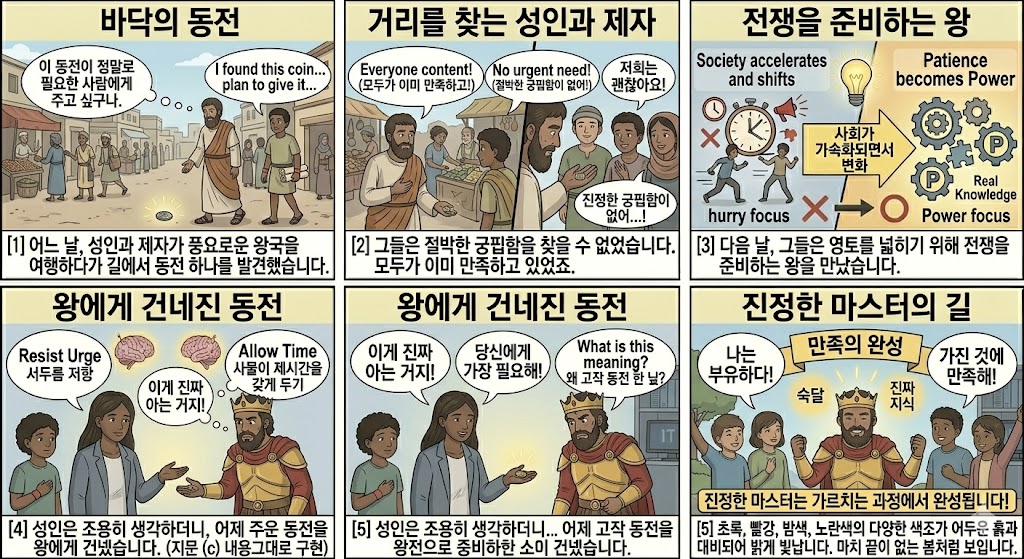
(A) One day, a sage was traveling with his disciple through the capital of a prosperous kingdom. As they walked along a busy road, the sage noticed a coin on the ground. Since he lived simply and had no need for it, he told his disciple (a) he hoped to give it to someone who truly required it. The two men searched the streets, but found no one in genuine need of the coin.
(B)The king, puzzled and slightly annoyed at what he did, asked, “What is the meaning of this coin? I am the richest king in the land. Why would I need a single coin?” The sage replied calmly, “Oh, Great King, I found this coin yesterday while walking through your capital. I had no need for it, so I planned to give it to someone who did. Yet everyone (b) I met seemed content and lacked any urgent need.”
(C) The next morning, near the palace, they saw the king preparing for a war. The king was not satisfied with what he had and sought to expand his kingdom. Accompanied by his army, he stopped when he saw the sage and his disciple. He approached the sage and asked for a blessing that might ensure victory. After a quiet moment of thought, the sage handed the king the coin (c) he had found the previous day.
(D) The sage added, “Today, I see you preparing for war, seeking to conquer more. And (d) I thought you, the one who desires more, were in need of this coin.” The king was struck by the sage’s words. He realized that his hunger for more had made him forget the value of contentment. The sage’s simple but powerful lesson made him change (e) his plans. The king called off the invasion and chose to appreciate what he already had.
* conquer: 정복하다
43. 주어진 글 (A)에 이어질 내용을 순서에 맞게 배열한 것으로 가장 적절한 것은?
① (B) - (D) - (C) ② (C) - (B) - (D) ③ (C) - (D) - (B) ④ (D) - (B) - (C) ⑤ (D) - (C) - (B)
정답 2
44. 밑줄 친 (a)~(e) 중에서 가리키는 대상이 나머지 넷과 다른 것은?
① (a) ② (b) ③ (c) ④ (d) ⑤ (e)
정답 5
45. 윗글에 관한 내용으로 적절하지 않은 것은?
① 현자는 소박한 삶을 살았기에 동전이 필요하지 않았다.
② 왕은 현자가 한 행동에 당황스러웠고 약간 불쾌함을 느꼈다.
③ 현자는 전쟁을 마치고 돌아오는 왕을 궁전 근처에서 보았다.
④ 왕은 현자에게 다가가 축복을 부탁했다.
⑤ 왕은 침략을 취소했고 자신이 가진 것을 소중히 여기기로 했다.
정답 3
[1] One day, a sage was traveling with his disciple and noticed a coin on the ground.
[2] Since he lived simply, he told his disciple (a) he hoped to give it to someone who truly required it.
[3] The king was not satisfied with what he had and sought to expand his kingdom by preparing for a war.
[4] The king approached the sage and asked for a blessing that might ensure victory.
[5] The sage handed the king the coin (c) he had found the previous day.
[6] The king was puzzled and asked, “Why would I need a single coin? I am the richest king in the land.”
[7] The sage replied, “Everyone (b) I met seemed content, but today I see you seeking to conquer more.”
[8] “(d) I thought you, the one who desires more, were in need of this coin.”
[9] The king realized that his hunger for more had made him forget the value of contentment.
[10] The sage’s powerful lesson made the king change (e) his plans, call off the invasion, and appreciate what he already had.
[내용 연결 & 핵심 키워드 통합 정리]
1단계: 동전의 주인을 찾는 성자 (The Search for the Needy)
소박한 삶을 사는 성자는 길에서 주운 동전 하나를 **진정으로 필요한 사람(someone who truly required it)**에게 주기로 결심합니다. 하지만 부유한 왕국의 거리에서 만난 모든 이들은 이미 **자족(content)**하고 있어 동전의 필요성을 느끼지 못했습니다.
2단계: 왕의 욕망과 성자의 축복 (The King's Greed)
이튿날, 성자는 영토를 확장하기 위해 **전쟁을 준비(preparing for a war)**하던 왕을 만납니다. 승리를 위한 축복을 구하는 왕에게 성자는 어제 주운 동전을 건넵니다. 모든 것을 가진 왕이 고작 동전 한 닢에 당황하자, 성자는 일침을 가합니다.
3단계: 진정한 가난과 자족의 교훈 (The Lesson of Contentment)
성자는 "더 많은 것을 갈망하는 당신이야말로 이 동전이 가장 필요한 사람"이라고 말합니다. 왕은 자신의 끝없는 **갈망(hunger for more)**이 스스로를 가난하게 만들었음을 깨닫습니다. 결국 왕은 침공을 취소하고 **이미 가진 것에 감사(appreciate what he already had)**하기로 결심하며 **계획을 변경(change his plans)**합니다.
쉽게 암기하는 "공식“
- (성자) Has a coin $\rightarrow$ Looks for the truly needy 🪙🔍
- (왕) Has everything $\rightarrow$ Not satisfied / Wants to conquer ⚔️👑
- (반전) Sage gives coin to King $\rightarrow$ "You are the one in need!" 🧠💥
- (결론) Wealth = Contentment / Poverty = Greed ✅
지칭 추론 & 핵심 문법
- (a), (b), (c), (d): 모두 **The Sage(성자)**를 지칭합니다.
- (e): 전쟁을 준비하고 계획을 바꾼 **The King(왕)**을 지칭합니다. (정답 후보)
- 핵심 문구: "the one who desires more, were in need of this coin" (더 많이 바라는 자가 진정 궁핍한 자다.)
주제·제목·요약
주제 (Topic)
The true meaning of wealth and the importance of contentment over greed
진정한 부의 의미와 탐욕보다 중요한 자족의 중요성
제목 (Title)
The Richest Beggar: A Lesson on Contentment
가장 부유한 거지: 자족에 대한 교훈
요약 (Summary)
A sage gives a found coin to a wealthy king preparing for war, explaining that despite his vast riches, the king's constant desire for more makes him the most "in need," ultimately teaching him the value of being satisfied with what he possesses.
한 성자가 전쟁을 준비하는 부유한 왕에게 주운 동전을 주며, 방대한 부에도 불구하고 더 많은 것을 끊임없이 갈망하는 왕이야말로 가장 '궁핍한' 존재라고 설명함으로써, 자신이 가진 것에 만족하는 가치를 일깨워준다.
현자와 왕: 진정한 필요는 마음의 만족에서 온다
🪙 현자와 왕: 진정한 결핍에 대한 교훈
동전의 주인 찾기
[1] One day (어느 날), / a sage was traveling with his disciple (한 현자가 그의 제자와 여행하고 있었다) / through the capital of a prosperous kingdom (번영하는 왕국의 수도를 가로질러).
어느 날, 한 현자가 번영하는 왕국의 수도를 제자와 함께 여행하고 있었다.
- 친구 단어 (의미 단위):
- sage was traveling: 현자가 여행하고 있었다
- capital of a prosperous kingdom: 번영하는 왕국의 수도
- 표현 포인트:
- [시제] 과거진행형(was traveling)을 사용하여 이야기의 시작 배경을 묘사하는 덩어리입니다.
[2] As they walked along a busy road (그들이 붐비는 도로를 따라 걸을 때), / the sage noticed a coin on the ground (현자는 땅에 떨어진 동전 하나를 발견했다).
그들이 붐비는 길을 걷고 있을 때, 현자는 땅에 있는 동전 하나를 발견했다.
[3] Since he lived simply and had no need for it (그는 검소하게 살았고 그것이 필요 없었기에), / he told his disciple (a) he hoped to give it to someone (그는 그의 제자에게 그것을 누군가에게 주기를 바란다고 말했다) / who SX truly required it (그것을 정말로 필요로 하는).
그는 검소하게 살았고 동전이 필요 없었기 때문에, 제자에게 그것을 정말로 필요로 하는 사람에게 주고 싶다고 말했다.
- Since: ~이기 때문에 (이유)
- who: someone을 수식하는 주격 관계대명사
- 친구 단어 (의미 단위):
- noticed a coin on the ground: 땅 위의 동전을 알아차리다
- lived simply: 검소하게(단순하게) 살다
- truly required it: 그것을 진정으로 필요로 하다
- 표현 포인트:
- [접속사] Since는 여기에서 '때문에(=Because)'라는 이유의 덩어리로 쓰였습니다.
- [지칭 추론] (a)의 he는 동전을 발견한 **'현자(sage)'**를 가리킵니다.
[4] The two men searched the streets (두 남자는 거리를 뒤졌다), / but found no one in genuine need of the coin (하지만 그 동전을 진정으로 필요로 하는 사람을 아무도 찾지 못했다).
두 남자는 거리를 샅샅이 뒤졌지만, 그 동전을 진정으로 필요로 하는 사람은 아무도 찾지 못했다.
- 친구 단어 (의미 단위):
- searched the streets: 거리를 뒤지다(찾다)
- in genuine need of: ~을 진정으로 필요로 하는
- 표현 포인트:
- [부정어] found no one은 "아무도 찾지 못했다"라는 뜻의 부정 덩어리입니다.
전쟁을 준비하는 왕과의 만남
[5] The next morning, near the palace (다음 날 아침, 궁궐 근처에서), / they saw the king preparing for a war (그들은 전쟁을 준비하는 왕을 보았다).
다음 날 아침, 궁궐 근처에서 그들은 전쟁을 준비하는 왕을 보았다.
[6] The king was not satisfied with what he had OX (왕은 그가 가진 것에 만족하지 못했다) / and sought to expand his kingdom (그리고 그의 왕국을 확장하기를 추구했다).
왕은 자신이 가진 것에 만족하지 못했고 영토를 확장하기를 원했다.
- what he had: 그가 가진 것 (관계대명사 what)
- saw (지각동사) + the king (목적어) + preparing (목적보어 - 현재분사): 왕이 준비하는 것을 보다
- 친구 단어 (의미 단위):
- preparing for a war: 전쟁을 준비하는
- not satisfied with: ~에 만족하지 못하는
- expand his kingdom: 그의 왕국을 확장하다
- 표현 포인트:
- [5형식 지각동사] saw(지각동사) + the king(목적어) + preparing(목적보어) 구조의 핵심 덩어리입니다.
- [관계대명사] what he had는 "그가 가진 것"으로 해석되는 명사절 친구입니다.
왕의 축복 요청과 현자의 대응
[7] Accompanied by his army (그의 군대를 대동한 채), / he stopped when he saw the sage and his disciple (그는 현자와 그의 제자를 보았을 때 멈췄다).
군대를 거느리고 가던 왕은 현자와 제자를 보고 걸음을 멈췄다.
- Accompanied by 명사: ~을 동반한 (과거분사구문)
- Accompanied by 명사: ~와 동행하여 / ~를 거느리고
- 표현 포인트:
- [분사구문] Accompanied by는 "(군대에 의해) 동반된"이라는 수동 의미의 분사 덩어리입니다.
[8] He approached the sage (그는 현자에게 다가갔다) / and asked for a blessing (그리고 축복을 청했다) / that SX might ensure victory (승리를 보장해 줄 수도 있는).
그는 현자에게 다가가 승리를 보장해 줄 수 있는 축복을 내려달라고 요청했다.
- that: blessing을 수식하는 주격 관계대명사
- 친구 단어 (의미 단위):
- asked for a blessing: 축복을 요청하다
- ensure victory: 승리를 보장하다
[9] After a quiet moment of thought (잠시 조용히 생각한 후에), / the sage handed the king the coin (현자는 왕에게 그 동전을 건네주었다) / (c) he had found the previous day (그가 전날 발견했던).
잠시 조용히 생각한 후, 현자는 전날 발견했던 그 동전을 왕에게 건네주었다.
- handed (수여동사) + the king (간접목적어) + the coin (직접목적어): 왕에게 동전을 건네주다
- had found: 과거완료 (전쟁 준비보다 더 이전에 발견함)
- 친구 단어 (의미 단위):
- moment of thought: 생각의 순간 (잠시 생각함)
- handed the king the coin: 왕에게 동전을 건네주다 (4형식)
- previous day: 전날
- 표현 포인트:
- [시제] 동전을 준 시점(과거)보다 찾은 시점이 더 이전이므로 과거완료(had found)를 쓴 덩어리입니다.
- [지칭 추론] (c)의 he 역시 동전을 찾았던 **'현자(sage)'**입니다.
당황한 왕과 현자의 설명
[10] The king, puzzled and slightly annoyed (당황하고 약간 짜증이 난 왕은) / at what he did OX (그(현자)가 한 행동에), / asked, “What is the meaning of this coin? (물었다, "이 동전의 의미가 무엇인가요?) /
I am the richest king in the land (나는 이 땅에서 가장 부유한 왕입니다). / Why would I need a single coin?” (내가 왜 단 한 개의 동전이 필요하겠습니까?")
현자의 행동에 당황하고 약간 짜증이 난 왕은 "이 동전의 의미가 무엇입니까? 나는 이 땅에서 가장 부유한 왕인데, 왜 고작 동전 한 개가 필요하겠습니까?"라고 물었다.
- 친구 단어 (의미 단위):
- puzzled and slightly annoyed: 어리둥절하고 약간 짜증 난
- richest king in the land: 세상에서 가장 부유한 왕
- single coin: 단 한 닢의 동전
- 표현 포인트:
- [분사구문] puzzled and ... annoyed는 왕의 심리 상태를 나타내는 형용사구 덩어리입니다.
[11] The sage replied calmly (현자는 차분하게 대답했다), / “Oh, Great King, I found this coin yesterday ( "오, 대왕이시여, 저는 어제 이 동전을 발견했습니다) / while walking through your capital (당신의 수도를 걷는 동안). /
I had no need for it (저는 그것이 필요 없었습니다), / so I planned to give it to someone who SX did (그래서 그것이 필요한 누군가에게 주려고 계획했습니다).”
현자는 차분하게 대답했다. "대왕이시여, 저는 어제 당신의 수도를 걷다가 이 동전을 발견했습니다. 저는 필요가 없었기에, 이것이 필요한 누군가에게 주려 했습니다."
[12] Yet everyone (b) I met (하지만 제가 만난 모든 사람은) / seemed content (만족해 보였습니다) / and lacked any urgent need (그리고 어떤 절박한 필요도 없어 보였습니다).” "하지만 제가 만난 모든 사람은 만족해 보였고, 어떤 절박한 필요도 없는 듯했습니다."
- 친구 단어 (의미 단위):
- replied calmly: 차분하게 대답하다
- while walking through: ~을 걷는 동안
- seemed content: 만족해 보이다 (content = 만족하는)
- urgent need: 긴급한 필요
- 표현 포인트:
- [대동사] someone who did에서 did는 needed it을 대신하는 친구입니다.
- [지칭 추론] (b)의 I는 사람들을 만난 주체인 **'현자(sage)'**입니다.
현자의 일침과 왕의 깨달음
[13] The sage added (현자는 덧붙였다), / “Today, I see you preparing for war (오늘, 저는 당신이 전쟁을 준비하는 것을 봅니다), / seeking to conquer more (더 많은 것을 정복하기를 추구하며). /
And (d) I thought you, the one who SX desires more (그리고 저는 더 많은 것을 갈망하는 당신이), / were in need of this coin (이 동전이 필요하다고 생각했습니다).” 현자는 덧붙였다. "오늘, 저는 당신이 더 많은 것을 정복하기 위해 전쟁을 준비하는 것을 봅니다. 그래서 더 많은 것을 갈망하는 당신이야말로 이 동전이 필요한 사람이라고 생각했습니다."
- 친구 단어 (의미 단위):
- seeking to conquer more: 더 많이 정복하려고 애쓰는
- desires more: 더 많은 것을 갈망하다
- were in need of: ~이 필요한 상태이다
- 표현 포인트:
- [핵심 역설] 왕을 '가장 부유한 자'가 아닌 '가장 결핍된 자'로 정의하는 이 지문의 주제 덩어리입니다.
- [지칭 추론] (d)의 I 역시 말을 하고 있는 **'현자(sage)'**입니다.
[14] The king was struck by the sage’s words (왕은 현자의 말에 충격을 받았다). 왕은 현자의 말에 큰 충격을 받았다.
[15] He realized (그는 깨달았다) / that his hunger for more (더 많은 것에 대한 그의 갈망이) / had made him forget the value of contentment (그로 하여금 만족의 가치를 잊게 만들었다는 것을). 그는 더 많은 것을 얻으려는 자신의 탐욕이 만족의 가치를 잊게 만들었음을 깨달았다.
- had made (사역동사) + him (목적어) + forget (동사원형): 그가 잊게 만들었다
[16] The sage’s simple but powerful lesson (현자의 단순하지만 강력한 교훈은) / made him change (e) his plans (그의 계획을 바꾸게 만들었다). 현자의 단순하지만 강력한 교훈은 그가 계획을 바꾸게 만들었다.
- 친구 단어 (의미 단위):
- struck by the words: 말에 충격을 받다(감명받다)
- hunger for more: 더 많은 것에 대한 갈망(굶주림)
- value of contentment: 만족의 가치 (핵심 키워드)
- change his plans: 그의 계획을 바꾸다
- 표현 포인트:
- [사역동사] made(사역동사) + him(목적어) + forget(동사원형) 구조의 덩어리입니다.
- [지칭 추론] (e)의 his는 계획의 주체인 **'왕(king)'**을 가리킵니다. 따라서 **정답은 (e)**가 됩니다.
[17] The king called off the invasion (왕은 침공을 취소했다) / and chose to appreciate what he already had OX (그리고 그가 이미 가진 것에 감사하기로 선택했다).
왕은 침공을 취소하고 이미 자신이 가진 것에 감사하기로 했다.
- 친구 단어 (의미 단위):
- called off the invasion: 침공을 취소하다 (=cancel)
- appreciate what he already had: 이미 가진 것에 감사하다(가치를 인정하다)
- 표현 포인트:
- [숙어] call off는 "취소하다"라는 뜻의 아주 중요한 동사 덩어리 친구입니다.
지문의 요지: 진정한 가난은 물질의 부족이 아니라 끊임없이 더 많은 것을 원하는 '탐욕'에서 비롯된다는 것을, 현자가 왕에게 동전을 건네줌으로써 일깨워준 이야기입니다.
1. 밑줄 친 (a)~(e) 중에서 가리키는 대상이 나머지 넷과 다른 것은? [2.5점]
One day, a sage was traveling with his disciple and noticed a coin on the ground. Since he lived simply, he told his disciple (a) he hoped to give it to someone who truly required it. The king was not satisfied with what he had and sought to expand his kingdom by preparing for a war. The king approached the sage and asked for a blessing that might ensure victory. The sage handed the king the coin (c) he had found the previous day. The king was puzzled and asked, “Why would I need a single coin? I am the richest king in the land.” The sage replied, “Everyone (b) I met seemed content, but today I see you seeking to conquer more.” “(d) I thought you, the one who desires more, were in need of this coin.” The king realized that his hunger for more had made him forget the value of contentment. The sage’s powerful lesson made the king change (e) his plans, call off the invasion, and appreciate what he already had.
① (a) ② (b) ③ (c) ④ (d) ⑤ (e)
2. 다음 글의 요지로 가장 적절한 것은? [2.6점]
One day, a sage was traveling with his disciple and noticed a coin on the ground. Since he lived simply, he told his disciple he hoped to give it to someone who truly required it. The king was not satisfied with what he had and sought to expand his kingdom by preparing for a war. The king approached the sage and asked for a blessing that might ensure victory. The sage handed the king the coin he had found the previous day. The king was puzzled and asked, “Why would I need a single coin? I am the richest king in the land.” The sage replied, “Everyone I met seemed content, but today I see you seeking to conquer more.” “I thought you, the one who desires more, were in need of this coin.” The king realized that his hunger for more had made him forget the value of contentment. The sage’s powerful lesson made the king change his plans, call off the invasion, and appreciate what he already had.
① 훌륭한 지도자는 끊임없이 국가의 영토 확장을 도모해야 한다.
② 물질적인 부유함이 항상 내면의 평화와 일치하는 것은 아니다.
③ 진정한 가치와 행복은 끝없는 탐욕이 아니라 현재에 만족하는 데 있다.
④ 전쟁에서 승리하기 위해서는 현명한 조언자의 지혜를 구하는 것이 필수적이다.
⑤ 아무리 작은 돈이라도 함부로 낭비하지 않는 것이 부를 축적하는 지름길이다.
[서술형 1번] 다음 글을 읽고, 밑줄 친 우리말의 의미에 맞게 영어로 작성하시오. [6점]
One day, a sage was traveling with his disciple and noticed a coin on the ground. Since he lived simply, he told his disciple he hoped to give it to someone who truly required it. The king was not satisfied with what he had and sought to expand his kingdom by preparing for a war. The king approached the sage and asked for a blessing that might ensure victory. The sage handed the king the coin he had found the previous day. The king was puzzled and asked, “Why would I need a single coin? I am the richest king in the land.” The sage replied, “Everyone I met seemed content, but today I see you seeking to conquer more.” “I thought you, the one who desires more, were in need of this coin.” <왕은 더 많은 것을 향한 그의 갈망이 그로 하여금 만족의 가치를 잊게 만들었다는 것을 깨달았다.> The sage’s powerful lesson made the king change his plans, call off the invasion, and appreciate what he already had.
[ 조 건 ]
사역동사 make의 과거완료(대과거) 형태를 활용할 것.
목적어절을 이끄는 접속사 that을 활용할 것.
아래 [ 보기 ]에 주어진 8개의 어구들을 모두 한 번씩만 사용하여 바르게 배열할 것. (단어 추가 및 어형 변화 불가)
[ 보 기 ] his hunger for more / forget / him / realized / the value of contentment / had made / that / The king
⇨ _____________________________________________________________________________.
정답 및 해설
1. 정답: ⑤
- 해설: (a), (b), (c), (d)는 모두 동전 하나도 꼭 필요한 사람에게 주려 했던 욕심 없는 '현자(the sage)'를 가리키지만, (e)의 his는 전쟁 계획을 취소하고 현재에 감사하게 된 '왕(the king)'의 계획을 의미합니다. 일화 지문의 가장 전형적인 출제 포인트입니다.
2. 정답: ③
- 해설: 가장 부유한 왕임에도 더 많은 영토를 차지하려 전쟁을 일으키려는 왕에게 현자가 일침을 가하고, 이를 통해 왕이 '만족의 가치(the value of contentment)'를 깨달았다는 내용이므로 글의 요지는 ③번이 가장 적절합니다.
3. 정답: The king realized that his hunger for more had made him forget the value of contentment.
- 해설 및 지도 포인트: * realized that ~ (~라는 것을 깨달았다)
- had made (사역동사 과거완료) + him (목적어) + forget (목적격 보어: 동사원형)
- 아이들이 주어인 his hunger for more(더 많은 것을 향한 그의 갈망)와 the value of contentment(만족의 가치)를 쪼개지 않고 온전한 '친구단어' 덩어리로 인식해야 배열이 꼬이지 않습니다. 더불어, 깨달은 시점(과거)보다 잊게 만든 시점이 먼저이므로 had made라는 과거완료 시제가 쓰였다는 점과, 뒤에 사역동사 공식인 동사원형 forget이 온다는 구조를 칠판에 적어 한 번 더 확실하게 각인시켜 주시면 완벽하겠습니다!
'고1 > 고1 3월 모의고사' 카테고리의 다른 글
| 2026년 고1 3월 모의고사 영어 21번 모든 변형문제 (1) | 2026.04.24 |
|---|---|
| 2026년 고1 3월 모의고사 영어 질 좋은 변형문제 서술형 모음 - 업데이트 중 (0) | 2026.04.08 |
| 2026년 고1 3월 모의고사 영어 41 42번 해설 및 분석 변형문제 (0) | 2026.03.27 |
| 2026년 고1 3월 모의고사 영어 40번 해설 및 분석 변형문제 (0) | 2026.03.27 |
| 2026년 고1 3월 모의고사 영어 39번 해설 및 분석 변형문제 (0) | 2026.03.27 |