본문 키워드 암기 04
[1] When completing math problems, it is important to avoid “answer-only” completions for several reasons.
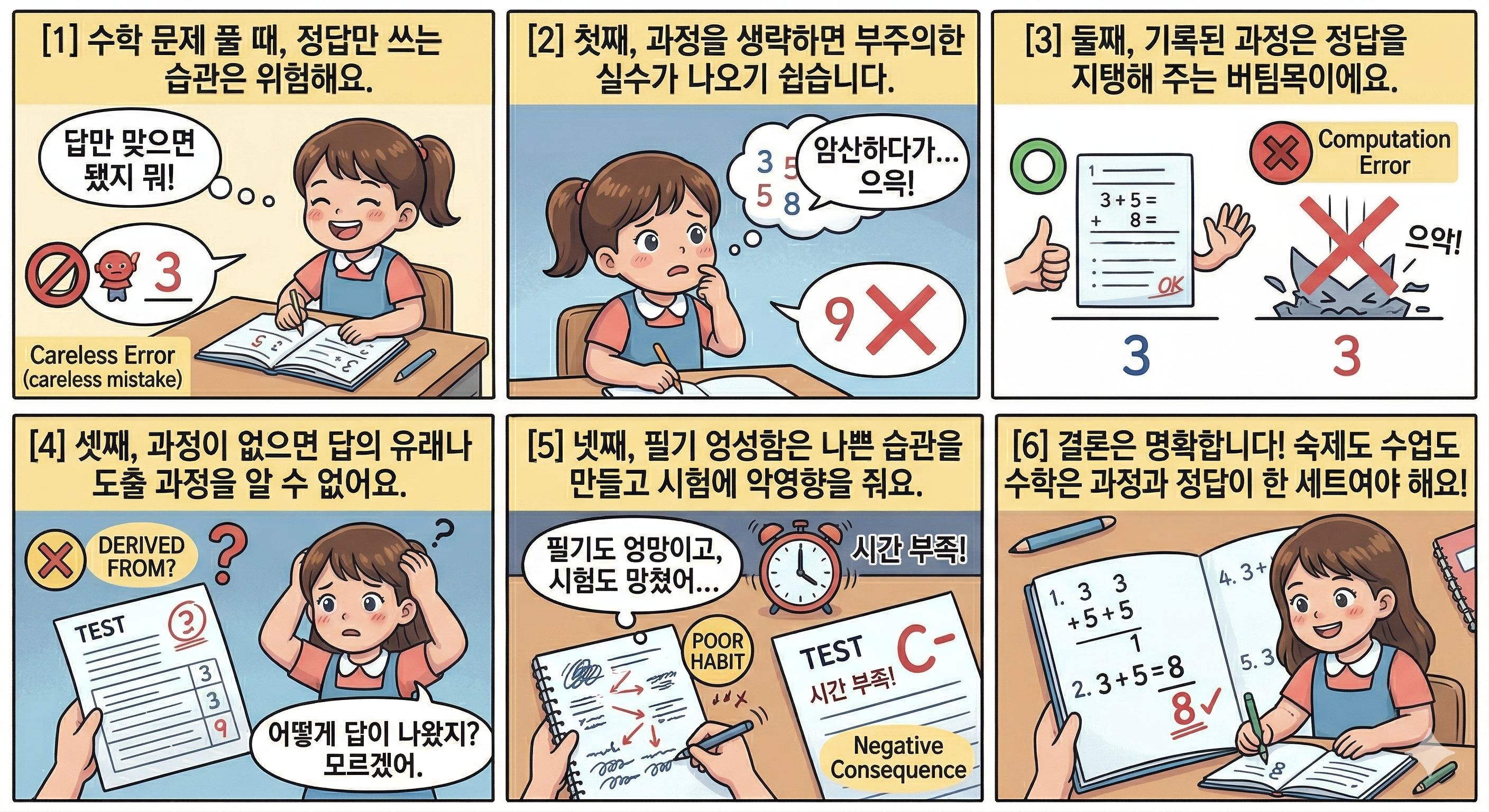
[2] First, simply writing the answer to a problem without the procedure that precedes it negatively encourages students to produce careless errors.
[3] In other words, the written-out procedure supports the answer; if the procedure is not shown, it is much easier to make a computation error.
[4] Second, lack of a written-out procedure does not allow students to identify the origin of an answer or how an answer to a problem is derived.
[5] Third, lack of procedure contributes to poor study habits in note-taking and sloppiness, which may have negative consequences when taking tests.
[6] In short, homework and in-class math assignments should always include both procedures and answers when answering questions.
정답만 적는 것의 위험성
[1] When completing math problems, it is important to avoid “answer-only” completions for several reasons.
풀이 과정 부재와 계산 실수
[2] First, simply writing the answer to a problem without the procedure that precedes it negatively encourages students to produce careless errors.
풀이 과정의 지지 역할
[3] In other words, the written-out procedure supports the answer; if the procedure is not shown, it is much easier to make a computation error.
답의 도출 근거 식별 불가
[4] Second, lack of a written-out procedure does not allow students to identify the origin of an answer or how an answer to a problem is derived.
나쁜 학습 습관으로의 연결
[5] Third, lack of procedure contributes to poor study habits in note-taking and sloppiness, which may have negative consequences when taking tests.
결론: 과정과 정답의 병행
[6] In short, homework and in-class math assignments should always include both procedures and answers when answering questions.
[내용 연결 & 핵심 키워드 통합 정리]
1단계: "정답만 적기"의 위험성 (The Risk of "Answer-Only") 수학 문제를 풀 때 여러 가지 이유로 **"정답만 적는 것(answer-only completions)"**을 피하는 것이 중요합니다. 단순히 답만 적는 행위는 과정의 중요성을 간과하게 만듭니다.
2단계: 과정 기록이 필요한 세 가지 이유 (Three Reasons for Procedures)
- 실수 방지: 과정(procedure)이 없으면 **부주의한 실수(careless errors)**나 **계산 오류(computation error)**가 발생하기 훨씬 쉽습니다.
- 근거 파악: 과정이 없으면 답이 어떻게 도출되었는지(derived), 그 **근원(origin)**이 어디인지를 학생 스스로 확인하기 어렵습니다.
- 습관 형성: 과정 생략은 **나쁜 학습 습관(poor study habits)**과 **부주의함(sloppiness)**으로 이어져 시험에서 **부정적인 결과(negative consequences)**를 초래합니다.
3단계: 올바른 수학 학습 방향 (The Conclusion) 결론적으로, 숙제나 수업 중 과제를 수행할 때 질문에 답하는 과정에서는 **항상 풀이 과정과 정답 모두를 포함(include both procedures and answers)**해야 합니다.
| 주제 (Topic) | The importance of writing out procedures when solving math problems 수학 문제를 풀 때 풀이 과정을 적는 것의 중요성 |
쉽게 암기하는 "3단계 공식“ |
| 제목 (Title) | Beyond the Result: Why the Process Matters in Math 결과 그 이상: 수학에서 과정이 중요한 이유 |
(문제) Answer-only? → No! ❌ (이유) 1. Careless/Computation Errors (실수) 2. Unknown Origin/Derivation (근거 미달) 3. Poor Study Habits (나쁜 습관) (정답) Always Procedures + Answers! ✅ |
| 요약 (Summary) | Writing down the full procedure in math is essential because it prevents careless errors, helps students understand how an answer is derived, and fosters disciplined study habits for better test performance. 수학에서 전체 풀이 과정을 적는 것은 부주의한 실수를 방지하고, 답이 도출되는 방식을 이해하도록 돕고, 더 나은 시험 성적을 위한 절제된 학습 습관을 길러주기 때문에 필수적이다. |
본문 해석 04
[1] 정답만 적는 것의 위험성
When completing math problems (수학 문제를 풀 때), it is important to avoid (피하는 것이 중요하다) “answer-only” completions (정답만 적는 완성을) for several reasons (몇 가지 이유로).
전체 해석: 수학 문제를 풀 때, 몇 가지 이유로 "정답만 적는" 완성 방식을 피하는 것이 중요하다.
- 친구 단어 (의미 단위)
- completing math problems: 수학 문제를 풀다(완수하다)
- answer-only completions: 정답만 적는 완성(방식)
- several reasons: 몇 가지 이유들
- 표현 포인트
- It (가주어) ... to avoid (진주어 - 피하는 것): 수학 학습에서 정답 위주의 나쁜 습관을 경계해야 한다는 이 글의 핵심 주제를 제시합니다.
[2] 풀이 과정 부재와 계산 실수
First (첫째로), simply writing the answer to a problem (단순히 문제의 정답을 쓰는 것은) without the procedure that precedes it (그것에 앞서는 과정 없이) negatively encourages students (학생들에게 부정적으로 부추긴다) to produce careless errors (부주의한 실수를 하도록).
전체 해석: 첫째로, 정답에 앞서는 과정 없이 단순히 문제의 답만 쓰는 것은 학생들이 부주의한 실수를 하도록 부정적으로 부추긴다.
- that: the procedure(풀이 과정)를 수식하는 관계대명사
- it: the answer (정답)
- 친구 단어 (의미 단위)
- precede it: 그것(정답)에 앞서다
- negatively encourage: 부정적으로 부추기다/유도하다
- careless errors: 부주의한 실수들
- 표현 포인트
- procedure that precedes it (그것에 앞서는 과정): 정답이 나오기까지의 논리적 단계를 뜻하며, 이것이 생략될 때의 위험성을 경고합니다.
- encourage A to B (A가 B하도록 부추기다): 'encourage'가 여기서는 실수를 유발한다는 부정적인 맥락으로 쓰였습니다.
[3] 풀이 과정의 지지 역할
In other words (다시 말해서), the written-out procedure (작성된 풀이 과정은) supports the answer (정답을 지지한다); if the procedure is not shown (만약 과정이 보여지지 않는다면), it is much easier (훨씬 더 쉽다) to make a computation error (계산 실수를 하는 것이).
전체 해석: 다시 말해서, 상세히 기록된 풀이 과정은 정답을 뒷받침해 준다. 만약 과정이 제시되지 않는다면, 계산 실수를 하기가 훨씬 더 쉽다.
- 친구 단어 (의미 단위)
- in other words: 다시 말해서 (재진술)
- written-out procedure: 상세히 기록된 과정
- computation error: 계산 실수
- 표현 포인트
- much easier (훨씬 더 쉬운): 비교급 강조 부사 much를 사용하여 풀이 과정이 없을 때 실수가 발생할 확률이 급격히 높아짐을 강조합니다.
[4] 답의 도출 근거 식별 불가
Second (둘째로), lack of a written-out procedure (상세한 풀이 과정의 부족은) does not allow students (학생들에게 허용하지 않는다) to identify the origin of an answer (정답의 기원을 확인하는 것을) or how an answer to a problem is derived (혹은 문제의 정답이 어떻게 도출되었는지를).
전체 해석: 둘째로, 상세한 풀이 과정이 없으면 학생들은 정답의 근원을 확인하거나 문제의 답이 어떻게 도출되었는지를 파악할 수 없다.
- 친구 단어 (의미 단위)
- lack of: ~의 부족/결핍
- identify the origin: 기원(근거)을 확인하다
- is derived: 도출되다 (수동태)
- 표현 포인트
- allow A to B (A가 B하게 허용하다): 과정이 기록되어야만 학생이 자신의 사고 과정을 복기하고 정답의 논리를 이해할 수 있음을 나타냅니다.
[5] 나쁜 학습 습관으로의 연결
Third (셋째로), lack of procedure (과정의 부족은) contributes to poor study habits (좋지 못한 학습 습관의 원인이 된다) in note-taking and sloppiness (노트 필기와 부주의함에 있어서), which may have negative consequences (그리고 그것은 부정적인 결과를 초래할 수 있다) when taking tests (시험을 볼 때).
전체 해석: 셋째로, 과정의 부족은 노트 필기에서의 나쁜 학습 습관과 부주의함의 원인이 되며, 이는 시험을 볼 때 부정적인 결과를 초래할 수 있다.
- which: 앞 문장 전체(나쁜 학습 습관을 갖게 되는 것)를 지칭하는 관계대명사의 계속적 용법
- 친구 단어 (의미 단위)
- contribute to: ~의 원인이 되다 / ~에 기여하다
- poor study habits: 좋지 못한 학습 습관
- negative consequences: 부정적인 결과들
- 표현 포인트
- which (관계대명사의 계속적 용법): 앞 문장 전체(나쁜 학습 습관)를 선행사로 받아, 평소의 사소한 습관이 결국 '시험'이라는 중요한 순간에 악영향을 끼침을 설명합니다.
[6] 결론: 과정과 정답의 병행
In short (요약하자면), homework and in-class math assignments (숙제와 교실 내 수학 과제들은) should always include (항상 포함해야 한다) both procedures and answers (과정과 정답 모두를) when answering questions (질문에 답할 때).
전체 해석: 요약하자면, 수학 숙제와 수업 시간의 과제는 질문에 답할 때 항상 풀이 과정과 정답 모두를 포함해야 한다.
- 친구 단어 (의미 단위)
- in short: 요약하자면
- math assignments: 수학 과제들
- both A and B: A와 B 둘 다
- 표현 포인트
- both procedures and answers (과정과 정답 모두): 이 글의 최종 결론으로, 결과(answer)만큼이나 과정(procedure)의 가치가 중요함을 재차 강조하며 마무리합니다.
'고1 > ebs 리딩파워 유형편 기본' 카테고리의 다른 글
| ebs 리딩파워 유형편 unit 03 - 01 (0) | 2026.03.25 |
|---|---|
| ebs 리딩파워 유형편 unit 03 - EXAMPLE (0) | 2026.03.25 |
| ebs 리딩파워 유형편 unit 02 - 03 (0) | 2026.03.13 |
| ebs 리딩파워 유형편 unit 02 - 02 (0) | 2026.03.13 |
| ebs 리딩파워 유형편 unit 02 - 01 (0) | 2026.03.12 |