24. 다음 글의 제목으로 가장 적절한 것은? [3점]
Habits aren’t bad. We need them to survive. Understanding how the brain uses habits, and how you can work with them, is essential for business. One question to ask is, are you really trying to break a habit, or would you do better by attaching to another one (known as temptation bundling)? Wharton professor Katy Milkman led a research project called Holding the Hunger Games Hostage at the Gym, where participants could only have access to their audio devices while at the gym. This uses a tempting habit — listening to that awesome audiobook — and combines it with a habit people would like to build, but may otherwise feel forced to put off, like exercising. The participants whose devices were “held hostage” were 51 percent more likely to visit the gym. And the really amazing thing is what happened after it was over: nearly two-thirds opted to pay to have gym only access for their devices!
* temptation: 유혹 ** hostage: 볼모
① Stop Thinking and Just Go to the Gym Now!
- (해석) 생각은 그만하고 지금 바로 체육관으로 가라!
- [구문/숙어] stop ~ing : ~하는 것을 그만두다 / go to A : A에 가다
- [친구 단어] thinking(생각하기), gym(체육관)
② Avoid Listening to Music While You Work Out
- (해석) 운동하는 동안 음악을 듣는 것을 피하라
- [구문/숙어] avoid ~ing : ~하는 것을 피하다 / work out : 운동하다 / while ~ : ~하는 동안(접속사)
- [친구 단어] listening to music(음악 듣기)
③ Why Smart Businesses Focus on Healthcare Service
- (해석) 영리한 기업들이 건강관리 서비스에 집중하는 이유
- [구문/숙어] focus on A : A에 집중하다 / healthcare service : 건강관리 서비스
- [친구 단어] smart(영리한), business(기업/사업)
④ The Key to Success in Life: Give Up Everyday Hobbies
- (해석) 인생 성공의 열쇠: 매일의 취미를 포기하라
- [구문/숙어] key to A : A의 열쇠(비결) / give up A : A를 포기하다
- [친구 단어] success(성공), everyday hobby(매일의 취미)
⑤ Pairing Pleasure with Effort: Guiding People to New Behavior
- (해석) 즐거움과 노력을 결합하기: 사람들을 새로운 행동으로 안내하기
- [구문/숙어] pair A with B : A와 B를 결합하다(짝을 짓다) / guide A to B : A를 B로 안내하다
- [친구 단어] pleasure(즐거움), effort(노력), behavior(행동)
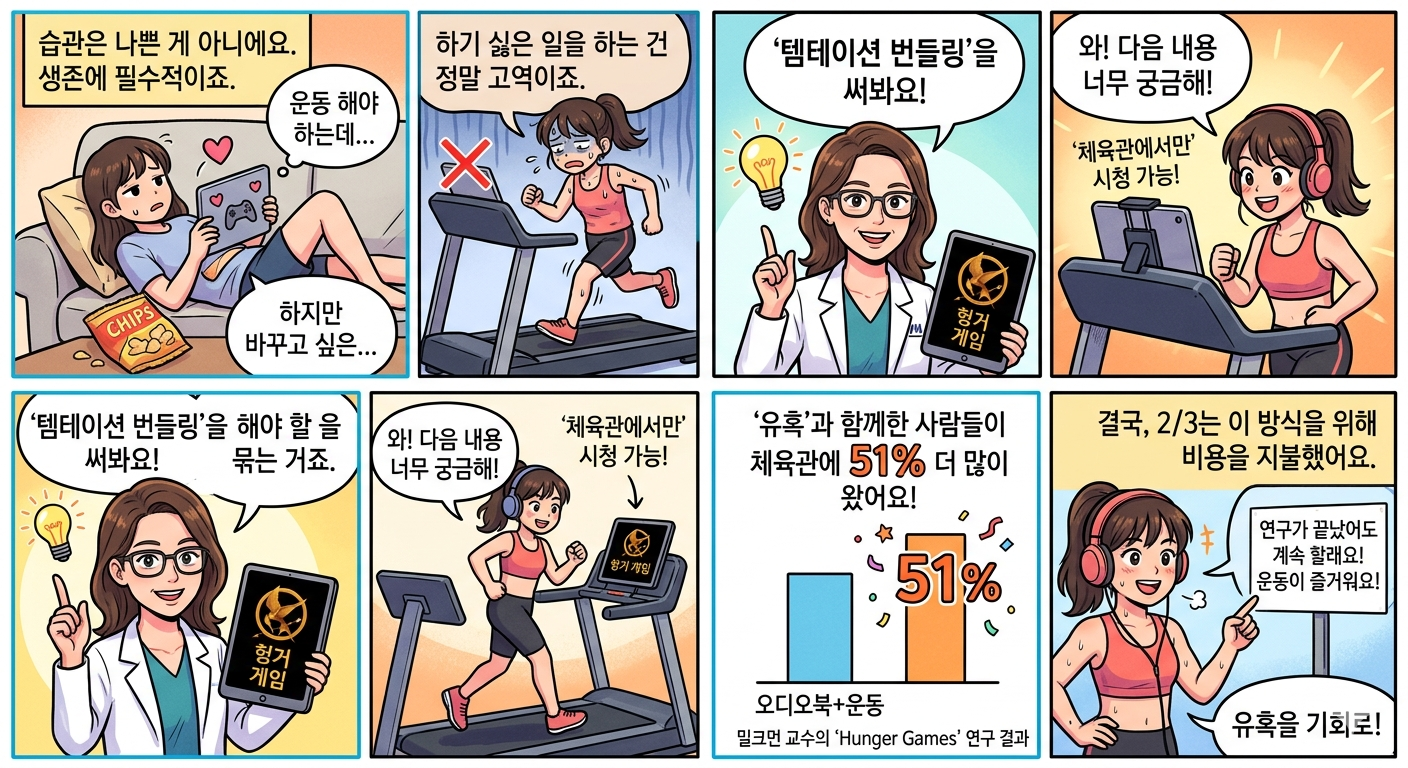
[1] Habits aren’t bad. We need them to survive.
[2] Understanding how the brain uses habits, and how you can work with them, is essential for business.
[3] One question to ask is, are you really trying to break a habit, or would you do better by attaching to another one (known as temptation bundling)?
[4] Wharton professor Katy Milkman led a research project where participants could only have access to their audio devices while at the gym.
[5] This uses a tempting habit — listening to that awesome audiobook — and combines it with a habit people would like to build, but may otherwise feel forced to put off, like exercising.
[6] The participants whose devices were “held hostage” were 51 percent more likely to visit the gym.
[7] And the really amazing thing is what happened after it was over: nearly two-thirds opted to pay to have gym-only access for their devices!
[내용 연결 & 핵심 키워드 통합 정리]
1단계: 습관의 필요성과 비즈니스적 가치 (Necessity & Business)
습관은 생존에 필수적이며 나쁜 것이 아닙니다. 뇌가 습관을 어떻게 사용하는지 이해하고 이를 활용하는 것은 비즈니스에서 매우 **필수적(essential)**입니다.
2단계: 유혹 묶기 전략의 원리 (Mechanism: Temptation Bundling)
나쁜 습관을 끊으려 애쓰기보다, 새로운 습관을 다른 것에 붙이는(attaching) 것이 더 효과적일 수 있습니다. 이를 **'유혹 묶기(temptation bundling)'**라고 합니다. 하고 싶은 일(audiobook)과 해야 하지만 미루고 싶은 일(gym)을 하나로 결합하는 방식입니다.
3단계: 실험 결과와 지속적인 효과 (Result & Continuity)
실험 결과, 오디오 장치를 체육관에서만 쓰도록 '인질로 잡힌(held hostage)' 집단은 체육관 방문 확률이 51%나 더 높았습니다. 더 놀라운 점은 실험이 끝난 후에도 참여자의 2/3가 그 제한적인 환경을 유지하기 위해 기꺼이 비용을 지불하기로 했다는 사실입니다.
쉽게 암기하는 "공식“
- (전략) Temptation Bundling = Want to do + Should do 🔗
- (실험) Audiobooks (Tempting) + Gym (Forced to put off) 🏋️♂️🎧
- (결과) 51% ↑ Visit Rate (Effective Strategy) ✅
- (지속) 2/3 Opted to pay (Voluntary restriction) 💸
주제·제목·요약
주제 (Topic)
The effectiveness of temptation bundling in building new habits
새로운 습관 형성에 있어 유혹 묶기의 효과성
제목 (Title)
Combine Want with Should: The Secret of Temptation Bundling
하고 싶은 것과 해야 하는 것을 결합하라: 유혹 묶기의 비밀
요약 (Summary)
Temptation bundling, which combines a desirable activity with a behavior one wants to improve, is a highly effective way to build habits, as shown by participants' increased gym attendance when their entertainment was restricted to workout sessions.
바람직한 활동과 개선하고 싶은 행동을 결합하는 '유혹 묶기'는 습관 형성에 매우 효과적인데, 이는 운동 중에만 오디오 장치 사용을 제한했을 때 체육관 방문율이 크게 증가한 실험 결과를 통해 증명된다.
"공부할 때만 제일 맛있는 간식을 먹는 것"
💡 팁: [4]번 문장의 "held hostage"(인질로 잡힌)라는 표현은 비유적인 표현으로, 특정 장소(gym)에서만 즐거움을 허용하는 '강제적 환경 설정'을 의미합니다. 문맥 파악 문제로 자주 나오니 꼭 체크해 두세요!
🏋️ 유혹 묶기(Temptation Bundling): 새로운 습관을 만드는 전략
습관의 필요성과 비즈니스적 중요성
[1] Habits aren’t bad (습관은 나쁜 것이 아니다). /
습관은 나쁜 것이 아니다.
[2] We need them to survive (우리는 생존하기 위해 그것들이 필요하다). /
우리는 생존하기 위해 습관이 필요하다.
survive: 생존하다
[3] Understanding how the brain uses habits (뇌가 어떻게 습관을 사용하는지 이해하는 것), / and how you can work with them (그리고 당신이 어떻게 그것들을 활용할 수 있는지는), / is essential for business (비즈니스에 필수적이다).
뇌가 습관을 어떻게 사용하는지, 그리고 당신이 그것들을 어떻게 활용할 수 있는지를 이해하는 것은 비즈니스에 있어 필수적이다.
[동명사구 - 주어역할1] Understanding how the brain uses habits
and
[의문사절 - 주어역할2] how you can work with them
[동사 - 단수취급] is
Understanding ~ and how ... (동명사구 주어): '~을 이해하는 것' (단수 취급하여 is 사용)
친구 단어 (의미 단위)
essential: 필수적인
be essential for 명사: ~에 필수적이다
work with: ~을 활용하다 / ~와 함께 일하다
표현 포인트
Understanding... and how... is (이해하는 것과 방법은 ~이다): 동명사 주어(Understanding)와 의문사절(how...)이 병렬 구조로 쓰여 비즈니스 성공을 위한 두 가지 핵심 요소를 제시합니다.
유혹 묶기 전략의 제안
[4] One question to ask OX is (던져야 할 한 가지 질문은 ~이다), / are you really trying to break a habit (당신이 정말로 습관을 고치려고 노력하고 있는가), / or would you do better (아니면 더 잘할 것인가) / by attaching to another one (또 다른 습관에 덧붙임으로써) / (known as temptation bundling)?
던져야 할 한 가지 질문은, 당신이 정말로 습관을 고치려고 노력하고 있는 것인지, 아니면 (유혹 묶기라고 알려진) 또 다른 습관에 덧붙임으로써 더 잘 해낼 것인지이다.
another one: another habit (또 다른 습관)
known as: '~라고 알려진' (과거분사구)
친구 단어 (의미 단위)
break a habit: 습관을 깨다
attach to 명사: ~에 덧붙이다 / 첨부하다
At- (Attach): "~쪽으로"라는 뜻이라서, 가까이 가서 찰떡같이 붙는 느낌이야.
De- (Detach): "반대로" 혹은 "멀리"라는 뜻이라서, 원래 있던 곳에서 멀어지는 느낌이야.
Attach: ➕ (더하기 / 붙이기)
Detach: ➖ (빼기 / 떼기)
Attach (At + tach)
At (~쪽으로) + tach (박다/붙이다)뜻: ~쪽으로 붙이다.
이미지: 벽에 못을 박아서 액자를 걸어두는 모습!
Detach (De + tach)
De (반대로/떨어져) + tach (박다/붙이다)뜻: 박혀 있던 걸 떼어내다.
이미지: 벽에 박힌 못을 장도리로 쑥 뽑아내는 모습!
temptation bundling: 유혹 묶기 (핵심 키워드)
표현 포인트
temptation bundling (유혹 묶기): 하고 싶은 일(유혹)과 해야 하는 일(습관)을 결합하여 시너지를 내는 기법을 정의합니다.
'헝거 게임' 실험 사례
[5] Wharton professor Katy Milkman (와튼 스쿨의 Katy Milkman 교수는) / led a research project (연구 프로젝트를 이끌었다) / called Holding the Hunger Games Hostage at the Gym ( ‘체육관에 헝거 게임 인질로 잡아두기’라고 불리는), / where participants could only have access to their audio devices (그곳에서 참가자들은 오직 그들의 오디오 기기에만 접속할 수 있었다) / while at the gym (체육관에 있는 동안에만).
와튼 스쿨의 Katy Milkman 교수는 ‘체육관에 헝거 게임 인질로 잡아두기’라는 연구 프로젝트를 이끌었는데, 이 프로젝트에서 참가자들은 체육관에 있는 동안에만 그들의 오디오 기기를 사용할 수 있었다.
call A B: A를 B라고 부르다
be called B: B라고 불리다
called B: ~라고 불리는
called O.C명사: '~라고 불리는'
where: research project를 부연 설명하는 관계부사
친구 단어 (의미 단위)
led a research project: 연구 프로젝트를 이끌다
holding ... hostage: ~을 인질로 잡다
have access to 명사: ~에 접근하다 / ~을 이용하다
표현 포인트
where (관계부사): 'research project'를 선행사로 받아 실험의 구체적인 제한 조건을 설명합니다.
Holding ... Hostage (인질로 잡기): 재미있는 오디오북(유혹)을 체육관(장소)에 묶어둠으로써 운동을 강제하는 전략을 비유적으로 표현했습니다.
유혹적인 습관과 형성하고 싶은 습관의 결합
[6] This uses a tempting habit (이것은 유혹적인 습관을 이용한다) / — listening to that awesome audiobook — (그 멋진 오디오북을 듣는 것과 같은) / and combines it (그리고 그것을 결합한다) / with a habit people would like to build OX (사람들이 형성하고 싶어 하는 습관과), / but may otherwise feel forced to put off (하지만 그렇지 않으면 미뤄야 한다고 느낄 수도 있는), / like exercising (운동하기와 같은).
이것은 그 멋진 오디오북을 듣는 것과 같은 유혹적인 습관을 이용하며, 그것을 운동하기와 같이 사람들이 형성하고 싶어 하지만 그렇지 않으면 미루고 싶어 할 수도 있는 습관과 결합한다.
combines A with B: A와 B를 결합하다
put off: 미루다, 연기하다
친구 단어 (의미 단위)
tempting habit: 유혹적인 습관
combines A with B: A와 B를 결합하다
build a habit: 습관을 만들다
break a habit: 습관을 고치다
force A to V: A가 ~하도록 강요하다
be forced to V: ~하도록 강요받다
forced to V: ~하도록 강요받는
feel forced to V: ~하도록 강요받는다고 느끼다
put off: 미루다, 연기하다
Postpone [포스트폰]: 공식적으로 "일정을 미루다"라는 뜻이야. (예: 비가 와서 경기를 미룰 때)
Delay [딜레이]: 무언가 때문에 늦어지거나 미뤄지는 거야. (예: 비행기가 늦게 뜰 때)
Procrastinate [프로크래스티네이트]: 이건 진짜 '하기 싫어서' 꾸물꾸물 미루는 거야. ('미루기 대장'이라는 뜻으로 많이 써!)
표현 포인트
otherwise (그렇지 않으면): 유혹 묶기를 하지 않았을 때 사람들이 겪을 수 있는 '미루기 습관'을 가정합니다.
otherwise가 가리키는 것은:
영어: without combining it with a tempting habit (또는 without temptation bundling)
우리말: 유혹적인 습관(오디오북 듣기 등)과 결합하지 않는다면
실험 결과와 지속적인 효과
[7] The participants [whose devices were “held hostage”] ( [기기가 “인질로 잡힌”] 참가자들은) / were 51 percent more likely to visit the gym (체육관에 방문할 가능성이 51% 더 높았다). /
기기가 “인질로 잡힌” 참가자들은 체육관을 방문할 확률이 51%나 더 높았다.
whose: 소유격 관계대명사 (참가자들의 기기)
[8] And the really amazing thing is (그리고 정말 놀라운 점은) / what happened after it was over (그것이 끝난 후에 일어난 일이다): / nearly two-thirds opted to pay (거의 3분의 2가 비용을 지불하는 것을 선택했다) / to have gym-only access for their devices! (그들의 기기를 체육관에서만 사용할 수 있도록 하기 위해!)
그리고 정말 놀라운 점은 실험이 끝난 후에 일어난 일인데, 거의 3분의 2에 달하는 사람들이 자신의 기기를 체육관에서만 사용할 수 있도록 비용을 지불하는 쪽을 선택했다는 것이다!
친구 단어 (의미 단위)
more likely to V: ~할 가능성이 더 높은
after it was over: 그것이 끝난 후에
nearly two-thirds: 거의 3분의 2
opted to V: ~하는 것을 선택하다
표현 포인트
opted to pay (비용 지불을 선택했다): 실험이 강제성이 있었음에도 불구하고, 스스로 그 제약을 유지하려 했다는 점에서 '유혹 묶기'의 강력한 효능을 입증합니다.
지문의 요지: 하고 싶은 일(유혹)과 해야 하는 일(습관)을 하나로 묶는 '유혹 묶기' 전략은 새로운 습관을 형성하는 데 매우 효과적이며, 실험 종료 후에도 지속될 만큼 강력한 동기부여가 됩니다.
1. 다음 글의 빈칸에 들어갈 말로 가장 적절한 것은?
Habits aren’t bad. We need them to survive. Understanding how the brain uses habits, and how you can work with them, is essential for business. One question to ask is, are you really trying to break a habit, or would you do better by attaching to another one (known as temptation bundling)? Wharton professor Katy Milkman led a research project where participants could only have access to their audio devices while at the gym. This uses a tempting habit — listening to that awesome audiobook — and ____________________________________________________. The participants whose devices were “held hostage” were 51 percent more likely to visit the gym. And the really amazing thing is what happened after it was over: nearly two-thirds opted to pay to have gym-only access for their devices!
① limits the total amount of time spent on leisure activities
② completely replaces a bad habit with a newly formed one
③ couples it with a habit you want to build but tend to delay
④ forces participants to abandon their favorite audio devices
⑤ makes people realize the negative effects of digital media
2. 글의 흐름으로 보아, 주어진 문장이 들어가기에 가장 적절한 곳은?
[주어진 문장] This uses a tempting habit — listening to that awesome audiobook — and combines it with a habit people would like to build, but may otherwise feel forced to put off, like exercising.
Habits aren’t bad. We need them to survive. Understanding how the brain uses habits, and how you can work with them, is essential for business. ( ① ) One question to ask is, are you really trying to break a habit, or would you do better by attaching to another one (known as temptation bundling)? ( ② ) Wharton professor Katy Milkman led a research project where participants could only have access to their audio devices while at the gym. ( ③ ) The participants whose devices were “held hostage” were 51 percent more likely to visit the gym. ( ④ ) And the really amazing thing is what happened after it was over: ( ⑤ ) nearly two-thirds opted to pay to have gym-only access for their devices!
3. 다음 글의 밑줄 친 부분 중, 문맥상 낱말의 쓰임이 적절하지 않은 것은?
Habits aren’t bad. We need them to survive. Understanding how the brain uses habits, and how you can work with them, is ①essential for business. One question to ask is, are you really trying to break a habit, or would you do better by ②attaching to another one (known as temptation bundling)? Wharton professor Katy Milkman led a research project where participants could only have access to their audio devices while at the gym. This uses a tempting habit — listening to that awesome audiobook — and combines it with a habit people would like to build, but may otherwise feel forced to ③postpone, like exercising. The participants whose devices were “held hostage” were 51 percent ④less likely to visit the gym. And the really amazing thing is what happened after it was over: nearly two-thirds ⑤opted to pay to have gym-only access for their devices!
💡 [정답 및 출제 포인트 분석]
[문제 1번 정답] ③ couples it with a habit you want to build but tend to delay
- 출제 의도: '유혹 묶기'의 정확한 작동 원리(좋아하는 것 + 해야 하지만 미루고 싶은 것)를 설명한 문장을 유의어로 패러프레이징할 수 있는지 묻는 빈칸 추론입니다.
- 해설: 원문의 combines를 couples로, feel forced to put off를 tend to delay로 변형했습니다. 본문의 내용을 정확히 이해하고 어휘력까지 갖춰야 풀 수 있는 1등급 변별력 문항입니다.
[문제 2번 정답] ③
- 출제 의도: 지시대명사 This가 가리키는 구체적인 실험 내용을 논리적으로 연결하는 문장 삽입 문제입니다.
- 해설: 주어진 문장의 This는 바로 앞 문장(②번 뒤)에 나오는 Katy Milkman 교수의 실험 세팅(체육관에서만 오디오 기기 접근 가능)을 가리킵니다. 또한, 주어진 문장에서 오디오북과 운동을 결합했다는 설명이 나온 직후에, 그 결과로 체육관 방문 확률이 높아졌다는 내용(③번 뒤 문장)이 이어져야 논리적 인과관계가 완벽하게 성립합니다.
[문제 3번 정답] ④ less (원문: more)
- 출제 의도: 실험의 최종 결과(유혹 묶기의 긍정적 효과)를 정반대로 뒤집어 놓은 어휘 문제입니다.
- 해설: 좋아하는 오디오북을 듣기 위해 체육관에 가야만 하는 상황(인질로 잡힌 상황)이 되었으므로, 사람들은 체육관에 갈 확률이 51% '더 높아졌다(more likely)'가 되어야 합니다. 이를 '덜 하게 되었다(less likely)'로 바꾸면 글의 주제와 정면으로 충돌합니다. (※ 참고로 ③번의 postpone은 원문의 put off를 알맞은 동의어로 변형한 것입니다.)
1. 다음 글의 제목으로 가장 적절한 것은? [2.6점]
Habits aren’t bad. We need them to survive. Understanding how the brain uses habits, and how you can work with them, is essential for business. One question to ask is, are you really trying to break a habit, or would you do better by attaching to another one (known as temptation bundling)? Wharton professor Katy Milkman led a research project where participants could only have access to their audio devices while at the gym. This uses a tempting habit — listening to that awesome audiobook — and combines it with a habit people would like to build, but may otherwise feel forced to put off, like exercising. The participants whose devices were “held hostage” were 51 percent more likely to visit the gym. And the really amazing thing is what happened after it was over: nearly two-thirds opted to pay to have gym-only access for their devices!
① Why We Need to Break Our Bad Habits Quickly
② Temptation Bundling: A Clever Strategy to Build New Habits
③ The Side Effects of Listening to Audiobooks at the Gym
④ How Financial Rewards Affect Your Exercise Routine
⑤ The Hidden Danger of Forcing Yourself to Work Out
2. 다음 글의 밑줄 친 부분 중, 문맥상 낱말의 쓰임이 적절하지 않은 것은? [3.1점]
Habits aren’t bad. We need them to ① survive. Understanding how the brain uses habits, and how you can work with them, is ② essential for business. One question to ask is, are you really trying to break a habit, or would you do better by attaching to another one (known as temptation bundling)? Wharton professor Katy Milkman led a research project where participants could only have access to their audio devices while at the gym. This uses a ③ tempting habit — listening to that awesome audiobook — and combines it with a habit people would like to build, but may otherwise feel ④ forced to put off, like exercising. The participants whose devices were “held hostage” were 51 percent ⑤ less likely to visit the gym. And the really amazing thing is what happened after it was over: nearly two-thirds opted to pay to have gym-only access for their devices!
[서술형 1번] 다음 글을 읽고, 밑줄 친 우리말의 의미에 맞게 영어로 작성하시오. [6점]
Habits aren’t bad. We need them to survive. Understanding how the brain uses habits, and how you can work with them, is essential for business. One question to ask is, are you really trying to break a habit, or would you do better by attaching to another one (known as temptation bundling)? Wharton professor Katy Milkman led a research project where participants could only have access to their audio devices while at the gym. This uses a tempting habit — listening to that awesome audiobook — and combines it with a habit people would like to build, but may otherwise feel forced to put off, like exercising. <기기가 "인질로 잡힌" 참가자들은 체육관에 방문할 가능성이 51퍼센트 더 높았다.> And the really amazing thing is what happened after it was over: nearly two-thirds opted to pay to have gym-only access for their devices!
[ 조 건 ]
- 소유격 관계대명사 whose를 사용하여 주어를 수식할 것.
- be likely to 구문 및 수동태를 활용할 것.
- 아래 [ 보기 ]에 주어진 11개의 어구들을 모두 한 번씩만 사용할 것 (어형 변화 불가).
[ 보 기 ] 51 percent / devices / the gym / participants / "held hostage" / more likely / were / The / to visit / were / whose
⇨ _____________________________________________________________________________.
정답 및 해설
1. 정답: ②
- 해설: 이 글은 오디오북 듣기라는 '매력적인 습관'을 운동이라는 '형성하고 싶은 습관'과 결합하는 '유혹 묶기(temptation bundling)'의 효과를 설명하고 있습니다. 따라서 "유혹 묶기: 새로운 습관을 형성하기 위한 영리한 전략"이 제목으로 가장 적절합니다.
2. 정답: ⑤ (less ⇨ more)
- 해설: 실험 내용상 오디오북을 듣기 위해 체육관에 가야만 하는 제한(인질)이 걸린 참가자들이 체육관을 방문할 확률이 51% '더 높았다(more likely)'고 해야 글의 전체적인 논리(유혹 묶기의 긍정적 효과)에 부합합니다.
3. 정답: The participants whose devices were "held hostage" were 51 percent more likely to visit the gym.
- 해설 및 지도 포인트: * whose devices (그들의 기기가 ~한) 형태의 소유격 관계대명사절이 주어 The participants를 수식하는 구조.
- were held hostage (인질로 잡히다)의 수동태 표현.
- be more likely to (~할 가능성이 더 높다) 숙어의 활용.
- 원장님께서 늘 수업 시간에 강조하시는 '친구단어' 위주의 바른 해석 및 영작이 제대로 체화되었는지 확인하기 딱 좋은 문장입니다. 아이들이 whose devices were held hostage를 하나의 덩어리로 묶어서 주어를 수식하도록 지도해 주시면 실전에서 실수를 줄일 수 있습니다.
'고1 > 고1 3월 모의고사' 카테고리의 다른 글
| 2026년 고1 3월 모의고사 영어 30번 해설 및 분석 변형문제 (0) | 2026.03.26 |
|---|---|
| 2026년 고1 3월 모의고사 영어 29번 해설 및 분석 변형문제 (0) | 2026.03.26 |
| 2026년 고1 3월 모의고사 영어 23번 해설 및 분석 변형문제 (0) | 2026.03.24 |
| 2026년 고1 3월 모의고사 영어 22번 해설 및 분석 (0) | 2026.03.24 |
| 2026년 고1 3월 모의고사 영어 21번 해설 및 분석 변형문제 (0) | 2026.03.24 |