32. Students often mistake familiarity with true mastery, creating a dangerous “illusion of competence” where recognizing information feels like genuine knowledge, but they struggle when asked to recall or apply it independently. This cognitive bias, strengthened by passive study methods, leads learners to overestimate their understanding. Teaching materials (even informally or imaginatively) actively counters this illusion by requiring deep processing, active recall, structured organization, and revealing gaps in knowledge. It introduces powerful methods like teaching imaginary students, peerteaching in study groups, employing the Feynman Technique, and writing explanations for others. Ultimately, ______________ transforms surface familiarity into real mastery, exposing and filling gaps in knowledge and ensuring solid, reliable understanding.
① adopting the teacher mindset
- (해석) 교사의 사고방식(마음가짐)을 채택하기
- [구문/숙어] adopt A : A를 채택하다(받아들이다) / teacher mindset : 교사의 사고방식
- [친구 단어] perspective(관점), teaching approach(교수법)
② using leisure time effectively
- (해석) 여가 시간을 효과적으로 사용하기
- [구문/숙어] use A effectively : A를 효과적으로 사용하다 / leisure time : 여가 시간
- [친구 단어] efficiency(효율성), free time(자유 시간)
③ activating background knowledge
- (해석) 배경지식을 활성화하기
- [구문/숙어] activate A : A를 활성화하다 / background knowledge : 배경지식
- [친구 단어] prior knowledge(이전 지식), schema(스키마)
④ supporting the emotional stability
- (해석) 정서적 안정을 지원하기
- [구문/숙어] support A : A를 지원하다(지지하다) / emotional stability : 정서적 안정
- [친구 단어] psychological well-being(심리적 안녕), calm(차분한)
⑤ reducing the amount of studying time
- (해석) 공부 시간의 양을 줄이기
- [구문/숙어] reduce A : A를 줄이다 / amount of A : A의 양
- [친구 단어] decrease(감소시키다), study load(학습량)
[1] Students often mistake familiarity with true mastery, creating a dangerous “illusion of competence” where recognizing information feels like genuine knowledge.
[2] This cognitive bias, strengthened by passive study methods, leads learners to overestimate their understanding.
[3] Teaching materials actively counters this illusion by requiring deep processing, active recall, and revealing gaps in knowledge.
[4] It introduces powerful methods like teaching imaginary students, peer-teaching, and employing the Feynman Technique.
[5] Ultimately, adopting the teacher mindset transforms surface familiarity into real mastery.
[6] This process exposes and fills gaps in knowledge, ensuring solid, reliable understanding.
[내용 연결 & 핵심 키워드 통합 정리]
1단계: '유능감의 착각'이라는 함정 (The Illusion of Competence)
학생들은 단순히 눈에 익은 **익숙함(familiarity)**을 내용을 완전히 이해한 **통달(true mastery)**로 흔히 착각합니다. 이를 **'유능감의 착각(illusion of competence)'**이라 하며, 정보를 알아보는 것(recognition)을 진짜 지식으로 오해하는 위험한 **인지적 편향(cognitive bias)**입니다.
2단계: 수동적 학습의 한계 (Passive vs. Active)
읽기만 하는 등의 **수동적 학습 방법(passive study methods)**은 자신의 이해도를 **과대평가(overestimate)**하게 만듭니다. 반면, 누군가를 **가르치는 행위(teaching materials)**는 지식을 체계화하고 **심층적인 처리(deep processing)**와 **능동적 회상(active recall)**을 요구하므로 이러한 착각을 깨부숩니다.
3단계: 가르치기 전략과 진정한 통달 (Teaching Mindset & Mastery)
가상의 학생을 가르치거나, 스터디 그룹에서 친구를 가르치기, 혹은 어려운 개념을 쉽게 설명하는 파인만 기법(Feynman Technique) 등을 활용해 보세요. **교사의 마음가짐(teacher mindset)**을 가지면 자신이 모르는 **지식의 빈틈(gaps in knowledge)**이 명확히 드러나고, 이를 채움으로써 **견고하고 신뢰할 수 있는 이해(solid, reliable understanding)**에 도달하게 됩니다.
쉽게 암기하는 "공식“
- (착각) Familiarity (눈에 익음) → Mastery (통달) ❌
- (원인) Passive Study → Illusion of Competence (유능감의 착각) 😵
- (해결) Teacher Mindset → Active Recall & Deep Processing 🧠
- (도구) Feynman Technique (쉽게 설명하기) 🗣️
- (결과) Expose & Fill Gaps → Real Mastery ✅
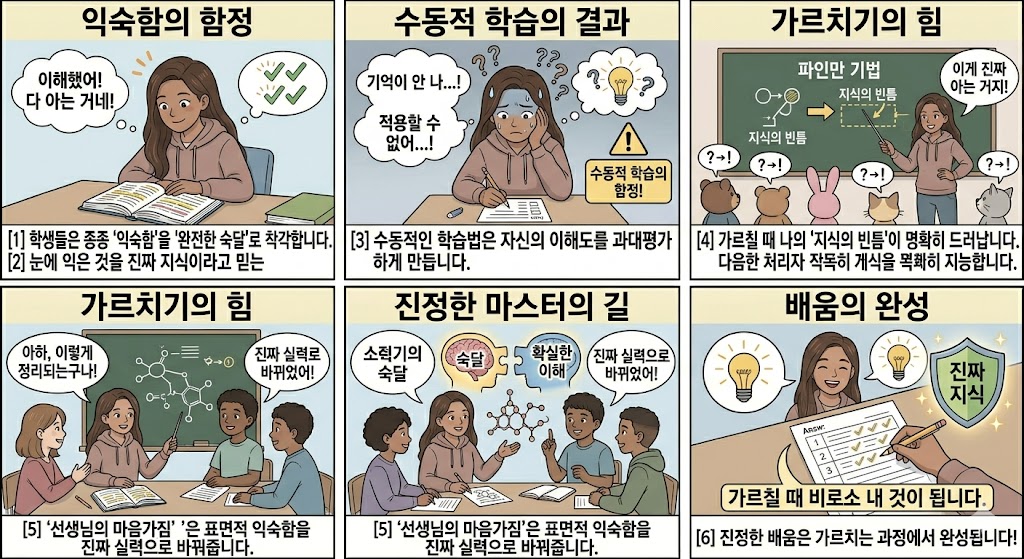
주제·제목·요약
주제 (Topic)
Overcoming the illusion of competence by adopting a teacher mindset
교사의 마음가짐을 가짐으로써 유능감의 착각을 극복하기
제목 (Title)
Don't Just Read, Teach: How to Transform Familiarity into Real Mastery
단지 읽지 말고 가르쳐라: 익숙함을 진정한 통달로 바꾸는 법
요약 (Summary)
To avoid the cognitive bias of overestimating one's knowledge, students should shift from passive studying to a teacher mindset, using methods like the Feynman Technique to expose knowledge gaps and achieve true mastery.
자신의 지식을 과대평가하는 인지적 편향을 피하기 위해, 학생들은 수동적 학습에서 벗어나 교사의 마음가짐으로 전환해야 하며, 파인만 기법과 같은 방법을 통해 지식의 빈틈을 찾아내고 진정한 통달을 이루어야 한다.
"너희가 눈으로만 보는 공부는 진짜가 아니야!"
💡 팁: [4]번 문장의 **"Feynman Technique"**은 복잡한 개념을 어린아이도 이해할 수 있을 만큼 쉽게 설명해 보는 공부법입니다. 이 단어가 지문에 나왔다면 핵심은 항상 **'가르치기를 통한 이해의 점검'**이라는 것을 기억하세요!
🎓 친숙함을 넘어 진정한 숙달로: 가르치는 학습법의 힘
친숙함과 숙달 사이의 위험한 착각
[1] Students often mistake (학생들은 종종 오해한다) / familiarity with true mastery (친숙함을 진정한 숙달로), / creating a dangerous “illusion of competence” (위험한 “능숙함의 환상”을 만들어내면서) / where recognizing information (정보를 알아보는 것이) / feels like genuine knowledge (진정한 지식처럼 느껴지는), / but they struggle (하지만 그들은 고군분투한다) / when asked to recall or apply it independently (그것을 독립적으로 회상하거나 적용하라고 요청받을 때).
학생들은 종종 친숙함을 진정한 숙달로 오해하여, 정보를 알아보는 것이 진정한 지식처럼 느껴지지만 막상 그것을 독립적으로 회상하거나 적용하라고 하면 어려움을 겪는 위험한 “능숙함의 환상”을 만들어낸다.
- mistake A for B : A를 B로 오해하다
- Don't mistake salt for sugar! 소금을 설탕으로 착각하면 안 돼!
- mistake A with B: A를 B로 오해하다
- confuse A with B
- People often confuse Tim with his twin brother." 사람들은 자주 팀과 그의 쌍둥이 형제를 헷갈려 해.
- creating: 분사구문 (결과적으로 ~을 만들어내다)
- where: '능숙함의 환상'이라는 상황을 수식하는 관계부사
- when (they are) asked: 접속사 뒤에 주어+be동사가 생략된 수동태 구문
- ask A to V: A가 ~하도록 요청(요구)하다
- be asked to V: ~하도록 요구받다
- asked to V: ~하도록 요구받은
- when asked to V: ~하도록 요구받을 때
- 친구 단어 (의미 단위):
- mistake A with B: A를 B로 착각하다
- true mastery: 진정한 숙달(실력)
- illusion of competence: 능숙함의 착각 (핵심 용어)
- genuine knowledge: 진짜 지식
- recall or apply: 회상하거나 적용하다
- 표현 포인트:
- [분사구문] creating은 결과나 부대 상황을 나타내며, 착각의 결과로 생기는 상태를 설명합니다.
- [수동태] when (they are) asked to 구조로 "요구받을 때"라는 의미의 덩어리입니다.
수동적 학습이 부르는 인지적 편향
[2] This cognitive bias (이러한 인지적 편향은), / strengthened by passive study methods (수동적인 학습 방법들에 의해 강화된), / leads learners to overestimate their understanding (학습자들이 자신의 이해도를 과대평가하도록 이끈다).
수동적인 학습 방법에 의해 강화되는 이러한 인지적 편향은 학습자들이 자신의 이해 정도를 과대평가하게 만든다.
- strengthened: '강화된' (과거분사구가 주어 수식)
- lead A to V: A가 ~하도록 이끌다
- 친구 단어 (의미 단위):
- cognitive bias: 인지적 편향
- passive study methods: 수동적인 학습 방법들 (눈으로만 보는 공부 등)
- overestimate their understanding: 그들의 이해를 과대평가하다
- 표현 포인트:
- [5형식] lead + 목적어(learners) + 목적보어(to overestimate) 구조로 "A가 B하게 이끌다"라는 핵심 친구입니다.
- This cognitive bias 이 가리키는 것은
가르치는 활동을 통한 능동적 학습
[3] Teaching materials (학습 자료를 가르치는 것은) / (even informally or imaginatively) (심지어 비공식적으로나 상상 속에서라도) / actively counters this illusion (이러한 환상에 능동적으로 대항한다) / by requiring deep processing, active recall, structured organization, (깊은 처리, 능동적 회상, 구조적 조직화를 요구함으로써) / and revealing gaps in knowledge (그리고 지식의 빈틈을 드러냄으로써).
(심지어 비공식적으로나 상상 속에서라도) 학습 자료를 가르치는 것은 깊은 정보 처리, 능동적 회상, 구조적 조직화를 요구하고 지식의 빈틈을 드러냄으로써 이러한 환상에 능동적으로 대처하게 해준다.
- Teaching: 동명사 주어 (~하는 것)
- counter: 반박하다, 대항하다
- by -ing: ~함으로써 (수단/방법)
- 친구 단어 (의미 단위):
- informally or imaginatively: 비공식적으로 혹은 상상 속에서
- actively counters: 능동적으로 대처하다(반격하다)
- deep processing: 깊은 (정보) 처리
- revealing gaps in knowledge: 지식의 틈(빈틈)을 드러내기
- 표현 포인트:
- [병렬 구조] by 뒤에 동명사 덩어리들(requiring, revealing)이 연결되어 가르치기가 주는 구체적인 효과들을 나열합니다.
구체적인 '가르치는 학습'의 방법들
[4] It introduces powerful methods (그것은 강력한 방법들을 도입한다) / like teaching imaginary students (가상의 학생들을 가르치는 것과 같은), / peer-teaching in study groups (스터디 그룹에서의 또래 가르치기), / employing the Feynman Technique (파인만 기법을 사용하는 것), / and writing explanations for others (그리고 타인을 위해 설명을 써보는 것과 같은).
그것은 가상의 학생 가르치기, 스터디 그룹에서의 또래 학습, 파인만 기법 활용, 타인을 위한 설명 작성과 같은 강력한 방법들을 도입하게 한다.
- like: ~와 같은 (전치사 뒤 동명사 병렬 구조: teaching, employing, writing)
- 친구 단어 (의미 단위):
- imaginary students: 상상 속의(가상의) 학생들
- peer-teaching: 또래 가르치기
- employing the Feynman Technique: 파인만 기법을 고용(사용)하기
- writing explanations for others: 타인을 위해 설명을 쓰기
- 표현 포인트:
- [예시 나열] like 뒤에 구체적인 학습 전략 덩어리들을 나열하여 "가르치는 학습법"의 실체를 보여줍니다.
결론: '교사의 마음가짐'이 주는 진정한 이해
[5] Ultimately (궁극적으로), / adopting the teacher mindset (교사의 마음가짐을 채택하는 것은) / transforms surface familiarity into real mastery (표면적인 친숙함을 진정한 숙달로 변모시킨다), / exposing and filling gaps in knowledge (지식의 빈틈을 노출하고 채우면서) / and ensuring solid, reliable understanding (그리고 견고하고 믿을 수 있는 이해를 보장하면서).
궁극적으로, 교사의 마음가짐을 갖는 것은 지식의 빈틈을 드러내어 채우고 견고하며 신뢰할 수 있는 이해를 보장함으로써, 표면적인 친숙함을 진정한 숙달로 변화시킨다.
- adopting: 동명사 주어
- transform A into B: A를 B로 변화시키다
- exposing / filling / ensuring: 분사구문의 병렬 구조 (~하면서)
- 친구 단어 (의미 단위):
- adopting the teacher mindset: 교사의 마음가짐을 채택(채용)하다
- transforms A into B: A를 B로 변모시키다
- surface familiarity: 표면적인 익숙함
- solid, reliable understanding: 단단하고 신뢰할 수 있는(확실한) 이해
- 표현 포인트:
- [핵심 숙어] transform A into B는 대조적인 변화를 나타낼 때 쓰는 아주 중요한 친구입니다.
- [분사구문] exposing, filling, ensuring 세 개의 덩어리가 병렬로 연결되어 real mastery가 되는 과정을 설명합니다.
지문의 요지: 단순히 눈에 익은 '친숙함'을 안다고 착각하는 '능숙함의 환상'을 깨기 위해서는, 남을 가르치듯 설명하는 능동적인 학습법(파인만 기법 등)을 통해 지식의 빈틈을 확인하고 진정한 숙달의 단계로 나아가야 합니다.
1. 다음 글의 빈칸에 들어갈 말로 가장 적절한 것은?
Students often mistake familiarity with true mastery, creating a dangerous “illusion of competence” where recognizing information feels like genuine knowledge. This cognitive bias, strengthened by passive study methods, leads learners to overestimate their understanding. Teaching materials actively counters this illusion by requiring deep processing, active recall, and revealing gaps in knowledge. It introduces powerful methods like teaching imaginary students, peer-teaching, and employing the Feynman Technique. Ultimately, adopting the teacher mindset ____________________________________. This process exposes and fills gaps in knowledge, ensuring solid, reliable understanding.
① reinforces the passive study methods they prefer
② turns superficial recognition into genuine understanding
③ creates a stronger illusion of competence in their brains
④ allows learners to memorize data without deep processing
⑤ makes students focus on memorizing rather than teaching
2. 글의 흐름으로 보아, 주어진 문장이 들어가기에 가장 적절한 곳은?
[주어진 문장] It introduces powerful methods like teaching imaginary students, peer-teaching, and employing the Feynman Technique.
Students often mistake familiarity with true mastery, creating a dangerous “illusion of competence” where recognizing information feels like genuine knowledge. ( ① ) This cognitive bias, strengthened by passive study methods, leads learners to overestimate their understanding. ( ② ) Teaching materials actively counters this illusion by requiring deep processing, active recall, and revealing gaps in knowledge. ( ③ ) Ultimately, adopting the teacher mindset transforms surface familiarity into real mastery. ( ④ ) This process exposes and fills gaps in knowledge, ensuring solid, reliable understanding. ( ⑤ )
3. 다음 글의 밑줄 친 부분 중, 문맥상 낱말의 쓰임이 적절하지 않은 것은?
Students often ①confuse familiarity with true mastery, creating a dangerous “illusion of competence” where recognizing information feels like genuine knowledge. This cognitive bias, strengthened by passive study methods, leads learners to ②underestimate their understanding. Teaching materials actively ③counters this illusion by requiring deep processing, active recall, and revealing gaps in knowledge. It introduces powerful methods like teaching imaginary students, peer-teaching, and employing the Feynman Technique. Ultimately, adopting the teacher mindset transforms ④surface familiarity into real mastery. This process exposes and ⑤fills gaps in knowledge, ensuring solid, reliable understanding.
💡 [정답 및 출제 포인트 분석]
[문제 1번 정답] ② turns superficial recognition into genuine understanding
- 출제 의도: 글의 결론인 5번 문장(transforms surface familiarity into real mastery)을 완벽하게 패러프레이징(유의어 환언)한 문장을 찾을 수 있는지 묻는 고난도 빈칸 추론입니다.
- 해설: 피상적인 인지(표면적 친숙함)를 진짜 이해(진정한 숙달)로 바꾼다는 논리입니다. 본문의 surface familiarity가 superficial recognition으로, real mastery가 genuine understanding으로 치환되었음을 짚어주시면 아이들의 어휘력 확장에 큰 도움이 됩니다.
[문제 2번 정답] ③
- 출제 의도: 대명사 지시어(It)의 쓰임과 논리적 예시의 연결 고리를 파악하는 문제입니다.
- 해설: 주어진 문장의 It은 바로 앞 문장인 정답 자리 ③번 앞의 Teaching materials를 지목합니다. 앞 문장에서 '이러한 착각에 대응(counter)한다'고 선언한 뒤, 주어진 문장에서 그 구체적이고 강력한 방법론들(가상의 학생 가르치기, 파인만 테크닉 등)을 나열(introduce)하고 있으므로 ③번 자리가 가장 자연스럽습니다.
[문제 3번 정답] ② underestimate (원문: overestimate)
- 출제 의도: 글의 핵심 소재인 '인지적 편향(착각)'이 어떤 결과를 낳는지 정확히 이해했는지 묻는 어휘 문제입니다.
- 해설: 친숙함을 진짜 아는 것으로 착각하는 '능력의 환상(illusion of competence)'에 빠진 학생들은 자신의 이해도를 '과대평가(overestimate)'하게 됩니다. 이를 '과소평가(underestimate)'로 바꾸어 출제한 매력적인 오답입니다. (참고로 ①번의 confuse는 원문의 mistake를 알맞게 유의어로 바꾼 것입니다. confuse A with B = mistake A for B)
'고1 > 고1 3월 모의고사' 카테고리의 다른 글
| 2026년 고1 3월 모의고사 영어 34번 해설 및 분석 변형문제 (0) | 2026.03.27 |
|---|---|
| 2026년 고1 3월 모의고사 영어 33번 해설 및 분석 변형문제 (0) | 2026.03.27 |
| 2026년 고1 3월 모의고사 영어 31번 해설 및 분석 변형문제 (0) | 2026.03.26 |
| 2026년 고1 3월 모의고사 영어 30번 해설 및 분석 변형문제 (0) | 2026.03.26 |
| 2026년 고1 3월 모의고사 영어 29번 해설 및 분석 변형문제 (0) | 2026.03.26 |