[순서배열 / 지칭 서술형]
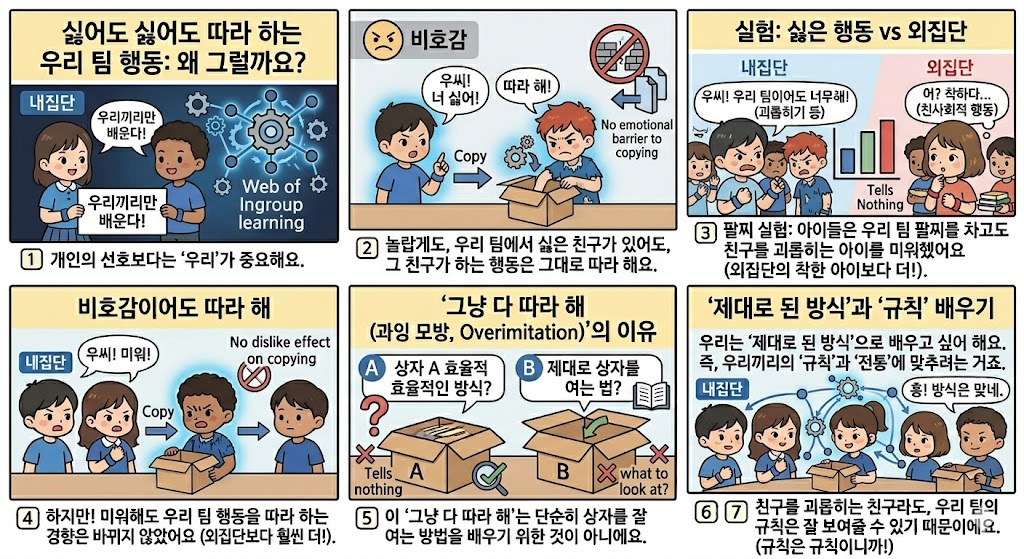
34. The emphasis on learning from the ingroup takes little account of individuals. Amazingly, while we may dislike some of the people in our ingroup, we still copy them. Wilks, Kirby, and Nielsen studied copying behavior in the context of observing how to open a puzzle box. Ingroups and outgroups were distinguished in a minimal way, using simple color coding of wristbands. The children did not simply like all members of their ingroup; they disliked those who behaved in an antisocial fashion. Indeed, they liked these antisocial ingroup members less than the prosocial members of an outgroup. Still, their dislike did not affect their tendency to copy ingroup behavior more closely than outgroup behavior. This overimitation reveals that we are not copying in order to learn how to open a box most efficiently. We want to learn how to do it in the proper way — in other words, ______________________________ . This will be appropriately demonstrated even by antisocial ingroup members. [3점]
① conforming to the rules and conventions of the ingroup
- (해석) 내집단의 규칙과 관습에 따르는 것
- [구문/숙어] conform to A : A(규칙·관습 등)에 따르다, 순응하다 / ingroup : 내집단(소속된 집단)
② following outgroup behavior which is socially appropriate
- (해석) 사회적으로 적절한 외집단의 행동을 따르는 것
- [구문/숙어] follow A : A를 따르다 / outgroup : 외집단(타 집단) / socially appropriate : 사회적으로 적절한
③ avoiding behaviors demonstrated by the ingroup on purpose
- (해석) 내집단에 의해 보여지는 행동들을 일부러 피하는 것
- [구문/숙어] avoid A : A를 피하다 / demonstrated by A : A에 의해 보여진(증명된) / on purpose : 고의로, 일부러
④ pursuing the most efficient strategy for completing the task
- (해석) 과업을 완수하기 위한 가장 효율적인 전략을 추구하는 것
- [구문/숙어] pursue A : A를 추구하다 / strategy for A : A를 위한 전략 / complete the task : 과업을 완수하다
⑤ maintaining an individual identity rather than a group identity
- (해석) 집단 정체성보다는 개인의 정체성을 유지하는 것
- [구문/숙어] maintain A : A를 유지하다 / A rather than B : B보다는 차라리 A / individual identity : 개인 정체성
정답 1
[1] The emphasis on learning from the ingroup takes little account of individuals.
[2] Amazingly, while we may dislike some of the people in our ingroup, we still copy them.
[3] In a study using wristbands for color coding, children disliked ingroup members who behaved in an antisocial fashion—even more than prosocial members of an outgroup.
[4] Still, their dislike did not affect their tendency to copy ingroup behavior more closely than outgroup behavior.
[5] This overimitation reveals that we are not copying to learn how to open a box most efficiently.
[6] We want to learn how to do it in the proper way — in other words, conforming to the rules and conventions of the ingroup.
[7] This will be appropriately demonstrated even by antisocial ingroup members.
[내용 연결 & 핵심 키워드 통합 정리]
1단계: 내집단 학습과 개인적 감정 (Ingroup vs. Individuals)
내집단(ingroup)으로부터 배우는 것은 개인의 특성을 거의 고려하지 않습니다. 놀랍게도 우리는 내집단 구성원이 싫더라도(dislike) 그들의 행동을 **여전히 모방(still copy)**합니다.
2단계: 호불호를 넘어서는 모방의 본능 (The Wristband Study)
손목 밴드 색깔로 내집단과 외집단을 나눈 실험에서, 아이들은 반사회적인 내집단 구성원을 외집단 구성원보다 더 싫어했습니다. 하지만 이러한 **거부감(dislike)**조차 내집단 행동을 더 밀접하게 따라 하려는 경향에는 아무런 영향을 주지 않았습니다(did not
affect).
3단계: 효율성보다는 관습의 준수 (Rules & Conventions)
이러한 **과잉 모방(overimitation)**은 우리가 단순히 가장 효율적인(efficiently) 방법을 배우려는 게 아님을 보여줍니다. 우리는 그 집단의 '적절한 방식(proper way)', 즉 내집단의 **규칙과 관습(rules and conventions)**에 **순응(conforming)**하는 법을 배우고자 하는 것입니다. 설령 반사회적인 인물일지라도 그가 내집단원이라면 그가 보여주는 방식이 집단의 '표준'이라고 믿기 때문입니다.
쉽게 암기하는 "공식“
- (현상) Dislike Ingroup Member $\rightarrow$ Still Copy (Overimitation) 🤖
- (이유) Not for Efficiency (효율성 X) ❌
- (진실) For Rules & Conventions (집단 관습 준수 O) ✅
- (결론) We learn the "Proper Way" of our group! 🤝
주제·제목·요약
주제 (Topic)
The tendency to conform to ingroup conventions regardless of personal liking
개인적인 호감도와 무관하게 내집단의 관습에 순응하려는 경향
제목 (Title)
Proper over Efficient: Why We Copy People We Dislike
효율보다 적절함: 우리가 싫어하는 사람조차 모방하는 이유
요약 (Summary)
Human overimitation of ingroup members, even those disliked for antisocial behavior, demonstrates that the primary goal of social learning is not task efficiency, but rather conforming to the specific rules and conventions of one's own group.
반사회적 행동으로 싫어하는 내집단원조차 과잉 모방하는 인간의 성향은 사회적 학습의 주된 목표가 과업의 효율성이 아니라, 자기 집단만의 특정한 규칙과 관습에 순응하는 것임을 보여준다.
"싫어하는 짝꿍이라도 우리 반 애면 걔가 하는 방식을 따라 하게 된다"
💡 팁: [6]번 문장의 **"proper way"**와 **"rules and conventions"**는 이 지문의 빈칸 추론 0순위 키워드입니다. 우리가 단순히 '방법'을 배우는 게 아니라 '우리 팀의 방식'을 배우려 한다는 점이 핵심입니다!
👥 내집단 동조: 호불호보다 강한 '우리 방식'의 힘
내집단 학습과 개인의 소외
[1] The emphasis on learning from the ingroup (내집단으로부터 배우는 것에 대한 강조는) / takes little account of individuals (개개인을 거의 고려하지 않는다).
내집단으로부터 배우는 것에 대한 강조는 개개인을 거의 고려하지 않는다.
- take account of: ~을 고려하다 (little이 붙어 '거의 고려하지 않다'는 부정 의미)
- 친구 단어 (의미 단위):
- emphasis on learning: 배우는 것에 대한 강조
- ingroup: 내집단 (반: outgroup 외집단)
- takes little account of: ~을 거의 고려하지 않다 (=ignores)
- 표현 포인트: * [부정어] little은 '거의 없는'이라는 부정의 의미를 담은 덩어리입니다. a little과 헷갈리지 않게 아이들에게 꼭 짚어주세요.
싫어하는 사람조차 모방하는 현상
[2] Amazingly (놀랍게도), / while we may dislike some of the people in our ingroup (우리가 내집단의 몇몇 사람들을 싫어할 수도 있지만), / we still copy them (우리는 여전히 그들을 모방한다).
놀랍게도, 우리가 내집단의 몇몇 사람들을 싫어할 수도 있지만, 우리는 여전히 그들을 모방한다.
- 친구 단어 (의미 단위):
- dislike some of the people: 사람들 중 일부를 싫어하다
- still copy them: 여전히 그들을 모방하다/따라 하다
- 표현 포인트: * [대조] dislike(감정)와 copy(행동)의 모순적인 관계가 이 글의 핵심 반전 포인트입니다.
퍼즐 상자 실험을 통한 모방 행동 연구
[3] Wilks, Kirby, and Nielsen (Wilks, Kirby, 그리고 Nielsen은) / studied copying behavior (모방 행동을 연구했다) / in the context of observing (관찰하는 맥락에서) / how to open a puzzle box (퍼즐 상자를 여는 방법을).
Wilks, Kirby, 그리고 Nielsen은 퍼즐 상자를 여는 방법을 관찰하는 맥락에서 모방 행동을 연구했다.
- 친구 단어 (의미 단위):
- copying behavior: 모방 행동
- in the context of: ~의 상황(맥락)에서
- observing how to open: 여는 방법을 관찰하는 것
- 표현 포인트: * [의문사구] how to open은 "~하는 방법"으로 해석되는 명사 덩어리 친구입니다.
최소한의 장치로 구분된 내집단과 외집단
[4] Ingroups and outgroups were distinguished in a minimal way (내집단과 외집단은 최소한의 방식으로 구별되었다), / using simple color coding of wristbands (손목밴드의 단순한 색상 코딩을 사용하여).
내집단과 외집단은 손목밴드의 단순한 색상 코딩을 사용하는 최소한의 방식으로 구별되었다.
- distinguished: 구별된 (수동태)
- using: ~을 사용하여 (분사구문)
- 친구 단어 (의미 단위):
- distinguished in a minimal way: 최소한의 방식으로 구분된
- color coding of wristbands: 손목밴드의 색상 분류
- 표현 포인트: * [수동태] were distinguished는 "구분되었다"라는 상태를 나타내는 친구입니다.
- [분사구문] using은 수단(~을 사용하여)을 나타내는 덩어리입니다.
도덕적 선호와 집단 정체성의 충돌
[5] The children did not simply like all members of their ingroup (아이들이 단순히 내집단의 모든 구성원을 좋아한 것은 아니었다); / they disliked those who SX behaved in an antisocial fashion (그들은 반사회적인 방식으로 행동하는 사람들을 싫어했다).
아이들이 단순히 내집단의 모든 구성원을 좋아한 것은 아니었다. 그들은 반사회적인 방식으로 행동하는 사람들을 싫어했다.
- those who: ~하는 사람들
- 친구 단어 (의미 단위):
- members of their ingroup: 그들 내집단의 구성원들
- behaved in an antisocial fashion: 반사회적인 방식으로 행동했다
- 표현 포인트: * [관계대명사] those who는 "~하는 사람들"이라는 뜻으로 수능 독해의 단골 친구입니다. 묶어서 외우게 해주세요.
- [어휘] fashion은 '유행'이 아니라 '방식(=way, manner)'으로 쓰였습니다.
[6] Indeed (실제로), / they liked these antisocial ingroup members less (그들은 이 반사회적인 내집단 구성원들을 덜 좋아했다) / than the prosocial members of an outgroup (외집단의 친사회적인 구성원들보다).
실제로, 그들은 외집단의 친사회적인 구성원들보다 이 반사회적인 내집단 구성원들을 덜 좋아했다.
- 친구 단어 (의미 단위):
- prosocial members: 친사회적인 구성원들
- less than: ~보다 덜하게/적게
- 표현 포인트: * [비교급] liked ... less than 구조로 호감도의 우선순위를 명확히 보여줍니다.
호불호를 압도하는 내집단 모방 성향
[7] Still (그럼에도 불구하고), /their dislike did not affect their tendency (그들의 싫어함은 그들의 경향에 영향을 주지 않았다) / to copy ingroup behavior more closely (내집단 행동을 더 밀접하게 모방하려는) / than outgroup behavior (외집단 행동보다).
그럼에도 불구하고, 그들의 싫어함은 외집단 행동보다 내집단 행동을 더 밀접하게 모방하려는 경향에 영향을 주지 않았다.
- 친구 단어 (의미 단위):
- did not affect: 영향을 주지 않았다
- tendency to copy: 모방하려는 경향
- more closely than: ~보다 더 밀접하게
- 표현 포인트: * [핵심 문장] 감정(dislike)과 상관없이 집단 정체성(ingroup behavior)을 따른다는 실험의 결론이 담긴 아주 중요한 덩어리입니다.
과잉 모방의 진짜 목적: 효율성 vs 적절성
[8] This overimitation reveals (이러한 과잉 모방은 드러낸다) / that we are not copying (우리가 모방하고 있는 것이 아니라는 것을) / in order to learn how to open a box most efficiently (상자를 가장 효율적으로 여는 방법을 배우기 위해서).
이러한 과잉 모방은 우리가 상자를 가장 효율적으로 여는 방법을 배우기 위해 모방하고 있는 것이 아님을 드러낸다.
- in order to: ~하기 위해서
- 친구 단어 (의미 단위):
- overimitation reveals: 과잉 모방은 드러낸다 (핵심 용어)
- in order to learn: 배우기 위해서
- most efficiently: 가장 효율적으로
- 표현 포인트: * [목적] in order to는 "~하기 위해서"라는 목적의 덩어리 친구입니다.
- [부사] efficiently는 동사 open을 수식하는 짝꿍입니다.
- This overimitation이 가리키는 것은?
- 내집단 구성원을 싫어함에도 불구하고, 외집단의 행동보다 내집단의 행동을 더 똑같이 모방하는
- copy ingroup behavior more closely than outgroup behavior (despite their dislike)
결론: 내집단의 규칙과 관습에 대한 동조
[9] We want to learn how to do it in the proper way (우리는 그것을 '적절한 방식'으로 하는 법을 배우길 원한다) / — in other words (다시 말해서), / conforming to the rules and conventions of the ingroup (내집단의 규칙과 관습에 순응하는 방식으로).
우리는 그것을 '적절한 방식'으로 하는 법, 다시 말해 내집단의 규칙과 관습에 순응하는 방식으로 하는 법을 배우길 원하는 것이다.
- conform to 명사: ~에 순응하다, 따르다
- 친구 단어 (의미 단위):
- in the proper way: 적절한 방식으로
- In other words: 다시 말해서
- conforming to the rules: 규칙에 따르는/동조하는
- conventions of the ingroup: 내집단의 관습들
- 표현 포인트: * [숙어] conform to는 "~에 순응하다/따르다"라는 뜻으로 이 지문의 핵심 주제어 덩어리입니다.
[10] This will be appropriately demonstrated (이것은 적절하게 입증될 것이다) / even by antisocial ingroup members (심지어 반사회적인 내집단 구성원들에 의해서도).
이것은 심지어 반사회적인 내집단 구성원들에 의해서도 적절하게 입증될 것이다.
- 친구 단어 (의미 단위):
- appropriately demonstrated: 적절하게 입증된/보여진
- even by: 심지어 ~에 의해서조차
- 표현 포인트: * [결론] 아무리 싫은 사람이라도 "우리 편"이라면 그 방식이 "옳은 방식"이라고 믿고 따른다는 씁쓸하지만 강력한 결론입니다.
- This가 가리키는 것은?
- 올바른 방식으로 행동하는 법 또는 내집단의 규칙과 관습에 순응하는 것
- how to do it in the proper way 또는 conforming to the rules and conventions of the ingroup
지문의 요지: 인간은 내집단 구성원이 개인적으로 싫거나 반사회적일지라도 그들의 행동을 과도하게 모방(overimitation)하는데, 이는 효율적인 학습보다 '우리 집단의 방식(규칙과 관습)'에 동조하려는 사회적 욕구가 더 크기 때문입니다.
1. 다음 글의 빈칸에 들어갈 말로 가장 적절한 것은?
The emphasis on learning from the ingroup takes little account of individuals. Amazingly, while we may dislike some of the people in our ingroup, we still copy them. In a study using wristbands for color coding, children disliked ingroup members who behaved in an antisocial fashion—even more than prosocial members of an outgroup. Still, their dislike did not affect their tendency to copy ingroup behavior more closely than outgroup behavior. This overimitation reveals that we are not copying to learn how to open a box most efficiently. We want to learn how to do it in the proper way — in other words, ____________________________________________. This will be appropriately demonstrated even by antisocial ingroup members.
① distinguishing ourselves from antisocial members
② evaluating the personal traits of ingroup members
③ conforming to the rules and conventions of the ingroup
④ improving the overall efficiency of the given task
⑤ breaking the traditional customs of our society
2. 주어진 글 다음에 이어질 글의 순서로 가장 적절한 것은?
The emphasis on learning from the ingroup takes little account of individuals. Amazingly, while we may dislike some of the people in our ingroup, we still copy them.
(A) This overimitation reveals that we are not copying to learn how to open a box most efficiently. We want to learn how to do it in the proper way — in other words, conforming to the rules and conventions of the ingroup. This will be appropriately demonstrated even by antisocial ingroup members.
(B) Still, their dislike did not affect their tendency to copy ingroup behavior more closely than outgroup behavior.
(C) In a study using wristbands for color coding, children disliked ingroup members who behaved in an antisocial fashion—even more than prosocial members of an outgroup.
① (A) - (C) - (B)
② (B) - (A) - (C)
③ (B) - (C) - (A)
④ (C) - (A) - (B)
⑤ (C) - (B) - (A)
3. 다음 글의 밑줄 친 부분 중, 문맥상 낱말의 쓰임이 적절하지 않은 것은?
The emphasis on learning from the ingroup takes ①little account of individuals. Amazingly, while we may dislike some of the people in our ingroup, we still copy them. In a study using wristbands for color coding, children disliked ingroup members who behaved in an antisocial fashion—even more than prosocial members of an outgroup. Still, their dislike greatly ②reduced their tendency to copy ingroup behavior more closely than outgroup behavior. This ③overimitation reveals that we are not copying to learn how to open a box most ④efficiently. We want to learn how to do it in the proper way — in other words, ⑤conforming to the rules and conventions of the ingroup.
💡 [정답 및 출제 포인트 분석]
[문제 1번 정답] ③ conforming to the rules and conventions of the ingroup
- 출제 의도: 글의 가장 핵심적인 결론(우리가 왜 내집단을 과잉모방하는가?)을 정확히 파악했는지 묻는 빈칸 추론입니다.
- 오답 분석: ④번(주어진 일의 전반적인 효율성 향상)은 지문의 not copying to learn how to open a box most efficiently 부분과 정면으로 대치되는 매력적인 오답입니다. 본문 내용을 꼼꼼히 읽지 않고 '모방 = 효율성'이라는 통념으로 접근하는 학생들을 걸러낼 수 있습니다.
[문제 2번 정답] ⑤ (C) - (B) - (A)
- 출제 의도: 실험의 도입(C) 실험의 결과(B) 결과에 대한 분석 및 결론(A)으로 이어지는 전형적인 논리 전개 과정을 파악하는 문제입니다.
- 해설: 주어진 문장에서 '싫어해도 모방한다'는 주장을 던진 후, (C)에서 이를 입증하기 위한 '손목 밴드 실험' 예시가 시작됩니다. (B)의 Still, their dislike...는 (C)에서 언급된 아이들의 'dislike'를 그대로 이어받습니다. 마지막으로 (A)의 This overimitation이라는 지시어가 (B)의 모방 경향을 가리키며 결론을 내립니다.
[문제 3번 정답] ② reduced (원문: did not affect)
- 출제 의도: 어휘 문제의 탈을 쓴 주제 찾기 문제입니다. 글의 핵심은 '싫어하는 감정이 모방에 영향을 주지 않는다'는 것인데, 이를 반대로 뒤집어 출제했습니다.
- 해설: 내집단 멤버를 싫어하더라도 여전히 그들을 모방한다는 것이 글의 요지이므로, 싫어하는 감정이 모방하려는 경향을 '감소시켰다(reduced)'고 하면 문맥상 완전히 틀린 말이 됩니다.
[서술형 00번] 다음 글의 내용을 바탕으로 빈칸 (A)에 들어갈 요약문을 [조건]에 맞게 영어로 완성하시오. [6점]
[ 요약문 ] Overimitation is not about efficiency; rather, it is (A) [ ] to the conventions and rules of our own group.
[ 보 기 ] demonstrate, way, proper, of, a, conform (단, 필요한 단어를 추가하거나 어형 변화를 반드시 할 것)
[ 조 건 ]
- A of B (A라는 형태의 B) 구조를 반드시 포함하시오.
- **동명사구(Being / Showing 등)**를 활용하여 (A) 부분을 시작하시오.
- 지문에 제시된 **'proper way'**와 **'conform'**의 개념이 모두 드러나게 작성하시오.
- (A) 부분은 10단어 이내로 작성하시오.
⇨ (A) ______________________________________________________________________________________
'고1 > 고1 3월 모의고사' 카테고리의 다른 글
| 2026년 고1 3월 모의고사 영어 36번 해설 및 분석 변형문제 (1) | 2026.03.27 |
|---|---|
| 2026년 고1 3월 모의고사 영어 35번 해설 및 분석 변형문제 (0) | 2026.03.27 |
| 2026년 고1 3월 모의고사 영어 33번 해설 및 분석 변형문제 (0) | 2026.03.27 |
| 2026년 고1 3월 모의고사 영어 32번 해설 및 분석 변형문제 (0) | 2026.03.26 |
| 2026년 고1 3월 모의고사 영어 31번 해설 및 분석 변형문제 (0) | 2026.03.26 |