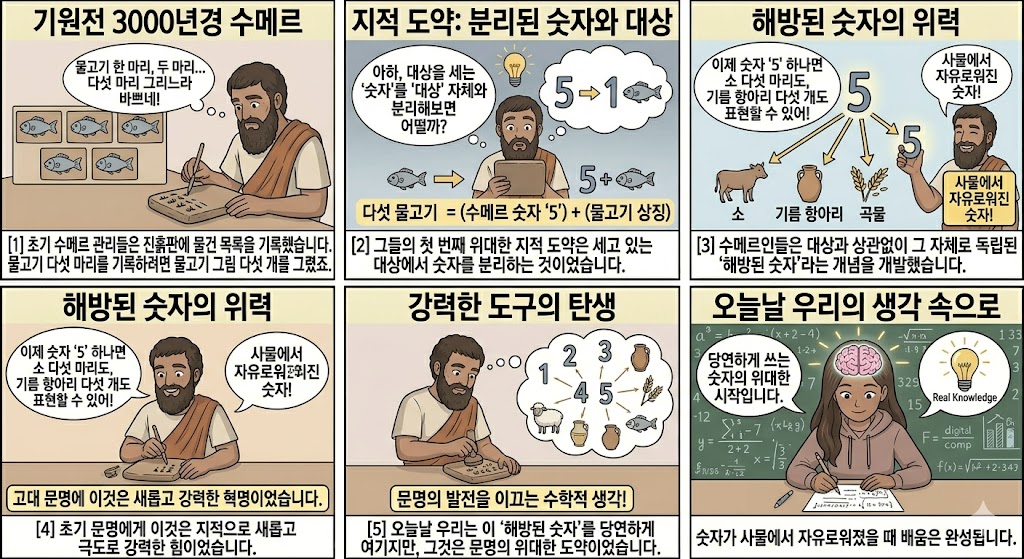
33. From around 3000 BC, the Sumerian officials would mark their lists of goods on clay tablets. If they wanted to record five fish, they would mark five pictures of a fish. Their first great intellectual leap came from separating the number from the object they were counting . In other words, they would represent five fish with a numeral for the number five alongside a symbol for the fish. If they wanted to describe five of something else, they realized they could keep the same numeral and trade the object symbol for a cow, or a jar of oil, or whatever else they were interested in. The Sumerians had developed the idea of an emancipated number, existing in its own right and independent of whatever it is being used to count. It is easy to take the emancipated number for granted as it is so deeply set into modern thought, but to the earliest civilizations it was intellectually new and extremely powerful. [3점]
① adding more complex symbols to describe the quality of goods
- (해석) 상품의 품질을 묘사하기 위해 더 복잡한 기호들을 추가하기
- [구문/숙어] add A to B : A를 B에 더하다 / describe A : A를 묘사하다
② separating the number from the object they were counting
- (해석) 세고 있는 대상(물건)으로부터 숫자를 분리하기
- [구문/숙어] separate A from B : A를 B로부터 분리하다 / count A : A를 세다
③ representing the physical shape of each object accurately
- (해석) 각 물건의 물리적 형태를 정확하게 표현하기
- [구문/숙어] represent A : A를 나타내다(표현하다) / physical shape : 물리적 형태
④ connecting the count of an object with its market value
- (해석) 물건의 수량과 그것의 시장 가치를 연결하기
- [구문/숙어] connect A with B : A를 B와 연결하다 / market value : 시장 가치
⑤ applying the use of numbers to only precious items
- (해석) 숫자의 사용을 오직 귀중한 품목에만 적용하기
- [구문/숙어] apply A to B : A를 B에 적용하다 / precious items : 귀중한 품목
[1] From around 3000 BC, the Sumerian officials would mark their lists of goods on clay tablets.
[2] If they wanted to record five fish, they would mark five pictures of a fish.
[3] Their first great intellectual leap came from separating the number from the object they were counting.
[4] In other words, they would represent five fish with a numeral for the number five alongside a symbol for the fish.
[5] If they wanted to describe five of something else, they realized they could keep the same numeral and trade the object symbol for a cow, or a jar of oil.
[6] The Sumerians had developed the idea of an emancipated number, existing in its own right and independent of whatever it is being used to count.
[7] It is easy to take the emancipated number for granted as it is so deeply set into modern thought, but to the earliest civilizations it was intellectually new and extremely powerful.
[내용 연결 & 핵심 키워드 통합 정리]
1단계: 초기 수의 기록 방식 (The Concrete Stage)
기원전 3,000년경 수메르 관리들은 점토판(clay tablets)에 물품 목록을 기록했습니다. 초기에는 물고기 5마리를 기록하려면 물고기 그림 5개를 직접 그렸습니다. 즉, 숫자와 대상이 하나로 묶여 있는 구체적인 형태였습니다.
2단계: 숫자와 대상의 분리 (The Intellectual Leap)
수메르인들의 위대한 **지적 도약(intellectual leap)**은 **숫자를 세는 대상으로부터 분리(separating the number from the object)**하면서 시작되었습니다. 이제 '물고기 그림 5개' 대신 '숫자 5를 나타내는 기호'와 '물고기 상징'을 따로 적게 된 것입니다.
3단계: 해방된 숫자의 탄생과 위력 (The Emancipated Number)
이들은 대상이 소나 기름 단지로 바뀌어도 **동일한 숫자 기호(same numeral)**를 유지할 수 있다는 점을 깨달았습니다. 이것이 바로 대상으로부터 독립하여 그 자체로 존재하는(existing in its own right) **'해방된 수(emancipated number)'**의 개념입니다. 오늘날에는 당연해 보이지만, 당시에는 문명의 흐름을 바꾼 매우 강력한(extremely powerful) 혁신이었습니다.
쉽게 암기하는 "공식“
- (초기) 5 Fish = Fish + Fish + Fish + Fish + Fish (상징의 반복) 🐟🐟🐟🐟🐟
- (도약) 5 Fish = Numeral '5' + Symbol 'Fish' (분리) 5️⃣ + 🐟
- (결과) Emancipated Number (해방된 수) = Independent of objects 🕊️🔢
- (의의) Intellectual Leap → Foundation of Modern Thought 🧠
주제·제목·요약
주제 (Topic)
The origin of the abstract number concept developed by the Sumerians
수메르인들에 의해 발전된 추상적 수 개념의 기원
제목 (Title)
The Birth of '5': How Sumerians Freed Numbers from Objects
'5'의 탄생: 수메르인들은 어떻게 숫자를 대상으로부터 해방시켰는가
요약 (Summary)
The Sumerians achieved a major intellectual breakthrough by separating numerals from the items being counted, creating "emancipated numbers" that could represent any object independently, which became a powerful foundation for modern mathematical thought.
수메르인들은 숫자를 세는 항목에서 분리함으로써 지적인 돌파구를 마련했고, 어떤 대상이든 독립적으로 나타낼 수 있는 '해방된 수'를 만들어냈으며, 이는 현대 수학 사고의 강력한 토대가 되었다.
"숫자가 사물에서 탈출(emancipate)했다"
수메르인의 지적 도약: 사물에서 분리된 숫자
emancipated, intellectual leap
💡 팁: [6]번 문장의 "emancipated number"(해방된 수)라는 표현은 '대상으로부터 자유로워진 추상적인 숫자'를 의미합니다. "independent"(독립적인)라는 단어와 짝을 지어 기억해 두시면 빈칸 추론 문제에 완벽히 대비할 수 있습니다!
🔢 수메르인의 혁명: 객체로부터 독립된 '수'의 탄생
초기 수메르인의 단순한 기록 방식
[1] From around 3000 BC (기원전 3000년경부터), / the Sumerian officials (수메르 관리들은) / would mark their lists of goods (그들의 물품 목록을 표시하곤 했다) / on clay tablets (점토판 위에).
기원전 3000년경부터 수메르 관리들은 점토판 위에 물품 목록을 기록하곤 했다.
- would: '~하곤 했다' (과거의 불규칙한 습관이나 상태)
- 친구 단어 (의미 단위):
- Sumerian officials: 수메르 관리들
- lists of goods: 물품 목록
- clay tablets: 점토판 (종이가 없던 시절의 기록 수단)
- 표현 포인트:
- [조동사] 여기서 would는 과거의 규칙적인 습관(~하곤 했다)을 나타내는 친구입니다.
[2] If they wanted to record five fish (만약 그들이 물고기 다섯 마리를 기록하고 싶었다면), / they would mark five pictures of a fish (그들은 물고기 그림 다섯 개를 표시했을 것이다).
만약 그들이 물고기 다섯 마리를 기록하고 싶었다면, 물고기 그림 다섯 개를 그려 넣었을 것이다.
- 친구 단어 (의미 단위):
- record five fish: 물고기 다섯 마리를 기록하다
- mark five pictures: 다섯 개의 그림을 표시하다
- 표현 포인트:
- [구체적 표기] 처음에는 숫자라는 개념이 없어 사물의 개수만큼 그림을 그렸다는 배경을 설명합니다.
위대한 지적 도약: 숫자와 객체의 분리
[3] Their first great intellectual leap (그들의 첫 번째 위대한 지적 도약은) / came from separating the number (숫자를 분리하는 것에서 나왔다) / from the object they were counting OX (그들이 세고 있던 객체로부터).
그들의 첫 번째 위대한 지적 도약은 세고 있던 객체로부터 숫자를 분리하는 것에서 비롯되었다.
- separating A from B: A를 B로부터 분리하다
- object [they were counting]: [그들이 세고 있던] 객체 (목적격 관계대명사 생략)
- 친구 단어 (의미 단위):
- great intellectual leap: 위대한 지적 도약 (핵심 키워드)
- separating A from B: A를 B로부터 분리하다
- object they were counting: 그들이 세고 있던 사물
- 표현 포인트:
- [핵심 구문] separate A from B는 수능 독해에서 "구분/분리"를 나타낼 때 가장 많이 쓰이는 덩어리 친구입니다.
- [관계사 생략] object (which) they were counting 구조로 목적격 관계대명사가 생략되어 있습니다.
기호 체계의 변화와 효율성
[4] In other words (다시 말해서), / they would represent five fish (그들은 물고기 다섯 마리를 나타냈을 것이다) / with a numeral for the number five (숫자 5를 위한 수사와 함께) / alongside a symbol for the fish (물고기를 나타내는 기호를 나란히 두어).
다시 말해서, 그들은 숫자 5를 나타내는 수사와 물고기를 나타내는 기호를 나란히 두어 물고기 다섯 마리를 표현했을 것이다.
- numeral: 수사, 숫자 기호
- alongside: ~옆에, ~와 나란히
- 친구 단어 (의미 단위):
- In other words: 다시 말해서 (환언의 연결어)
- represent five fish: 다섯 마리의 물고기를 표현하다
- numeral for the number: 숫자를 나타내는 기호/수사
- alongside a symbol: 기호와 나란히/옆에
- 표현 포인트:
- [내용 전개] 그림 5개가 아니라 '5'라는 기호와 '물고기' 기호를 따로 썼음을 구체화합니다.
추상적 숫자의 범용성 발견
[5] If they wanted to describe five of something else (만약 그들이 다른 무언가 다섯 개를 묘사하고 싶었다면), / they realized they could keep the same numeral (그들은 똑같은 수사를 유지할 수 있다는 것을 깨달았다) / and trade the object symbol for a cow, or a jar of oil, (그리고 객체 기호를 소나 기름 한 항아리로 교체할 수 있다는 것을) / or whatever else they were interested in OX (혹은 그들이 관심을 가진 그 밖의 무엇으로든).
만약 다른 무언가 다섯 개를 묘사하고 싶을 때, 그들은 숫자 기호는 그대로 두고 객체 기호만 소나 기름 항아리, 혹은 그들이 관심을 가진 그 무엇으로든 바꿀 수 있다는 것을 깨달았다.
- trade A for B: A를 B로 교체하다/맞바꾸다
- Substitute A for B: "A 대신 B를 대신 쓰다/채우다."
- whatever else: 그 밖의 무엇이든 (복합관계대명사)
- 친구 단어 (의미 단위):
- keep the same numeral: 똑같은 숫자를 유지하다
- trade A for B: A를 B로 바꾸다/교환하다
- jar of oil: 기름 한 항아리
- whatever else: 그 밖의 무엇이든
- 표현 포인트:
- [병렬 구조] could에 걸리는 keep과 trade가 친구입니다.
- [숙어] trade A for B는 A 대신 B를 넣는 "교체"의 의미를 담은 덩어리입니다.
'해방된 숫자' 개념의 확립
[6] The Sumerians had developed the idea (수메르인들은 개념을 발전시켰다) / of an emancipated number (해방된 숫자에 대한), / existing in its own right (그 자체의 권리로 존재하는) / and independent of whatever it is being used to count OX (그리고 그것이 무엇을 세는 데 사용되든 상관없이 독립적인).
수메르인들은 그것이 무엇을 세는 데 사용되든 상관없이, 그 자체로 존재하며 독립적인 '해방된 숫자'라는 개념을 발전시킨 것이었다.
- emancipated: 해방된, 해방시킨
- independent of: ~와 관계없는, 독립적인
- 친구 단어 (의미 단위):
- emancipated number: 해방된 숫자 (사물로부터 자유로워진 숫자)
- existing in its own right: 그 자체로 존재하는
- independent of: ~와 독립적인 (~와 상관없는)
- used to count: 세는 데 사용되는
- 표현 포인트:
- [분사구문] existing과 independent가 앞의 emancipated number를 부연 설명합니다.
- [숙어] independent of는 수능 필수 덩어리입니다. 꼭 묶어서 익히게 해주세요.
현대적 사고의 기초가 된 지적 혁신
[7] It is easy to take the emancipated number for granted (해방된 숫자를 당연하게 여기기 쉽다) / as it is so deeply set into modern thought (그것이 현대 사고방식에 너무나 깊이 자리 잡고 있기 때문에), / but to the earliest civilizations (하지만 초기 문명들에게) / it was intellectually new and extremely powerful (그것은 지적으로 새로운 것이었으며 매우 강력했다).
해방된 숫자의 개념은 현대 사고방식에 매우 깊이 박혀 있어 당연하게 여기기 쉽지만, 초기 문명들에게 그것은 지적으로 새로운 것이었으며 대단히 강력한 것이었다.
- take A for granted: A를 당연하게 여기다
- as: ~이기 때문에 (이유)
- 친구 단어 (의미 단위):
- take for granted: ~을 당연하게 여기다
- deeply set into: ~에 깊이 자리 잡은
- modern thought: 현대 사고
- earliest civilizations: 초기 문명들
- 표현 포인트:
- [가주어/진주어] It(가주어) ... to take(진주어) 구조입니다.
- [핵심 관용구] take A for granted는 빈칸 추론이나 서술형에 정말 자주 나오는 "초특급 친구"입니다.
지문의 요지: 수메르인들은 사물의 개수만큼 그림을 그리던 방식에서 벗어나, 숫자 기호와 사물 기호를 분리함으로써 '추상적인 수(해방된 숫자)'의 개념을 창조해냈으며, 이는 인류 지성사의 거대한 도약이었습니다.
1. 다음 글의 제목으로 가장 적절한 것은?
From around 3000 BC, the Sumerian officials would mark their lists of goods on clay tablets. If they wanted to record five fish, they would mark five pictures of a fish. Their first great intellectual leap came from separating the number from the object they were counting. In other words, they would represent five fish with a numeral for the number five alongside a symbol for the fish. If they wanted to describe five of something else, they realized they could keep the same numeral and trade the object symbol for a cow, or a jar of oil. The Sumerians had developed the idea of an emancipated number, existing in its own right and independent of whatever it is being used to count. It is easy to take the emancipated number for granted as it is so deeply set into modern thought, but to the earliest civilizations it was intellectually new and extremely powerful.
① The Evolution of Sumerian Writing Systems
② How Sumerians Invented the Emancipated Number
③ The Difficulties of Counting in Early Civilizations
④ Why Clay Tablets Were Essential in Ancient Times
⑤ The Unbreakable Bond Between Numbers and Objects
2. 글의 흐름으로 보아, 주어진 문장이 들어가기에 가장 적절한 곳은?
[주어진 문장] Their first great intellectual leap came from separating the number from the object they were counting.
From around 3000 BC, the Sumerian officials would mark their lists of goods on clay tablets. ( ① ) If they wanted to record five fish, they would mark five pictures of a fish. ( ② ) In other words, they would represent five fish with a numeral for the number five alongside a symbol for the fish. ( ③ ) If they wanted to describe five of something else, they realized they could keep the same numeral and trade the object symbol for a cow, or a jar of oil. ( ④ ) The Sumerians had developed the idea of an emancipated number, existing in its own right and independent of whatever it is being used to count. ( ⑤ ) It is easy to take the emancipated number for granted as it is so deeply set into modern thought, but to the earliest civilizations it was intellectually new and extremely powerful.
3. 다음 글의 빈칸에 들어갈 말로 가장 적절한 것은?
From around 3000 BC, the Sumerian officials would mark their lists of goods on clay tablets. If they wanted to record five fish, they would mark five pictures of a fish. Their first great intellectual leap came from separating the number from the object they were counting. In other words, they would represent five fish with a numeral for the number five alongside a symbol for the fish. If they wanted to describe five of something else, they realized they could keep the same numeral and trade the object symbol for a cow, or a jar of oil. The Sumerians had developed the idea of an emancipated number, existing in its own right and ____________________________________. It is easy to take the emancipated number for granted as it is so deeply set into modern thought, but to the earliest civilizations it was intellectually new and extremely powerful.
① highly dependent on the value of the goods
② completely replaced by modern mathematical symbols
③ strictly limited to tracking agricultural products
④ visually identical to the physical objects they represented
⑤ independent of whatever it is being used to count
💡 [정답 및 출제 포인트 분석]
[문제 1번 정답] ② How Sumerians Invented the Emancipated Number
- 출제 의도: 글의 핵심 소재인 '수메르인들'과 그들이 이룩한 '독립된 수(추상적 숫자)의 발명'이라는 키워드를 정확히 잡아낼 수 있는지 묻는 문제입니다.
- 오답 분석: ⑤번(숫자와 사물 사이의 깨질 수 없는 결속력)은 지문의 핵심인 separating(분리)과 정반대되는 매력적인 오답입니다. 본문 내용을 겉핥기식으로 읽은 학생들을 걸러낼 수 있습니다.
[문제 2번 정답] ②
- 출제 의도: 구체적인 사례(물고기 그림 5개)에서 추상적인 개념(숫자와 사물의 분리)으로 넘어가는 논리적 전환점(Pivot)을 찾을 수 있는지 평가합니다.
- 해설: 주어진 문장에서 '숫자와 사물을 분리했다'는 지적 도약이 언급됩니다. 그리고 정답 자리인 ②번 뒤의 문장에서 In other words(다시 말해서)라는 연결어와 함께 그 분리의 구체적 예시(숫자 5를 나타내는 기호 + 물고기 기호)가 부연 설명되므로 ②번 자리가 가장 완벽합니다.
[문제 3번 정답] ⑤ independent of whatever it is being used to count
- 출제 의도: 이 지문에서 가장 중요한 철학적/수학적 개념인 '독립된 수'의 정의를 묻는 고난도 빈칸 추론입니다.
- 해설: '해방된/독립된 수(emancipated number)'란 무엇을 세고 있는지(물고기든 소든 기름이든)와 관계없이 '독립적으로(independent of)' 존재하는 숫자를 의미합니다. ①번과 ④번은 본문의 논리와 완전히 반대되는 오답입니다.
[서술형 00번] 다음 글을 읽고, 밑줄 친 우리말의 의미와 일치하도록 [보기]의 표현을 활용하여 [조건]에 맞게 영작하시오. [6점]
From around 3000 BC, the Sumerian officials marked their goods on clay tablets. Initially, they drew five fish to record five fish. However, they soon achieved a great intellectual leap. <u>그들은 세고 있던 대상으로부터 숫자를 분리하는 아이디어를 발전시켰다.</u> They realized they could keep the same numeral and just change the object symbol. This was the birth of the "emancipated number," which exists independently of whatever it is used to count.
[ 보 기 ] separate / counting / the / idea / from / number / developed / object / were / they (단, 필요한 단어를 추가하거나 어형 변화를 반드시 할 것)
[ 조 건 ]
- A of B (A라는 형태의 B) 구조를 활용하여 '숫자를 분리하는 아이디어'를 표현하시오.
- 관계대명사를 사용하시오.
- 전체 15단어 이내의 완결된 문장으로 작성하시오.
⇨ They ____________________________________________________________________________________ .
정답: They developed the idea of separating the number from the object they were counting.
[분석 및 채점 가이드]
- 구문 지식 (Separate A from B) [2점]: '숫자(A)를 대상(B)으로부터 분리하다'라는 논리에 맞게 전치사 from을 정확히 사용했는가?
- A of B 구조 [2점]: 조건대로 the idea(A) of separating(B) 구조를 만들고, 전치사 of 뒤에 동명사 separating을 정확히 썼는가?
- 관계사 생략 구조 [2점]: the object (that) they were counting에서 목적격 관계대명사가 생략된 수식 구조를 정확히 구현했는가?
'고1 > 고1 3월 모의고사' 카테고리의 다른 글
| 2026년 고1 3월 모의고사 영어 35번 해설 및 분석 변형문제 (0) | 2026.03.27 |
|---|---|
| 2026년 고1 3월 모의고사 영어 34번 해설 및 분석 변형문제 (0) | 2026.03.27 |
| 2026년 고1 3월 모의고사 영어 32번 해설 및 분석 변형문제 (0) | 2026.03.26 |
| 2026년 고1 3월 모의고사 영어 31번 해설 및 분석 변형문제 (0) | 2026.03.26 |
| 2026년 고1 3월 모의고사 영어 30번 해설 및 분석 변형문제 (0) | 2026.03.26 |