Initially the catchphrase “less is more” had a simple meaning.
(A) Over time, many of their buttons became viewed as “extra” and were removed, and with each reduction these devices eventually developed into the phones in our pockets. The scale of the object became smaller, and the functions of the buttons got lost in the threedot menus and multilayered folders of our phones.
(B) First mentioned in Robert Browning’s poem “Andrea del Sarto,” it suggests that everything simple is better and more beautiful than the complex and tangled. Nowadays this phrase is heard often — maybe even too often.
(C) But it’s important to recognize that the way of thinking that lies behind these words slowly extinguishes certain habits from our daily life. For example, think about the heavy, massive radio receivers that existed back in the day.
① (A) - (C) - (B) ② (B) - (A) - (C) ③ (B) - (C) - (A) ④ (C) - (A) - (B) ⑤ (C) - (B) - (A)
[1] Initially the catchphrase “less is more” had a simple meaning.
[2] (B) First mentioned in Robert Browning’s poem, it suggests that everything simple is better and more beautiful than the complex and tangled.
[3] (C) But the way of thinking behind these words slowly extinguishes certain habits from our daily life; for example, the heavy, massive radio receivers of the past.
[4] (A) Over time, many of their buttons became viewed as “extra” and were removed, and these devices eventually developed into the phones in our pockets.
[5] (A) The scale of the object became smaller, and the functions of the buttons got lost in the three-dot menus and multilayered folders of our phones.
[내용 연결 & 핵심 키워드 통합 정리]
1단계: "Less is More"의 기원과 본래 의미 (Origin & Meaning)
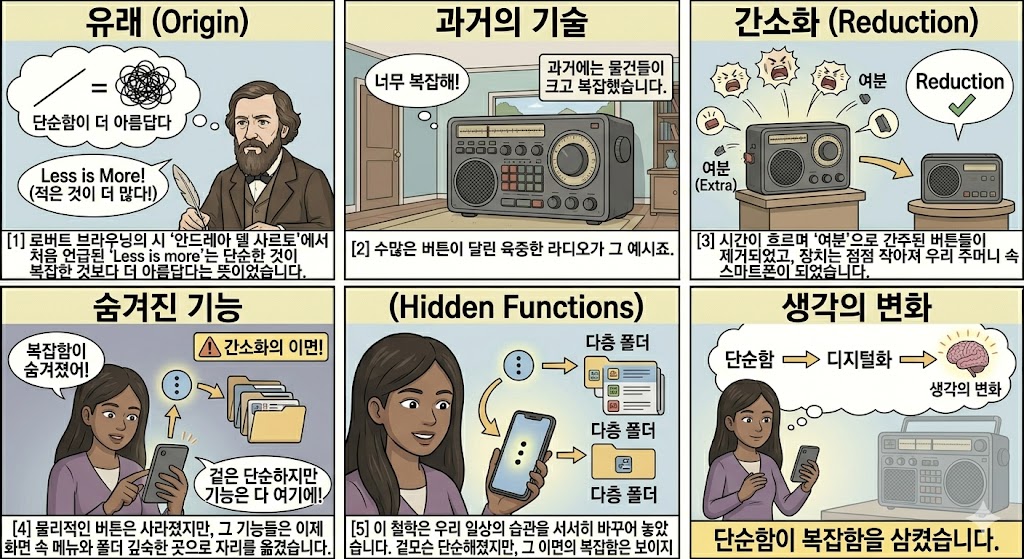
**"Less is More"**라는 문구는 원래 로버트 브라우닝의 시에서 처음 언급되었습니다. 복잡하고 얽힌 것보다 **단순한 것이 더 낫고 아름답다(simple is better and more beautiful)**는 철학적인 의미를 담고 있었습니다.
2단계: 기술의 발전과 극단적 단순화 (Evolution to Smartphones)
이러한 사고방식은 우리 일상에서 특정 습관들을 서서히 없애(extinguishes) 왔습니다. 과거의 크고 무거운 라디오 수신기에서 불필요한(extra) 버튼들을 제거하며 점점 작아졌고, 결국 우리 주머니 속의 **스마트폰(phones in our pockets)**으로 진화했습니다.
3단계: 단순화의 역설과 기능의 매몰 (The Paradox of Simplicity)
물건의 크기(scale)는 작아졌지만, 물리적 버튼이 수행하던 기능들은 스마트폰의 **점 세 개 메뉴(three-dot menus)**나 다층 폴더(multilayered folders) 속으로 숨어버렸습니다(got lost). 겉모습은 단순해졌으나, 사용자가 기능을 찾기 위해 거쳐야 할 단계는 오히려 복잡해진 아이러니를 보여줍니다.
쉽게 암기하는 "공식“
- (기원) Robert Browning's Poem → Simple = Better 🖋️✨
- (변화) Massive Radio → Remove "Extra" Buttons → Smartphone 📻📲
- (결과) Smaller Scale, but Functions got lost in menus 🔎📉
- (교훈) Less is More = Physical simplicity, but Digital complexity! ⚖️
주제·제목·요약
주제 (Topic)
The evolution of the "less is more" concept and its impact on the simplification of technology
"Less is More" 개념의 진화와 그것이 기술의 단순화에 미친 영향
제목 (Title)
The Price of Simplicity: How "Less is More" Changed Our Devices
단순함의 대가: "Less is More"가 우리의 기기를 어떻게 바꾸었나
요약 (Summary)
The philosophy of "less is more" led to the physical miniaturization of devices like radios into smartphones by removing "extra" buttons, but this simplicity often hides functions within complex digital menus, extinguishing old tactile habits.
"Less is More" 철학은 "불필요한" 버튼을 제거함으로써 라디오와 같은 기기를 스마트폰으로 물리적으로 소형화하게 만들었으나, 이러한 단순함은 종종 기능을 복잡한 디지털 메뉴 안에 숨겨 과거의 촉각적 습관들을 사라지게 만들었다.
"옛날 라디오의 그 많은 버튼이 다 어디로 갔을까? 바로 우리 폰의 점 세 개 메뉴 안으로 숨어버린 거야!"
겉으로만 단순해진 현대 기기의 사용 편의성 저하를 비판
💡 팁: [5]번 문장의 **"got lost in the three-dot menus"**는 겉으로만 단순해진 현대 기기의 사용 편의성 저하를 비판적으로 보여주는 대목입니다. 순서 배열 문제에서 라디오(과거) -> 버튼 제거(과정) -> 스마트폰 메뉴(현재/결과)의 흐름을 꼭 기억하세요!
📱 "Less is More": 단순함이 빚어낸 현대 기술의 변화
문구의 기원과 본래의 의미
[1] Initially (처음에) / the catchphrase “less is more” ( “적은 것이 더 많은 것이다”라는 문구는) / had a simple meaning (단순한 의미를 가지고 있었다).
처음에 “적은 것이 더 많은 것이다”라는 문구는 단순한 의미를 담고 있었다.
- 친구 단어 (의미 단위):
- Initially: 처음에, 시초에
- catchphrase: 문구, 표어
- simple meaning: 단순한 의미
- 표현 포인트:
- [시간 부사] Initially를 통해 이후에 의미가 어떻게 변했는지(통찰)를 암시하는 도입부 덩어리입니다.
[2] First mentioned in Robert Browning’s poem “Andrea del Sarto,” (Robert Browning의 시 “Andrea del Sarto”에서 처음 언급된) / it suggests (그것은 시사한다) / that everything simple is better and more beautiful (모든 단순한 것이 더 낫고 더 아름답다는 것을) / than the complex and tangled (복잡하고 뒤얽힌 것보다).
Robert Browning의 시 “Andrea del Sarto”에서 처음 언급된 이 문구는, 모든 단순한 것이 복잡하고 뒤얽힌 것보다 더 낫고 더 아름답다는 것을 시사한다.
- First mentioned: '~에서 처음 언급된' (과거분사구로 주어인 it을 수식)
- the complex and tangled: '복잡하고 뒤얽힌 것들' (the + 형용사 = 복수 보통명사)
- 친구 단어 (의미 단위):
- First mentioned in: ~에서 처음 언급된
- suggests that: ~라는 것을 시사하다(제안하다)
- complex and tangled: 복잡하고 얽힌
- 표현 포인트:
- [분사구문] First mentioned는 앞의 it(the phrase)을 수식하는 수동 형태의 덩어리입니다.
- [비교급] better and more beautiful than 구조로 단순함과 복잡함의 가치를 대조합니다.
현대 사회에서의 빈번한 사용과 영향
[3] Nowadays this phrase is heard often (요즘 이 문구는 자주 들린다) / — maybe even too often ( — 어쩌면 너무 자주일지도 모른다).
요즘 이 문구는 자주, 어쩌면 너무 자주 들린다.
- 친구 단어 (의미 단위):
- Nowadays: 요즘에는, 오늘날에는
- heard often: 자주 들리는
- 표현 포인트:
- [수동태] is heard를 통해 이 문구가 널리 퍼져 있는 상황을 설명하는 친구입니다.
[4] But it’s important to recognize (하지만 인식하는 것이 중요하다) / that the way of thinking [that SX lies behind these words] ( [이 말들 뒤에 놓여 있는] 사고방식이) / slowly extinguishes certain habits (특정 습관들을 서서히 없앤다는 것을) / from our daily life (우리 일상생활로부터).
하지만 이 말들 뒤에 숨겨진 사고방식이 우리 일상생활에서 특정 습관들을 서서히 없애고 있다는 점을 인식하는 것이 중요하다.
- It (가주어) ... to recognize (진주어): ~하는 것이 중요하다
- that [that lies behind these words]: 주격 관계대명사절이 the way of thinking을 수식
- 친구 단어 (의미 단위):
- important to recognize: 인식하는 것이 중요한
- way of thinking: 사고방식
- lies behind: ~의 뒤에 놓여 있는 (기저에 있는)
- extinguishes certain habits: 어떤 습관들을 없애다(불을 끄다)
- daily life: 일상생활
- 표현 포인트:
- [가주어/진주어] It(가주어) ... to recognize(진주어) 구조입니다.
- [관계대명사] that lies behind...가 주어인 way of thinking을 수식하는 긴 덩어리입니다.
라디오에서 스마트폰으로의 진화 예시
[5] For example, think about the heavy, massive radio receivers (예를 들어, 무겁고 거대한 라디오 수신기들을 생각해 보라) / that SX existed back in the day (그 옛날에 존재했던).
예를 들어, 옛날에 존재했던 무겁고 거대한 라디오 수신기들을 생각해 보라.
- 친구 단어 (의미 단위):
- For example: 예를 들어 (예시의 연결어)
- heavy, massive radio receivers: 무겁고 육중한 라디오 수신기들
- back in the day: 옛날에, 예전에
- 표현 포인트:
- [명령문] think about으로 시작하여 독자의 관심을 예시로 유도하는 친구입니다.
[6] Over time (시간이 흐르면서), / many of their buttons became viewed as “extra” (그것들의 많은 버튼들이 “불필요한 것”으로 간주되었다) / and were removed (그리고 제거되었다), / and with each reduction (그리고 각 단계의 축소와 함께) / these devices eventually developed into the phones (이 장치들은 결국 휴대폰으로 발전했다) / in our pockets (우리 주머니 속의).
시간이 흐르면서 그것들의 많은 버튼은 “불필요한 것”으로 간주되어 제거되었고, 각각의 축소 과정을 거치며 이 장치들은 결국 우리 주머니 속의 휴대폰으로 발전했다.
- became viewed as: '~로 간주되게 되다' (수동의 의미)
- 친구 단어 (의미 단위):
- Over time: 시간이 흐르면서
- viewed as “extra”: "여분의 것"으로 간주된
- developed into: ~로 발전하다
- phones in our pockets: 우리 주머니 속의 전화기 (스마트폰)
- 표현 포인트:
- [병렬 수동태] became viewed와 were removed가 and로 연결되어 버튼들의 운명을 설명하는 덩어리입니다.
물리적 크기의 축소와 기능의 디지털화
[7] The scale of the object became smaller (물건의 크기는 더 작아졌고), / and the functions of the buttons got lost (버튼의 기능들은 사라졌다) / in the three-dot menus and multilayered folders of our phones (우리 휴대폰의 점 세 개 메뉴와 다층 구조의 폴더 안으로).
물건의 크기는 더 작아졌고, 버튼의 기능들은 우리 휴대폰의 점 세 개 모양 메뉴와 다층 구조의 폴더 속으로 사라져 버렸다.
- scale: 규모, 크기
- got lost: 길을 잃다, 사라지다
- 친구 단어 (의미 단위):
- scale of the object: 물체의 크기(규모)
- functions of the buttons: 버튼의 기능들
- got lost: 사라지다, 길을 잃다
- three-dot menus: (스마트폰의) 점 세 개 메뉴
- multilayered folders: 다층 구조의 폴더
- 표현 포인트:
- [상태 변화] became smaller와 got lost를 통해 물리적 버튼이 디지털 메뉴로 대체된 과정을 설명하는 핵심 덩어리입니다.
지문의 요지: "Less is More"라는 미니멀리즘 철학은 디자인의 단순화와 아름다움을 추구하지만, 기술 발전 과정에서 물리적인 버튼과 습관들을 사라지게 만들고 모든 기능을 휴대폰 인터페이스 안으로 통합(축소)시키는 결과를 가져왔습니다.
1. 주어진 글 다음에 이어질 글의 순서로 가장 적절한 것은? [2.8점]
Initially the catchphrase “less is more” had a simple meaning.
(A) Over time, many of their buttons became viewed as “extra” and were removed, and these devices eventually developed into the phones in our pockets. The scale of the object became smaller, and the functions of the buttons got lost in the three-dot menus and multilayered folders of our phones.
(B) First mentioned in Robert Browning’s poem, it suggests that everything simple is better and more beautiful than the complex and tangled.
(C) But the way of thinking behind these words slowly extinguishes certain habits from our daily life; for example, the heavy, massive radio receivers of the past.
① (A) - (C) - (B) ② (B) - (A) - (C) ③ (B) - (C) - (A) ④ (C) - (A) - (B) ⑤ (C) - (B) - (A)
2. 다음 글의 밑줄 친 부분 중, 어법상 틀린 것은? [2.8점]
Initially the catchphrase “less is more” had a simple meaning. First ① mentioned in Robert Browning’s poem, it suggests that everything simple is better and more beautiful than the complex and tangled. But the way of thinking behind these words slowly ② extinguishes certain habits from our daily life; for example, the heavy, massive radio receivers of the past. Over time, many of their buttons became ③ viewing as “extra” and were removed, and these devices eventually ④ developed into the phones in our pockets. The scale of the object became smaller, and the functions of the buttons ⑤ got lost in the three-dot menus and multilayered folders of our phones.
[서술형 1번] 다음 글을 읽고, 밑줄 친 우리말의 의미에 맞게 영어로 작성하시오. [6점]
Initially the catchphrase “less is more” had a simple meaning. First mentioned in Robert Browning’s poem, <그것은 단순한 모든 것이 복잡하고 얽힌 것보다 더 낫고 더 아름답다는 것을 시사한다.> But the way of thinking behind these words slowly extinguishes certain habits from our daily life; for example, the heavy, massive radio receivers of the past. Over time, many of their buttons became viewed as “extra” and were removed, and these devices eventually developed into the phones in our pockets.
[ 조 건 ]
- -thing으로 끝나는 대명사의 후치 수식 규칙을 적용할 것.
- the + 형용사 구조(~한 것들)를 반드시 활용할 것.
- 아래 [ 보기 ]에 주어진 15개의 단어만을 모두 한 번씩 사용하여 바르게 배열할 것. (단어 추가 및 어형 변화 불가)
[ 보 기 ] suggests / better / simple / everything / that / the / beautiful / complex / is / more / tangled / and / it / than / and
⇨ _____________________________________________________________________________.
정답 및 해설
1. 정답: ③
- 해설: 주어진 문장에서 'less is more'의 원래 의미를 언급한 후, (B)에서 그 문구의 기원(로버트 브라우닝의 시)과 본래 의미(단순한 것이 복잡한 것보다 낫다)를 설명합니다. 이어서 (C)에서 'But(하지만)'으로 흐름을 전환하며 이 사고방식이 일상생활(과거의 무거운 라디오)에 미친 영향을 소개하고, (A)에서 그 라디오의 버튼들이 점차 사라지고 오늘날의 스마트폰으로 진화했다는 구체적인 결과로 마무리되는 논리적 흐름입니다.
2. 정답: ③ (viewing ⇨ viewed)
- 해설: 라디오의 버튼들(buttons)이 스스로 '보는(viewing)' 것이 아니라 불필요한 것으로 '여겨지는(viewed)' 수동의 의미가 되어야 하므로, became 뒤에 과거분사인 viewed가 와야 어법상 적절합니다.
3. 정답: it suggests that everything simple is better and more beautiful than the complex and tangled
- 해설 및 지도 포인트: * everything simple (단순한 모든 것)과 같이 -thing 대명사를 뒤에서 꾸며주는 형용사의 위치.
- the complex and tangled (복잡하고 얽힌 것들)처럼 'the + 형용사/분사'가 명사구를 이루는 문법 포인트가 핵심입니다.
- 학생들이 suggests that 뒤에 이어지는 문장을 통째로 하나의 **'친구단어(의미 단위 청크)'**로 묶어서 바르게 해석하고 영작할 수 있도록 지도해 주시면, 문장 구조를 훨씬 더 입체적으로 파악하는 데 도움이 될 것입니다.
'고1 > 고1 3월 모의고사' 카테고리의 다른 글
| 2026년 고1 3월 모의고사 영어 38번 해설 및 분석 변형문제 (0) | 2026.03.27 |
|---|---|
| 2026년 고1 3월 모의고사 영어 37번 해설 및 분석 변형문제 (1) | 2026.03.27 |
| 2026년 고1 3월 모의고사 영어 35번 해설 및 분석 변형문제 (0) | 2026.03.27 |
| 2026년 고1 3월 모의고사 영어 34번 해설 및 분석 변형문제 (0) | 2026.03.27 |
| 2026년 고1 3월 모의고사 영어 33번 해설 및 분석 변형문제 (0) | 2026.03.27 |