38. Thus, what we call major progress in science is not a movement from a less to a more accurate paradigm.
As Kuhn proposed, our propositions about the world are embedded within paradigms, roughly a network of interrelated commitments to a particular theory, a conception of a subject matter, and methodological practices. ( ① ) Thus, when scientists undertake research, they do so from within a specific paradigm. ( ② ) Even the most exacting measurements are only sensible from within that paradigm. ( ③ ) For example, a look into a microscope tells you nothing unless you are already informed about the nature of the instrument and what you are supposed to be looking at. ( ④ ) Rather, it is a horizontal shift from one ‘way of seeing the world’ to another. ( ⑤ ) For Kuhn, ‘the scientist with a new paradigm sees differently from the way he had seen before.’ [3점]
[1] As Kuhn proposed, our propositions about the world are embedded within paradigms, a network of interrelated commitments to a particular theory and methodological practices.
[2] Thus, when scientists undertake research, they do so from within a specific paradigm.
[3] Even the most exacting measurements are only sensible from within that paradigm.
[4] For example, a look into a microscope tells you nothing unless you are already informed about the nature of the instrument and what you are supposed to be looking at.
[5] (Thus, what we call major progress in science is not a movement from a less to a more accurate paradigm.)
[6] Rather, it is a horizontal shift from one ‘way of seeing the world’ to another.
[7] For Kuhn, ‘the scientist with a new paradigm sees differently from the way he had seen before.’
[내용 연결 & 핵심 키워드 통합 정리]
1단계: 패러다임의 정의와 구속성 (Embeddedness in Paradigms)
토마스 쿤은 우리의 세계관이 **패러다임(paradigm)**이라는 틀 안에 내재되어(embedded) 있다고 보았습니다. 과학자들은 연구를 시작할 때 이미 특정 이론과 방법론이 얽힌 네트워크 안에서 움직입니다.
2단계: 관찰의 패러다임 의존성 (Paradigm-Dependent Observation)
가장 **정밀한 측정(exacting measurements)**조차 그 패러다임 안에서만 의미를 갖습니다(sensible). 예를 들어, **현미경(microscope)**을 들여다봐도 기기의 성격과 관찰 대상을 미리 알지 못하면 아무것도 알 수 없습니다. 즉, 아는 만큼 보인다는 논리입니다.
3단계: 과학적 진보의 진정한 의미 (Horizontal Shift)
과학의 진보는 '덜 정확한 것에서 더 정확한 것'으로 옮겨가는 수직적 계단이 아닙니다. 그것은 단지 하나의 **'세상을 보는 방식(way of seeing the world)'**에서 다른 방식으로 옮겨가는 **수평적 이동(horizontal shift)**일 뿐입니다. 새로운 패러다임을 갖게 된 과학자는 이전과는 다르게 세상을 보게(sees differently) 됩니다.
쉽게 암기하는 "공식“
- (전제) Research = Inside a Paradigm 📦
- (관찰) Microscope = Nothing without Information 🔬🚫
- (진보) Not "More Accurate", but "Horizontal Shift" ↔️
- (결론) New Paradigm = Sees Differently (A New World) 👁️✨
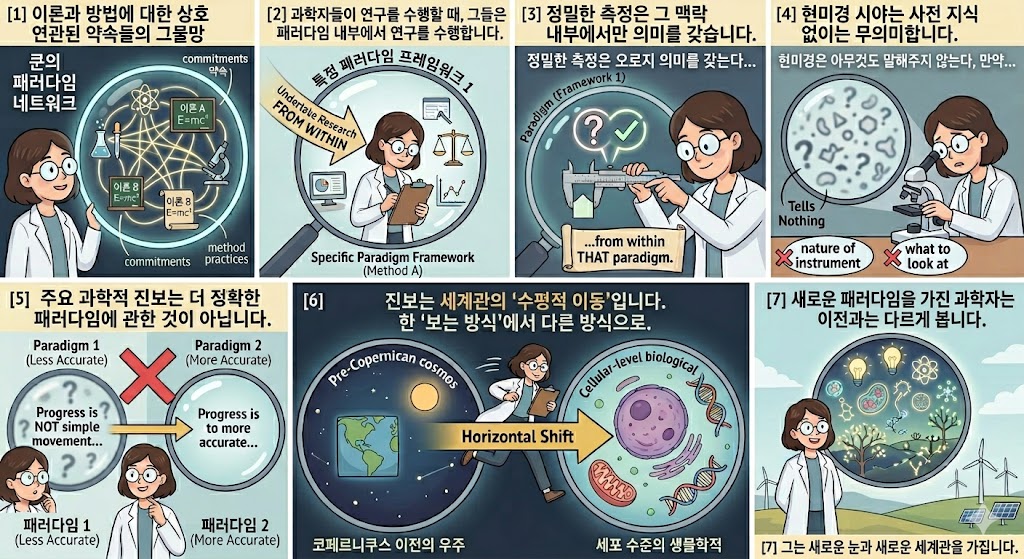
주제·제목·요약
주제 (Topic)
The paradigm-dependent nature of scientific research and the definition of progress as a horizontal shift
과학 연구의 패러다임 의존적 특성과 수평적 이동으로서의 과학적 진보의 정의
제목 (Title)
The Paradigm Shift: Science is Not about Accuracy, but a New Way of Seeing
패러다임 전환: 과학은 정확성이 아니라 세상을 보는 새로운 방식이다
요약 (Summary)
According to Kuhn, scientific research and measurements are only meaningful within a specific paradigm; therefore, scientific progress is not a vertical climb toward accuracy but a horizontal shift between different ways of perceiving the world.
쿤에 따르면, 과학적 연구와 측정은 특정 패러다임 안에서만 의미가 있다. 따라서 과학적 진보는 정확성을 향한 수직적 상승이 아니라, 세상을 인식하는 서로 다른 방식들 사이의 수평적 이동이다.
"과학은 계단을 올라가는 게 아니라, 파란색 안경을 쓰다가 빨간색 안경으로 갈아끼는 거야"
💡 팁: [5]번 문장의 **"not a movement from a less to a more accurate paradigm"**은 쿤의 철학을 관통하는 가장 중요한 부분입니다. 과학이 절대적인 진리를 향해 '더 나아지는 것'이 아니라, '다르게 해석하는 것'이라는 **수평적 이동(horizontal shift)**의 개념을 꼭 기억하세요!
🔬 토마스 쿤의 패러다임: 과학적 진보의 실체
패러다임의 정의와 구성 요소
[1] As Kuhn proposed (쿤이 제안했듯이), / our propositions about the world (세상에 대한 우리의 명제들은) / are embedded within paradigms (패러다임 안에 내재되어 있다), / roughly a network of interrelated commitments (대략적으로 상호 연관된 약속들의 네트워크인) /
to a particular theory (특정한 이론에 대한), / a conception of a subject matter (주제에 대한 개념), / and methodological practices (그리고 방법론적인 관행들에 대한).
쿤이 제안했듯이, 세상에 대한 우리의 명제들은 패러다임 안에 내재되어 있는데, 이것은 대략 특정한 이론, 주제에 대한 개념, 그리고 방법론적인 관행들에 대한 상호 연관된 약속들의 네트워크이다.
- be embedded within: ~에 내재되어 있다, 박혀 있다
- interrelated: 상호 연관된
- 친구 단어 (의미 단위):
- As Kuhn proposed: 쿤이 제안했듯이
- propositions about the world: 세상에 대한 명제들
- embedded within paradigms: 패러다임 안에 박혀 있는 (내재된)
- network of interrelated commitments: 상호 연관된 약속들의 네트워크
- commitment to 명사: ~에 대한 약속, 전념
- methodological practices: 방법론적 관행들
- 표현 포인트:
- [수동태] are embedded within은 명제가 독립적인 것이 아니라 패러다임이라는 틀 안에 속해 있음을 나타내는 핵심 덩어리입니다.
- [동격] roughly a network... 이 부분이 앞의 paradigms를 부연 설명하는 친구입니다.
패러다임 안에서의 과학 연구
[2] Thus, when scientists undertake research (따라서 과학자들이 연구를 수행할 때), / they do so from within a specific paradigm (그들은 특정한 패러다임 안에서 그렇게 한다).
따라서 과학자들이 연구를 수행할 때, 그들은 특정한 패러다임 안에서 연구를 수행한다.
- undertake: (일, 책임 등을) 맡다, 수행하다
- do so: '연구를 수행하다(undertake research)'를 대신하는 대동사 구문
- 친구 단어 (의미 단위):
- undertake research: 연구에 착수하다 (수행하다)
- from within a specific paradigm: 특정한 패러다임 안에서
- 표현 포인트:
- [대동사] do so는 앞의 undertake research를 대신하는 친구입니다.
측정의 의미와 패러다임의 관계
[3] Even the most exacting measurements (심지어 가장 정밀한 측정조차도) / are only sensible (오직 의미가 있다) / from within that paradigm (그 패러다임 안에서만).
심지어 가장 정밀한 측정조차도 그 패러다임 안에서만 의미가 있다.
- exacting: 정밀한, 엄격한
- sensible: 분별 있는, (여기서는) 의미가 통하는
- 친구 단어 (의미 단위):
- exacting measurements: 정밀한(엄격한) 측정들
- only sensible: 오직 의미가 있는 (합리적인)
- 표현 포인트:
- [한정] only를 통해 패러다임 밖에서는 데이터나 측정이 아무런 의미를 갖지 못한다는 단호한 논조를 보여줍니다.
현미경 사례를 통한 이해의 필요성
[4] For example, a look into a microscope (예를 들어, 현미경을 들여다보는 것은) / tells you nothing (당신에게 아무것도 말해주지 않는다) / unless you are already informed (당신이 이미 알고 있지 않다면) / about the nature of the instrument (그 도구의 성질에 대해) / and what you are supposed to be looking at OX (그리고 당신이 무엇을 보게 되어 있는지에 대해).
예를 들어, 당신이 그 도구(현미경)의 성질과 당신이 무엇을 보게 되어 있는지에 대해 이미 알고 있지 않다면, 현미경을 들여다보는 것은 당신에게 아무런 정보도 주지 못한다.
- unless: 만약 ~하지 않는다면 (if not)
- be supposed to V: ~하기로 되어 있다, ~해야 한다
- 친구 단어 (의미 단위):
- look into a microscope: 현미경을 들여다보다
- informed about: ~에 대해 알고 있는 (정보를 받은)
- nature of the instrument: 도구의 성질/본질
- supposed to be looking at: 보아야 하는 (보기로 되어 있는)
- 표현 포인트:
- [부사절] unless는 "만약 ~하지 않는다면"이라는 조건의 덩어리입니다.
- [의문사절] what you are supposed to...는 알고 있어야 할 지식의 내용을 나타내는 명사절 친구입니다.
과학적 진보의 진정한 의미: 수평적 이동
[5] Thus, what we call OX major progress in science (따라서 우리가 과학에서의 주요한 진보라고 부르는 것은) / is not a movement (이동이 아니다) / from a less to a more accurate paradigm (덜 정확한 패러다임에서 더 정확한 패러다임으로의).
따라서 우리가 과학에서의 주요한 진보라고 부르는 것은 덜 정확한 패러다임에서 더 정확한 패러다임으로 나아가는 이동이 아니다.
- not A but B 구문 연결: A가 아니라 B이다 ([5]번과 [6]번 문장 연결)
- 친구 단어 (의미 단위):
- major progress in science: 과학에서의 주요 진보
- less to a more accurate paradigm: 덜 정확한 곳에서 더 정확한 패러다임으로
- 표현 포인트:
- [관계대명사] what절이 주어로 쓰인 덩어리입니다. 쿤의 혁명적 주장이 담긴 핵심 문장입니다.
[6] Rather, it is a horizontal shift (오히려 그것은 수평적인 전환이다) / from one ‘way of seeing the world’ to another (하나의 ‘세상을 보는 방식’에서 다른 방식으로의).
오히려 그것은 하나의 ‘세상을 보는 방식’에서 다른 방식으로 옮겨가는 수평적인 전환이다.
- horizontal shift: 수평적 전환 (수직적 상승이 아님을 강조)
- 친구 단어 (의미 단위):
- horizontal shift: 수평적 이동 (핵심 키워드)
- way of seeing the world: 세상을 보는 방식
- from A to B: A에서 B로
- 표현 포인트:
- [대조] Rather를 사용하여 기존의 '수직적 축적' 관점을 '수평적 전환' 관점으로 뒤집는 덩어리입니다.
새로운 패러다임과 변화된 시각
[7] For Kuhn, ‘the scientist with a new paradigm (쿤에게 ‘새로운 패러다임을 가진 과학자는’) / sees differently from the way he had seen OX before (그가 이전에 보았던 방식과는 다르게 본다’).
쿤에게 있어, ‘새로운 패러다임을 가진 과학자는 그가 이전에 보았던 방식과는 다르게 본다.’
- had seen: 과거완료 (새로운 패러다임을 갖기 이전의 상태)
- 친구 단어 (의미 단위):
- sees differently from: ~와는 다르게 보다
- way he had seen before: 그가 이전에 보았던 방식
- 표현 포인트:
- [시제] 패러다임이 바뀌기 전의 과거를 나타내기 위해 과거완료(had seen)가 쓰인 덩어리입니다.
지문의 요지: 과학적 연구와 측정은 항상 특정 패러다임 안에서만 의미를 가집니다. 따라서 과학의 진보는 더 정확한 진리로 다가가는 수직적 발전이 아니라, 세상을 바라보는 틀 자체가 바뀌는 '수평적 관점의 전환'입니다.
1. 흐름으로 보아, 주어진 문장이 들어가기에 가장 적절한 곳은? [2.8점]
Rather, it is a horizontal shift from one ‘way of seeing the world’ to another.
As Kuhn proposed, our propositions about the world are embedded within paradigms, a network of interrelated commitments to a particular theory and methodological practices. ( ① ) Thus, when scientists undertake research, they do so from within a specific paradigm. ( ② ) Even the most exacting measurements are only sensible from within that paradigm. ( ③ ) For example, a look into a microscope tells you nothing unless you are already informed about the nature of the instrument and what you are supposed to be looking at. ( ④ ) Thus, what we call major progress in science is not a movement from a less to a more accurate paradigm. ( ⑤ ) For Kuhn, ‘the scientist with a new paradigm sees differently from the way he had seen before.’
2. 다음 글의 빈칸에 들어갈 말로 가장 적절한 것은? [3.2점]
As Kuhn proposed, our propositions about the world are embedded within paradigms, a network of interrelated commitments to a particular theory and methodological practices. Thus, when scientists undertake research, they do so from within a specific paradigm. Even the most exacting measurements are only sensible from within that paradigm. For example, a look into a microscope tells you nothing unless you are already informed about the nature of the instrument and what you are supposed to be looking at. Thus, what we call major progress in science is not a movement from a less to a more accurate paradigm. Rather, it is ______________________________________________________. For Kuhn, ‘the scientist with a new paradigm sees differently from the way he had seen before.’
① a gradual accumulation of scientific observations
② an absolute standard to measure universal truths
③ a vertical movement toward a flawless theory
④ a horizontal shift from one ‘way of seeing the world’ to another
⑤ an independent process free from any methodological practices
정답 및 해설
1. 정답: ⑤
- 해설: 주어진 문장의 'Rather(오히려)'는 앞 문장의 부정어(not)를 받아 대조적인 내용을 이끌어내는 강력한 연결사입니다. ⑤번 앞 문장에서 "과학적 진보는 덜 정확한 것에서 더 정확한 패러다임으로의 이동이 아니다(not a movement~)"라고 부정했으므로, 그 직후에 "오히려 그것은 세상을 보는 방식의 수평적 이동이다"라고 설명하는 주어진 문장이 들어가는 것이 논리적으로 완벽합니다.
2. 정답: ④
- 해설: 이 글의 핵심 요지는 과학적 발전이 객관적 진리를 향한 수직적 상승이 아니라, 패러다임이라는 틀 안에서 세상을 보는 관점 자체가 바뀌는 수평적 전환이라는 것입니다. 따라서 빈칸에는 ④번 "세상을 보는 한 방식에서 다른 방식으로의 수평적 이동"이 들어가는 것이 가장 적절합니다. (③번은 필자의 주장과 정반대되는 매력적인 오답으로 구성했습니다.)
[서술형 00번] 다음 글의 내용을 한 문장으로 요약하고자 한다. 빈칸에 들어갈 말을 [보기]의 단어를 활용하여 [조건]에 맞게 영어로 완성하시오. [6점]
As Kuhn proposed, our propositions about the world are embedded within paradigms, a network of interrelated commitments to a particular theory and methodological practices. Thus, when scientists undertake research, they do so from within a specific paradigm. Even the most exacting measurements are only sensible from within that paradigm. For example, a look into a microscope tells you nothing unless you are already informed about the nature of the instrument and what you are supposed to be looking at. Rather, what we call major progress in science is a horizontal shift from one ‘way of seeing the world’ to another. For Kuhn, ‘the scientist with a new paradigm sees differently from the way he had seen before.’
[ 요약문 ] According to Kuhn, scientific progress is not a matter of increasing accuracy, but (A) [ ].
[ 보 기 ] paradigm, another, view, shift, one, from, to (단, 필요한 경우 단어의 형태를 변형하고, 단어를 추가하여 완성할 것)
[ 조 건 ]
- A of B (A라는 형태의 B) 구조를 반드시 포함할 것.
- 동명사구를 활용하여 변화의 과정을 표현할 것.
- 지문의 핵심 표현인 **'horizontal shift'**의 의미가 담기도록 하시오.
- 12단어 이내로 작성하시오.
⇨ __________________________________________________________________________________________
정답: a horizontal shifting of view from one paradigm to another (또는 shifting a paradigm of view from one to another)
[분석 및 채점 가이드]
- A of B 구조 (2점): 지시대로 shifting(A) of view(B) 또는 paradigm(A) of view(B) 구조를 정확히 구현했는가?
- 동명사구 활용 (2점): shift를 shifting으로 변형하여 변화의 역동성을 표현했는가? (본문의 horizontal shift를 활용)
- 논리적 완성도 (2점): '한 패러다임에서 다른 패러다임으로의 이동'이라는 핵심 내용을 from one to another로 명확히 서술했는가?
- 단어 수 제한: 9~10단어로 작성되어 조건(12단어 이내)을 완벽히 충족함.
'고1 > 고1 3월 모의고사' 카테고리의 다른 글
| 2026년 고1 3월 모의고사 영어 40번 해설 및 분석 변형문제 (0) | 2026.03.27 |
|---|---|
| 2026년 고1 3월 모의고사 영어 39번 해설 및 분석 변형문제 (0) | 2026.03.27 |
| 2026년 고1 3월 모의고사 영어 37번 해설 및 분석 변형문제 (1) | 2026.03.27 |
| 2026년 고1 3월 모의고사 영어 36번 해설 및 분석 변형문제 (1) | 2026.03.27 |
| 2026년 고1 3월 모의고사 영어 35번 해설 및 분석 변형문제 (0) | 2026.03.27 |