2023년 고1 6월 모의고사 영어 33번 분석 및 변형문제
Someone else's body language affects our own body, which then creates an emotional echo that makes us feel accordingly. As Louis Armstrong sang, "When you're smiling, the whole world smiles with you." If copying another's smile makes us feel happy, the emotion of the smiler has been transmitted via our body. Strange as it may sound, this theory states that ____________________. For example, our mood can be improved by simply lifting up the corners of our mouth. If people are asked to bite down on a pencil lengthwise, taking care not to let the pencil touch their lips (thus forcing the mouth into a smile-like shape), they judge cartoons funnier than if they have been asked to frown. The primacy of the body is sometimes summarized in the phrase "I must be afraid, because I'm running." [3점]
lengthwise: 길게 frown: 얼굴을 찡그리다
① language guides our actions
② emotions arise from our bodies
③ body language hides our feelings
④ what others say affects our mood
⑤ negative emotions easily disappear
Someone else's body language affects our own body, which then creates an emotional echo that makes us feel accordingly. As Louis Armstrong sang, "When you're smiling, the whole world smiles with you." If copying another's smile makes us feel happy, the emotion of the smiler has been transmitted via our body. Strange as it may sound, this theory states that emotions arise from our bodies. For example, our mood can be improved by simply lifting up the corners of our mouth. If people are asked to bite down on a pencil lengthwise, taking care not to let the pencil touch their lips (thus forcing the mouth into a smile-like shape), they judge cartoons funnier than if they have been asked to frown. The primacy of the body is sometimes summarized in the phrase "I must be afraid, because I'm running."
[지문 분석: 신체 반응이 감정을 생성하고 전달하는 신체 우선설의 원리]
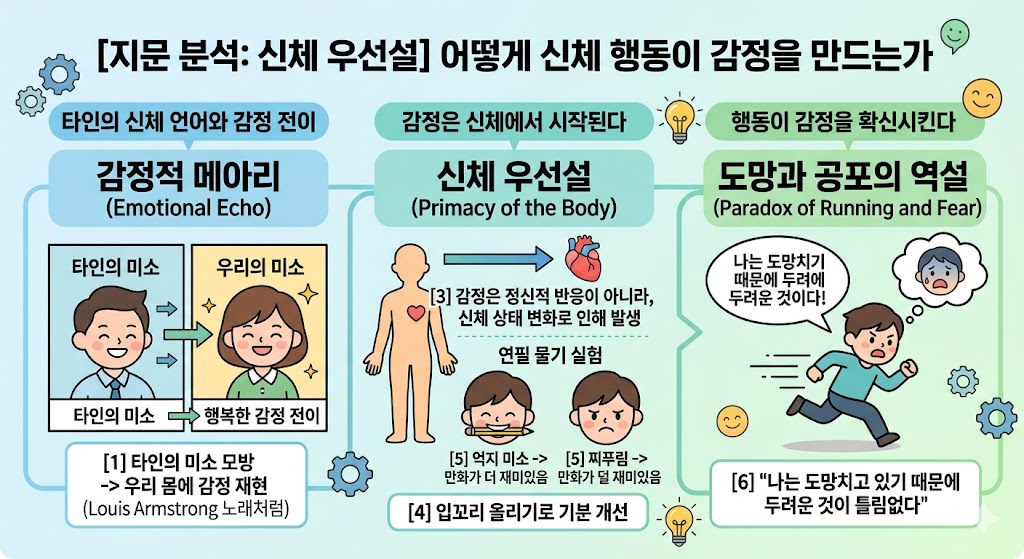
[1] Someone else's body language affects our own body, which then creates an emotional echo that makes us feel accordingly.
(타인의 신체 언어는 우리 자신의 신체에 영향을 미치며, 이는 다시 우리가 그에 맞춰 느끼게 만드는 감정적 메아리를 생성한다.)
[2] As Louis Armstrong sang, "When you're smiling, the whole world smiles with you." If copying another's smile makes us feel happy, the emotion of the smiler has been transmitted via our body.
(Louis Armstrong가 노래했듯이, "당신이 미소를 지을 때, 온 세상이 당신과 함께 미소 짓는다." 만약 타인의 미소를 모방하는 것이 우리를 행복하게 만든다면, 미소 짓는 사람의 감정은 우리 신체를 통해 전달된 것이다.)
[3] Strange as it may sound, this theory states that emotions arise from our bodies.
(이상하게 들릴지 모르지만, 이 이론은 감정이 우리의 신체로부터 발생한다고 주장한다.)
[4] For example, our mood can be improved by simply lifting up the corners of our mouth.
(예를 들어, 우리의 기분은 단순히 입꼬리를 올리는 것만으로도 개선될 수 있다.)
[5] If people are asked to bite down on a pencil lengthwise, taking care not to let the pencil touch their lips (thus forcing the mouth into a smile-like shape), they judge cartoons funnier than if they have been asked to frown.
(만약 사람들이 연필이 입술에 닿지 않게 주의하며 연필을 가로로 물도록 요청받으면(그렇게 함으로써 입을 미소와 유사한 모양으로 강제하게 됨), 그들은 찌푸리도록 요청받았을 때보다 만화를 더 재미있다고 판단한다.)
[6] The primacy of the body is sometimes summarized in the phrase "I must be afraid, because I'm running."
(신체의 우선성은 "나는 도망치고 있기 때문에 두려운 것이 틀림없다"라는 문구로 요약되기도 한다.)
[내용 연결 & 핵심 키워드 통합 정리]
- 감정적 메아리와 전이: 타인의 신체 언어는 우리 신체에 영향을 주며, 이를 모방함으로써 타인의 감정을 우리 몸 안에서 똑같이 느끼는 '감정적 메아리'가 생성됨
- 신체 우선설(Primacy of the body): 감정은 외부 사건에 대한 정신적 반응이 아니라, 신체적 상태가 먼저 변화함에 따라 그 결과를 감정으로 인식하게 된다는 이론임
- 신체적 조작을 통한 기분 전환: 미소 짓는 모양(입꼬리 올리기, 연필 물기)을 강제로 취하게 하면 뇌는 이를 행복한 상태로 해석하여 실제로 기분이 좋아지는 효과가 발생함
- 도망과 공포의 역설: 우리가 두렵기 때문에 도망치는 것이 아니라, 도망치는 신체 행동을 먼저 함으로써 그 뒤에 두려움이라는 감정을 역으로 확신하게 된다는 논리임
[제목 · 주제 · 요지 · 요약]
- 제목 (Title)
- 영문: The Body-First Theory: How Physical Actions Create Our Emotions
- 한글: 신체 우선 이론: 어떻게 신체적 행동이 우리의 감정을 창조하는가
- 주제 (Topic)
- 영문: The Primacy of the Body in Emotional Generation and Transmission
- 한글: 감정 생성과 전달에 있어서 신체의 우선성
- 요지 (Main Idea)
- 영문: Emotions originate from our physical state rather than just mental processes; thus, mimicking physical expressions can transmit others' emotions and even alter our own mood.
- 한글: 감정은 정신적 과정보다 신체적 상태에서 기원하므로, 신체적 표현을 모방하는 것은 타인의 감정을 전달하고 우리 자신의 기분까지 변화시킬 수 있다.
- 요약 (Summary - 지문 순서별 키워드 화살표 초압축형)
- [핵심 키워드] 감정적 메아리(Emotional Echo) / 신체 우선설(Primacy of the Body) / 신체적 행동(Physical Actions)
- [지문 1~2번] 1. 타인의 몸짓을 따라 하면 감정적 메아리(emotional echo)가 발생해 우리 몸에서 그 감정이 똑같이 재현됨.
- [지문 3~5번] 2. 감정은 신체에서 발생한다는 신체 우선설(primacy of the body)에 따라, 입꼬리를 올리거나 연필을 물어 웃는 모양을 만드는 것만으로도 기분이 개선됨.
- [지문 6번] 3. 즉, 우리는 감정을 느껴 행동하는 것이 아니라 도망치기 때문에 두려움을 확신(must be afraid, because I'm running)하는 것과 같은 원리임.
[한 문장 요약 (서술형 대비)]
"The theory of the body's primacy suggests that our emotions are fundamentally generated by our physical reactions, meaning that by mirroring the body language of others or physically forcing our own facial expressions, we can actively trigger and transmit specific emotional states."
(신체 우선설은 우리의 감정이 근본적으로 우리의 신체적 반응에 의해 생성된다는 점을 시사하며, 이는 우리가 타인의 신체 언어를 모방하거나 강제로 우리 자신의 표정을 만듦으로써 특정 감정 상태를 능동적으로 유발하고 전달할 수 있음을 의미합니다.)
우리가 타인의 행동을 모방함으로써 감정을 공유하게 된다는 '신체 피드백 이론(Facial Feedback Hypothesis/Body Primacy)'을 다룬 흥미로운 심리학 지문입니다.
"웃으니까 행복해지는 것인가, 행복해서 웃는 것인가?"라는 고전적 질문에 대해, 신체적 반응(근육의 움직임)이 감정의 원인이 될 수 있다는 파격적인 이론을 제시하고 있습니다. 연필을 입에 물어 미소 짓는 모양을 만드는 것만으로도 유머를 더 재밌게 느끼게 된다는 유명한 실험 사례
이 지문은 심리학에서 '신체화된 인지(Embodied Cognition)'의 핵심 원리인 '신체적 반응이 감정을 선행하거나 유발한다'는 이론을 다루고 있습니다.
우리가 타인의 표정을 무의식적으로 따라 하고, 그 신체적 모방이 우리 뇌에 정서적 신호를 전달하여 감정을 생성하는 인지적 메커니즘
1. 지문 속 핵심 메커니즘: '신체적 모방(Physical Mimicry)'과 '정서적 메아리(Emotional Echo)'
이 글은 감정이 마음에서 몸으로 흐르는 것이 아니라, 몸의 변화가 뇌를 속여 감정을 만들어낸다는 인과관계의 역설을 설명합니다.
- 정서적 전염(Emotional Contagion) = 타인의 신체적 반영 타인의 몸짓(body language)을 보는 것만으로도 우리의 몸은 본능적으로 그 모습을 복사(copying)합니다. 웃는 사람을 보면 우리 입꼬리 근육이 미세하게 움직이고, 이 '신체적 메아리'가 뇌로 전달되어 실제로 행복한 기분을 만들어냅니다. 즉, 타인의 감정은 몸을 매개로 전염(transmitted via our body)됩니다.
- 신체 우선주의(Primacy of the Body) = "웃어서 행복한 것이다" 전통적인 생각과 달리, 우리는 '행복해서 웃는 것'이 아니라 '웃기 때문에 행복을 느끼는 것'일 수 있습니다. 연필을 가로로 물어 입꼬리를 억지로 올리면 뇌는 이를 '웃음'이라는 신체 데이터로 해석하여, 보고 있는 만화를 더 재미있게 느끼는 감정적 출력값(output)을 내놓습니다. "무서워서 도망가는 것이 아니라, 도망가고 있으니 내가 무서운 것이다(I must be afraid, because I'm running)"라는 문구는 신체가 감정의 주도권을 쥐고 있음을 보여주는 결정적 증거입니다.
💡 [신체 피드백 이론: 신체의 움직임이 감정을 창조하는 역설적 메커니즘]
[문단 전개: 도입 - 타인의 신체 언어와 우리의 신체 사이의 '감정적 메아리(Emotional Echo)']
[1] Someone else's body language affects our own body, [which SX then creates an emotional echo (that SX makes us feel [accordingly]).
- 영어(한글) 의미덩어리 해석: Someone [else's] body language (다른 누군가의 신체 언어는) / affects our [own] body, (우리의 신체에 영향을 미친다,) / (which then creates) (그리고 그것은 그 후 만들어낸다) / an [emotional] echo (하나의 감정적 메아리를) / (that makes us feel) (우리가 느끼게 만드는) / [accordingly]). (그에 따라서).
- 전체 해석: 다른 누군가의 신체 언어는 우리의 신체에 영향을 미치고, 그 후 그것은 우리가 그에 따라(상응하게) 느끼도록 만드는 '감정적 메아리'를 생성합니다.
- 단어 정리: * body language: 신체 언어, 바디 랭귀지 * affect: 영향을 미치다 * emotional: 감정적인 * echo: 메아리, 반향 * accordingly: 그에 따라서, 상응하게
- 🔥 내신 출제 포인트 (관계대명사 계속적 용법 중첩): 지문의 서두에서 이론의 핵심을 던지는 중요 문장입니다.
- 콤마 뒤의 , which ~는 앞 문장 내용(타인의 바디랭귀지가 우리 몸에 영향을 미치는 현상)을 부연하는 관계대명사 계속적 용법(형용사절) 덩어리입니다. which 자리에 접속사 and나 that을 쓰면 어법상 오답입니다.
- 명사 echo 뒤의 (that makes us feel ~ )는 앞의 명사를 수식하는 주격 관계대명사절(형용사절) 덩어리이며, 그 내부에 make + 목적어(us) + 목적보어(동사원형 feel) 5형식 구조가 정교하게 결합해 있습니다.
[2] [As Louis Armstrong sang], “When you’re smiling, the whole world smiles with you.”
- 영어(한글) 의미덩어리 해석: [As Louis Armstrong sang], (루이 암스트롱이 노래했듯이,) / “When you’re [smiling], ( “당신이 미소 지을 때,) / the [whole] world smiles (온 세상이 미소 짓는다) / [with you].” (당신과 함께”).
- 전체 해석: 루이 암스트롱이 노래했듯이, “당신이 미소 지을 때, 온 세상이 당신과 함께 미소 짓습니다.”
- 표현 포인트: 1. [As ~ ]는 양태(~하듯이)를 나타내는 부사절 덩어리입니다. 2. 대명사 you는 일반적인 사람들을 지칭하는 덩어리입니다.
[3] [If copying another's smile makes us feel happy, the emotion (of the smiler) has been transmitted [via our body].
- 영어(한글) 의미덩어리 해석: [If copying [another's] smile] (만약 다른 사람의 미소를 따라 하는 것이) / makes us feel [happy], (우리가 행복함을 느끼게 만든다면,) / the emotion (그 감정은) / (of the smiler) (미소 짓는 사람의) / has been [transmitted] (전달되어 온 것이다) / [via our body]. (우리의 신체를 통해서).
- 전체 해석: 만약 타인의 미소를 따라 하는 것이 우리를 행복하게 만든다면, 그 미소 짓는 사람의 감정은 우리의 신체를 통해 전달된 것입니다.
- 단어 정리: * copy: 따라 하다, 복사하다 * transmit: 전달하다, 전송하다 (be transmitted: 전달되다) * via: ~을 통해서
- 🔥 내신 출제 포인트 (동명사 주어와 사역동사 보어): 조건부 부사절 [If ~] 내부에 동명사구 주어인 [copying another's smile]이 쓰였으며, 본동사 makes 뒤에 make + 목적어(us) + 목적보어(동사원형 feel) 5형식 사역 구조가 정교하게 호응합니다. 주절의 주어는 the emotion이며, 전달'되는' 수동 관계이므로 현재완료 수동태인 has been transmitted 덩어리가 쓰였습니다.
[문단 전개: 전개 1 - 이론의 핵심: 감정은 몸에서 비롯된다 (신체 피드백)]
[4] Strange [as it may sound], this theory states that emotions arise [from our bodies].
- 영어(한글) 의미덩어리 해석: [Strange] [as it may sound], (비록 그것이 이상하게 들릴지 모르겠지만,) / this theory states (이 이론은 명시한다) / [that emotions arise] (접속사 that 이하라는 점을: 감정들이 생겨난다는 것을) / [from our bodies]. (우리의 신체로부터).
- 전체 해석: 이상하게 들릴지 모르겠지만, 이 이론은 감정이 바로 우리의 신체로부터 생겨난다고 명시합니다.
- 단어 정리: * strange: 이상한, 낯선 * theory: 이론 * state: 명시하다, 말하다 * arise: 생겨나다, 발생하다
- 🔥 내신 출제 포인트 (양보의 도치 구문): 어순 배열 서술형 0순위 문장입니다.
- 원래 Although it may sound strange 문장에서 보어인 strange가 문두로 도치되면서 [Strange as it may sound]라는 양보의 부사절 덩어리를 형성합니다. as 자리에 though가 와도 동일한 구조이며, 이 도치 구문은 내신 어법의 꽃입니다. 타동사 states 뒤의 목적어로 명사절 [that ~]이 깔끔하게 위치합니다.
[문단 전개: 전개 2 - 실험 사례: 연필 물기 실험을 통한 신체 근육의 감정 유발 효과]
[5] [For example], our mood can be improved [by simply lifting up the corners (of our mouth)].
- 영어(한글) 의미덩어리 해석: [For example], (예를 들어,) / our mood can be [improved] (우리의 기분은 향상될 수 있다) / [by [simply] [lifting [up]]] (단지 들어 올림으로써) / the corners (입꼬리를) / (of our mouth). (우리 입의).
- 전체 해석: 예를 들어, 단순히 입꼬리를 들어 올리는 것만으로도 우리의 기분은 향상될 수 있습니다.
- 단어 정리: * mood: 기분 * improve: 향상시키다, 개선하다 * lift up: 들어 올리다 * corner: 모서리, 귀퉁이
- 표현 포인트: 수동태 can be improved 덩어리가 쓰였으며, [by ~ing] 수단 부사구 내부의 lifting up이 입꼬리를 물리적으로 올리는 행위를 묘사합니다.
[6] [If people are asked to bite down [on a pencil] [lengthwise]], taking care not to let the pencil touch their lips [thus] forcing the mouth [into a smile-like shape], they judge cartoons funnier [than [if they have been asked to frown]].
- 영어(한글) 의미덩어리 해석: [If people are asked] (만약 사람들이 요청받는다면) / [to bite [down] [on a pencil]] (연필을 꽉 물라고) / [lengthwise] (길이 방향으로,) / [taking care] (조심하면서) / [not [to let the pencil touch their lips]] (연필이 입술에 닿지 않도록) / (thus [forcing] the mouth) (따라서 입을 강제하면서) / [into a [smile-like] shape]), ( “미소와 유사한” 모양으로,) / they judge cartoons (그들은 만화들을 판단한다) / [funnier] (더 재미있다고) / [than [if they have been asked [to frown]]]. (그들이 찡그리라고 요청받았을 때보다).
- 전체 해석: 만약 사람들이 연필이 입술에 닿지 않게 주의하며 연필을 길이 방향으로 꽉 물라고(그렇게 하여 강제로 입 모양을 미소와 유사하게 만들라고) 요청받으면, 그들은 찡그리라고 요청받았을 때보다 만화를 더 재미있다고 판단합니다.
- 단어 정리: * bite down on: ~을 꽉 물다 * lengthwise: 길이 방향으로 * touch: 닿다 * force: 강요하다, 강제하다 * shape: 모양 * judge: 판단하다 * funny: 재미있는, 우스운 * frown: 찡그리다
- 친구 단어: * let + 목적어 + 동사원형: ~가 ~하게 두다
- 🔥 내신 출제 포인트 (분사구문 및 비교급 구조): 긴 호흡의 영작 최상위 문장입니다.
- 수동태 are asked to V 구조 내부에 bite down on 구동사가 결합해 있습니다.
- [taking care ~]는 부사적 분사구문 덩어리입니다.
- 목적보어 자리에 let + 목적어(the pencil) + 목적보어(동사원형 touch) 구조가 쓰였으며, 콤마 뒤의 [thus forcing ~]는 인과 관계를 나타내는 분사구문 덩어리입니다. forcing 내부의 5형식 구조 force + 목적어(the mouth) + 목적보어(into a shape)가 어법 핵심 스폿입니다.
- judge 뒤의 목적격 보어로 형용사 funnier가 안착해 있는데, 이를 부사 funny로 쓰면 문법상 파괴되므로 주의가 필요합니다. 마지막 [if ~ frown]은 비교 대상 부사절 덩어리입니다.
[문단 전개: 결론 - 신체 우선주의(Body Primacy)의 요약: "나는 도망치기 때문에 두렵다"]
[7] The primacy (of the body) is [sometimes] summarized [in the phrase] “I must be afraid, [because I’m running].”
- 영어(한글) 의미덩어리 해석: The primacy (우선주의는) / (of the body) (신체의) / is [sometimes] summarized (때때로 요약된다) / [in the phrase] (구절 속에서) / “I [must] be [afraid], ( “나는 두려움에 틀림없다,) / [because [I’m [running]]].” (왜냐하면 내가 달리고 있기 때문이다”).
- 전체 해석: 이러한 신체 우선주의는 때때로 “나는 지금 달리고 있으므로, 두려움을 느끼는 것이 틀림없다”라는 구절로 요약됩니다.
- 단어 정리: * primacy: 우선주의, 탁월함 * summarize: 요약하다 * afraid: 두려워하는 * run: 달리다
- 표현 포인트: 지문의 핵심 결론을 담은 인용문구입니다. 행동(달리기)이 감정(두려움)을 유발한다는 신체 우선주의(primacy of the body)의 본질을 완벽하게 관통하는 문장입니다.
💡 지문의 요지
타인의 신체 언어를 보거나 따라 하는 것만으로도 우리의 신체는 즉각적으로 반응하여 그와 상응하는 감정을 생성하는 '감정적 메아리(emotional echo)' 현상을 일으킵니다. 이를 입증하는 대표적인 이론인 '신체 피드백 이론'에 따르면, 감정은 마음에서 몸으로 전달되는 것이 아니라 역설적으로 우리 신체의 움직임(신체 우선주의, primacy of the body)에서 기인합니다. 실험 결과, 입꼬리를 올리는 미소 모양(smile-like shape)을 강제로 유지한 사람들은 인상을 찡그린 사람들보다 동일한 만화를 훨씬 더 재미있다고 판단했습니다. 이는 우리가 상황을 파악해서 웃는 것이 아니라, 몸이 먼저 웃고 있기에(I'm running) 행복이나 두려움이라는 감정을 역으로 유추(I must be afraid)하게 된다는, 감정의 생성 순서에 대한 혁신적인 심리학적 통찰을 다룬 글입니다.
다음 밑줄 친 I must be afraid, because I'm running.이 시사하는 감정 형성의 원리를 <조건>에 맞게 서술하시오. [4점]
[본문 맥락] Strange as it may sound, this theory states that emotions arise from our bodies. For example, our mood can be improved by simply lifting up the corners of our mouth. If people are asked to bite down on a pencil lengthwise... they judge cartoons funnier than if they have been asked to frown. The primacy of the body is sometimes summarized in the phrase "I must be afraid, because I'm running."
< 조 건 >
- 우리말 완결된 한 문장으로 서술할 것.
- 감정이 내면의 인지적 판단에서 먼저 발생하는 것이 아니라, '신체적 행동(달리기, 미소 등)'이 선행된 후에 '그 상태를 뇌가 해석하여 감정(공포, 행복 등)을 사후적으로 인식한다'는 원리를 명시하여 서술할 것.
- 분량 조건: 공백(띄어쓰기)을 포함하여 반드시 50자 이상 ~ 70자 이하로 작성할 것. (범위 미달 혹은 초과 시 감점)
⇨ [정답 예시] (공백 포함 총 67자) 감정은 내면에서 먼저 발생하는 것이 아니라 신체적인 반응이 선행되고, 뇌가 그 신체적 상태를 사후적으로 해석하여 감정을 인식함을 뜻한다.
위 글의 요지를 바탕으로 <보기>의 모든 단어만을 배열하여 빈칸 (A)에 들어갈 문장을 완성하시오. [6점]
Emotions are not merely internal psychological events; they are fundamentally rooted in physiological feedback. Consequently, ( A ) results in the subjective experience of distinct emotional states.
< 보 기 > [ the / feedback / by / generated / physical / of / manipulation / facial / muscles ]
< 조 건 >
- 제시된 단어를 모두 한 번씩만 사용할 것.
- 어형 변화는 하지 말 것.
- '얼굴 근육의 물리적 조작에 의해 생성된 피드백'이라는 복잡한 구조의 [명사구 주어]를 완성할 것. (중심 핵 명사가 전치사구들의 연속적인 후치 수식을 받도록 배열할 것)
- 명사구 주어의 핵심 핵(Head)을 정확히 발라내어, 빈칸 뒤에 이어지는 단수 본동사인 results와 수일치 장치가 자연스럽게 연동되도록 빌딩할 것.
- 지문에 제시된 문장 구조("the primacy of the body...")를 단순 모방하지 말 것.
⇨ 정답 예시: the feedback generated by physical manipulation of facial muscles (아이들이 맨 뒤에 배치되는 muscles라는 복수 명사에 눈이 팔려 주어의 진짜 핵인 단수 명사 feedback을 놓치면 본동사 results와 수일치가 어긋나도록 정밀 설계된 킬러 영작입니다.)
다음 글의 밑줄 친 ① ~ ⑤ 중 어법상 틀린 부분 두 개를 찾아 번호를 쓰고, 바르게 고친 후 그 이유를 우리말로 상세히 서술하시오. [5점]
Someone else's body language affects our own body, ① that creates an emotional echo that makes us feel accordingly. As Louis Armstrong sang, "When you're smiling, the whole world smiles with you." If copying another's smile makes us feel happy, the emotion of the smiler has been transmitted via our body. ②Strangely as it may sound, this theory states that emotions arise from our bodies. For example, our mood can be improved by simply lifting up the corners of our mouth. If people are ③ asked to bite down on a pencil lengthwise, taking care not to let the pencil touch their lips (thus forcing the mouth into a smile-like shape), they judge cartoons funnier than if they have been asked to frown. The primacy of the body is sometimes ④ summarized in the phrase "I must be afraid, because I'm running." The psychological mechanism ⑤ that dictates our mood is rooted in somatic feedback.
[정답 및 풀이]
- 첫 번째 틀린 번호: ①
- 바르게 고치기: which
- 이유: 앞선 절 전체의 내용을 선행사로 받아 부연 설명을 이어가는 관계대명사의 계속적 용법 자리입니다. 명사절 접속사 that은 콤마(,) 뒤에서 앞 문장 전체를 선행사로 받을 수 없으므로, 이를 수용하여 부연 설명하는 관계대명사인 which를 사용해야 합니다.
- 두 번째 틀린 번호: ②
- 바르게 고치기: Strange
- 이유: '양보의 의미를 담은 도치 구문'에서 보어로 쓰인 형용사를 판별하는 자리입니다. As절의 도치 구문에서 Strange가 보어 자리에 있는 형용사로서 앞에 놓인 것인데, 이를 부사인 Strangely로 쓰는 것은 어법상 옳지 않습니다. sound와 같은 연결동사(Linking verb) 뒤에 보어가 와야 하므로 Strange로 고쳐야 합니다.
다음 글의 내용을 한 문장으로 요약하고자 한다. 빈칸 (A), (B)에 들어갈 말로 가장 적절한 것은?
Someone else's body language affects our own body, which then creates an emotional echo that makes us feel accordingly. As Louis Armstrong sang, "When you're smiling, the whole world smiles with you." If copying another's smile makes us feel happy, the emotion of the smiler has been transmitted via our body. Strange as it may sound, this theory states that emotions arise from our bodies. For example, our mood can be improved by simply lifting up the corners of our mouth. If people are asked to bite down on a pencil lengthwise, taking care not to let the pencil touch their lips (thus forcing the mouth into a smile-like shape), they judge cartoons funnier than if they have been asked to frown. The primacy of the body is sometimes summarized in the phrase "I must be afraid, because I'm running."
▼
Since our emotional states are heavily influenced by physical reactions, adopting specific ( A ) expressions can trigger corresponding internal feelings, demonstrating that emotions are ( B ) by the body.
① (A) facial — (B) generated
② (A) facial — (B) suppressed
③ (A) stagnant — (B) generated
④ (A) stagnant — (B) misinterpreted
⑤ (A) facial — (B) misinterpreted
[정답 및 해설]
정답: ①
[완성된 요약문 및 최종 해석]
- Summary: Since our emotional states are heavily influenced by physical reactions, adopting specific facial expressions can trigger corresponding internal feelings, demonstrating that emotions are generated by the body.
- 해석: "우리의 감정 상태는 신체적 반응에 의해 크게 영향을 받기 때문에, 특정 얼굴(facial) 표정을 취하는 것은 그에 상응하는 내적 감정을 유발할 수 있으며, 이는 감정이 신체에 의해 **생성됨(generated)**을 입증한다."
1. 접속사절 (A)의 추론: facial (얼굴의)
- 정답 근거: 본문에서 감정을 유발하는 구체적인 예시로 "입꼬리를 올리기(lifting up the corners of our mouth)", "연필을 가로로 물어 웃는 모양 만들기(forcing the mouth into a smile-like shape)", "찌푸리기(frown)"를 들고 있습니다. 모두 얼굴 근육을 이용한 표정들이므로 facial이 가장 적절합니다.
2. 주절 (B)의 추론: generated (생성되는, 만들어지는)
- 정답 근거: 지문 중반부에서 "이 이론은 감정이 우리 몸으로부터 발생한다고(emotions arise from our bodies) 말한다"고 명시했습니다. 신체가 감정을 만들어낸다는 논리이므로, arise from의 의미를 가진 단어 generated가 정답입니다.
[선택지 한글 해석]
- ① (A) facial (얼굴의) — (B) generated (생성되는) (정답)
- ② (A) facial (얼굴의) — (B) suppressed (억압되는)
- ③ (A) stagnant (정체된) — (B) generated (생성되는)
- ④ (A) stagnant (정체된) — (B) misinterpreted (잘못 해석되는)
- ⑤ (A) facial (얼굴의) — (B) misinterpreted (잘못 해석되는)
다음 글의 제목으로 가장 적절한 것은?
Someone else's body language affects our own body, which then creates an emotional echo that makes us feel accordingly. As Louis Armstrong sang, "When you're smiling, the whole world smiles with you." If copying another's smile makes us feel happy, the emotion of the smiler has been transmitted via our body. Strange as it may sound, this theory states that emotions arise from our bodies. For example, our mood can be improved by simply lifting up the corners of our mouth. If people are asked to bite down on a pencil lengthwise, taking care not to let the pencil touch their lips (thus forcing the mouth into a smile-like shape), they judge cartoons funnier than if they have been asked to frown. The primacy of the body is sometimes summarized in the phrase "I must be afraid, because I'm running."
① The Emotional Echo: How Physical Actions Shape Our Feelings
② Mirror Neurons: The Biological Basis of Human Empathy
③ Why We Smile: The Evolutionary Advantage of Social Bonding
④ Beyond Body Language: The Cognitive Roots of Human Emotion
⑤ Fear and Laughter: A Physiological Analysis of Extremes
정답 및 해설
- 정답: ① The Emotional Echo: How Physical Actions Shape Our Feelings (감정의 반향: 신체적 행동이 우리의 감정을 형성하는 방식)
해설 (Explanation)
- 정답인 이유:
- 본문은 타인의 바디랭귀지를 따라 함으로써 우리 몸에 생기는 '감정적 반향(emotional echo)'을 설명하며 시작합니다. 즉, 감정은 신체로부터 유발된다는 이론(emotions arise from our bodies)을 제시하고, 입꼬리를 올리는 간단한 행위나 연필을 이용한 미소 짓기 실험을 통해 행동이 감정에 미치는 영향을 증명합니다. 마지막 문장의 "I must be afraid, because I'm running"은 감정보다 신체적 반응이 우선(primacy of the body)함을 완벽히 요약합니다. 따라서 감정이 신체적 행동에 의해 형성된다는 이 글의 중심 논지를 가장 정확하게 대변하는 ①번이 정답입니다.
- 오답 매력도 분석 (수능형 오답 출제 원리 반영):
- ② Mirror Neurons: The Biological Basis of Human Empathy (거울 뉴런: 인간 공감의 생물학적 토대) $\rightarrow$ 타인의 바디랭귀지를 따라 하는 현상을 보고 '공감'이나 '거울 뉴런'을 떠올리기 쉽도록 설계된 매력적인 오답입니다. 하지만 본문은 거울 뉴런이라는 특정 용어를 언급하지 않으며, 이 현상을 사회적 공감 차원이 아니라 감정의 신체적 기원이라는 심리학적 차원에서 다룹니다. (소재 오용 오답)
- ③ Why We Smile: The Evolutionary Advantage of Social Bonding (우리가 웃는 이유: 사회적 유대감의 진화론적 이점) $\rightarrow$ 루이 암스트롱의 노래 가사나 '웃음'이라는 소재를 활용했으나, 이 글은 웃음의 사회적 기능이나 진화적 이점을 다루는 글이 아닙니다. (주제 탈선 오답)
- ④ Beyond Body Language: The Cognitive Roots of Human Emotion (바디랭귀지를 넘어서: 인간 감정의 인지적 뿌리) $\rightarrow$ 본문이 신체 반응을 다루면서 인지 이론과 연결되기도 하지만, '인지적(Cognitive) 뿌리'를 강조하는 것은 본문이 주장하는 '신체 우선론(primacy of the body)'과 대치되는 방향입니다. (내용 왜곡 오답)
- ⑤ Fear and Laughter: A Physiological Analysis of Extremes (공포와 웃음: 극단적 감정에 대한 생리학적 분석) $\rightarrow$ 실험의 사례로 '웃음'과 '공포(running)'가 등장하여 그럴듯해 보이지만, 본문은 특정 감정의 생리학적 분석이 아니라 '신체가 감정을 유발한다'는 이론 자체를 설명하는 글입니다. (지엽적 소재 오답)
다음 글의 주제로 가장 적절한 것은?
Someone else's body language affects our own body, which then creates an emotional echo that makes us feel accordingly. As Louis Armstrong sang, "When you're smiling, the whole world smiles with you." If copying another's smile makes us feel happy, the emotion of the smiler has been transmitted via our body. Strange as it may sound, this theory states that emotions arise from our bodies. For example, our mood can be improved by simply lifting up the corners of our mouth. If people are asked to bite down on a pencil lengthwise, taking care not to let the pencil touch their lips (thus forcing the mouth into a smile-like shape), they judge cartoons funnier than if they have been asked to frown. The primacy of the body is sometimes summarized in the phrase "I must be afraid, because I'm running."
① emotional transmission through involuntary social mimicry
② body-based origins of human emotional experiences
③ impacts of pencil-biting on analytical problem-solving
④ physiological risks of suppressed facial expressions
⑤ psychological factors behind the primacy of memory
💡 실제 수능 기준 출제 코드 및 정답 해설
- 정답: ②
- 선지 구조: 글의 핵심 문장인 "emotions arise from our bodies"를 'body-based origins(신체에 기반을 둔 기원)'으로, "human emotional experiences(인간의 감정적 경험)"와 결합하여 학술적인 주제문으로 완벽하게 재진술(Paraphrasing)했습니다.
- 정답 해설: 이 글은 타인의 표정을 모방하거나(미소 짓기), 연필을 물어 강제로 웃는 표정을 만드는 것만으로도 행복을 느끼거나 만화를 더 재미있게 평가하게 된다는 실험 결과를 제시합니다. 즉, 감정이 뇌에서 시작되어 신체로 나타나는 것이 아니라, 신체의 물리적 상태(표정, 움직임)가 먼저 감정을 만들어낸다는 '신체의 우선성'을 주장하고 있습니다. 따라서 "인간의 감정적 경험이 신체로부터 유래한다"는 핵심 논지를 담은 ②번이 정답입니다.
- 실제 수능형 변별력 오답 함정 분석:
- ① emotional transmission through involuntary... (무의식적인 사회적 모방을 통한 감정의 전달): 지문 전반부(Someone else's body language affects our own...)만 보고 성급하게 판단하도록 유도한 지엽적 오답입니다. 타인으로부터의 감정 전달은 글의 도입부 예시일 뿐, 글 전체의 핵심인 '신체적 상태가 감정을 생성한다'는 논지까지 아우르지 못합니다. (지엽적 오답)
- ③ impacts of pencil-biting on analytical... (연필 물기가 분석적 문제 해결에 미치는 영향): 'pencil'과 'biting'이라는 구체적인 실험 도구를 활용해 파놓은 낚시성 선지입니다. 본문은 연필을 무는 행위가 감정에 미치는 영향을 논할 뿐 '분석적 문제 해결'과는 아무런 관련이 없습니다. (소재 오인 오답)
- ④ physiological risks of suppressed... (억제된 표정이 신체에 미치는 생리학적 위험): 마지막 부분의 'physiology(생리학)'적 관점을 오인하게 만드는 오답입니다. 본문은 감정 억제가 위험하다는 경고를 담고 있지 않습니다. (본문 외적 추론 오답)
- ⑤ psychological factors behind the primacy... (신체 우선성 뒤에 숨겨진 심리적 요인): 'primacy of the body'라는 핵심 문구를 재활용해 그럴싸하게 포장했으나, 글은 이 이론의 '심리적 요인'을 분석하는 것이 아니라 이 이론이 '무엇을 의미하는지'를 설명하는 글입니다. (개념 왜곡 오답)
다음 글의 요지로 가장 적절한 것은?
Someone else's body language affects our own body, which then creates an emotional echo that makes us feel accordingly. As Louis Armstrong sang, "When you're smiling, the whole world smiles with you." If copying another's smile makes us feel happy, the emotion of the smiler has been transmitted via our body. Strange as it may sound, this theory states that emotions arise from our bodies. For example, our mood can be improved by simply lifting up the corners of our mouth. If people are asked to bite down on a pencil lengthwise, taking care not to let the pencil touch their lips (thus forcing the mouth into a smile-like shape), they judge cartoons funnier than if they have been asked to frown. The primacy of the body is sometimes summarized in the phrase "I must be afraid, because I'm running."
① 타인의 감정을 이해하기 위해서는 상대방의 의도보다 상황적인 맥락을 파악하는 것이 중요하다.
② 인간의 감정은 뇌의 추상적인 사고 과정보다는 신체적 상태와 반응으로부터 유발되거나 강화된다.
③ 의식적으로 웃는 표정을 짓는 행위는 타인과의 사회적 유대를 강화하지만 개인의 감정 조절에는 한계가 있다.
④ 신체적 반응은 감정의 결과로 나타나는 종속적인 현상일 뿐, 감정 자체를 변화시키지는 못한다.
⑤ 루이 암스트롱의 노래 가사는 인간이 타인의 감정을 비판 없이 수용하는 경향이 있음을 암시한다.
[정답 및 해설]
- 정답: ②
- 출제 의도 및 오답 분석:
- ①번: '타인의 감정 이해'라는 소재를 활용했으나, 상황 맥락 파악이라는 엉뚱한 결론을 도출한 지엽적 오답입니다.
- ③번: 지문 후반부의 '표정 짓기'와 '사회적 유대'를 엮었으나, '감정 조절에 한계가 있다'는 진술은 글의 전체 논조(신체 반응이 감정을 개선한다)와 배치되는 오답입니다.
- ④번: 글의 핵심 주제인 '신체 우선성(primacy of the body)'과 정반대의 주장(신체 반응은 감정의 종속물일 뿐)을 펼치는 정반대 오답 선지입니다.
- ⑤번: 지문의 첫머리에 나온 인용구를 활용하여 문학적 해석을 유도한 낚시 선지입니다. 글의 요지와는 무관합니다.
- 핵심 지문 분석: 이 글은 도입부에서 타인의 신체 언어를 모방함으로써 감정이 전이된다는 사실을 언급하고, 중반부인 "Strange as it may sound, this theory states that emotions arise from our bodies.(이상하게 들릴지 모르지만, 이 이론은 감정이 우리 몸에서 비롯된다고 주장한다.)"를 통해 핵심 주제문을 던집니다.
- 이후 펜을 물어 웃는 표정을 만드는 실험과 "내가 달리고 있기 때문에 무서운 것이 틀림없다"는 결론 예시를 통해, 우리의 기분이나 감정이 뇌의 상위 사고가 아니라 신체적인 움직임(표정, 행동)에 의해 실시간으로 조절되고 발생한다는 메커니즘을 강조합니다. 따라서 '감정의 신체적 기원'을 정확히 짚어낸 ②번이 정답입니다.
다음 빈칸에 들어갈 말로 가장 적절한 것은?
Someone else's body language affects our own body, which then creates an emotional echo that makes us feel accordingly. As Louis Armstrong sang, "When you're smiling, the whole world smiles with you." If copying another's smile makes us feel happy, the emotion of the smiler has been ____________________ via our body. Strange as it may sound, this theory states that emotions arise from our bodies. For example, our mood can be improved by simply lifting up the corners of our mouth. If people are asked to bite down on a pencil lengthwise, taking care not to let the pencil touch their lips (thus forcing the mouth into a smile-like shape), they judge cartoons funnier than if they have been asked to frown. The primacy of the body is sometimes summarized in the phrase "I must be afraid, because I'm running."
① ignored by people around us
② transmitted via our body
③ completely forgotten in a second
④ measured by a complex machine
⑤ hidden behind our deep thoughts
- 정답: ②
- 해설: 상대의 미소를 따라 함으로써 행복감을 느끼게 되는 과정에서, 감정이 어떤 방식으로 전달되는지 묻는 빈칸입니다. 빈칸 앞뒤 맥락이 '신체 언어가 우리 몸에 영향을 주어 감정을 공유한다'는 내용이므로, "우리 몸을 통해 전달되었다(transmitted via our body)"가 문맥상 가장 적절합니다.
다음 빈칸에 들어갈 말로 가장 적절한 것은?
Someone else's body language affects our own body, which then creates an emotional echo that makes us feel accordingly. As Louis Armstrong sang, "When you're smiling, the whole world smiles with you." If copying another's smile makes us feel happy, the emotion of the smiler has been transmitted via our body. Strange as it may sound, this theory states that ____________________. For example, our mood can be improved by simply lifting up the corners of our mouth. If people are asked to bite down on a pencil lengthwise, taking care not to let the pencil touch their lips (thus forcing the mouth into a smile-like shape), they judge cartoons funnier than if they have been asked to frown. The primacy of the body is sometimes summarized in the phrase "I must be afraid, because I'm running."
① humans are born to hide their feelings
② emotions are only controlled by our mind
③ emotions arise from our bodies
④ body language is impossible to understand
⑤ cartoons are always funnier than real life
- 정답: ③
- 해설: 이 글 전체를 관통하는 핵심 이론(주제)을 묻는 빈칸입니다. 바로 뒤에 나오는 '입꼬리를 올리는 것만으로 기분이 좋아진다'는 예시와 '연필을 입에 물어 미소 모양을 만드는 예시'는 모두 마음이 신체에 영향을 주는 것이 아니라, "감정이 우리 신체로부터 발생한다(emotions arise from our bodies)"는 점을 증명하고 있습니다.
다음 빈칸에 들어갈 말로 가장 적절한 것은?
Someone else's body language affects our own body, which then creates an emotional echo that makes us feel accordingly. As Louis Armstrong sang, "When you're smiling, the whole world smiles with you." If copying another's smile makes us feel happy, the emotion of the smiler has been transmitted via our body. Strange as it may sound, this theory states that emotions arise from our bodies. For example, our mood can be improved by simply lifting up the corners of our mouth. If people are asked to bite down on a pencil lengthwise, taking care not to let the pencil touch their lips (thus forcing the mouth into a smile-like shape), they judge cartoons funnier than if they have been asked to frown. The primacy of the body is sometimes summarized in the phrase ____________________.
① "I am running because I am afraid."
② "I smile because I am happy."
③ "I must be afraid, because I'm running."
④ "I think, therefore I am."
⑤ "I run because I want to be healthy."
- 정답: ③
- 해설: 신체 우선설(the primacy of the body)을 가장 잘 요약하는 문구를 고르는 문제입니다. 보통은 '무서워서 도망친다(감정->행동)'고 생각하지만, 이 이론에 따르면 "도망치고 있으니(신체 반응) 내가 무서운 게 틀림없다(감정 발생)"는 순서가 되어야 하므로 ③번이 정답입니다.
다음 글의 밑줄 친 부분 중, 문맥상 낱말의 쓰임이 적절하지 않은 것은?
Someone else's body language affects our own body, which then creates an emotional echo that makes us feel accordingly. As Louis Armstrong sang, "When you're smiling, the whole world smiles with you." If copying another's smile makes us feel happy, the emotion of the smiler has been ① transmitted via our body. Strange as it may sound, this theory states that emotions arise from our bodies. For example, our mood can be improved by simply ② lifting up the corners of our mouth. If people are asked to bite down on a pencil lengthwise, taking care not to let the pencil touch their lips (thus forcing the mouth into a smile-like shape), they judge cartoons ③ funnier than if they have been asked to frown. This clearly shows that our physical actions ④ distort our emotional state. The primacy of the body is sometimes summarized in the phrase "I must be afraid, because I'm ⑤ running."
[출제 포인트 및 정답 해설]
- 정답: ④
- 정답 이유: 이 글의 핵심은 우리의 신체적 행동(웃는 표정, 달리는 행동 등)이 우리의 감정 상태를 만들어내거나 '영향을 미친다(influence)'는 것입니다. 단순히 감정을 왜곡(distort)한다는 표현은 감정이 신체로부터 비롯된다는 이 글의 핵심 이론(Embodied Cognition)과 맞지 않는 오답입니다. (원문: influence)
다음 글의 밑줄 친 The primacy of the body is sometimes summarized in the phrase "I must be afraid, because I'm running."가 다음 글에서 의미하는 바로 가장 적절한 것은?
Someone else's body language affects our own body, which then creates an emotional echo that makes us feel accordingly. As Louis Armstrong sang, "When you're smiling, the whole world smiles with you." If copying another's smile makes us feel happy, the emotion of the smiler has been transmitted via our body. Strange as it may sound, this theory states that emotions arise from our bodies. For example, our mood can be improved by simply lifting up the corners of our mouth. If people are asked to bite down on a pencil lengthwise, taking care not to let the pencil touch their lips (thus forcing the mouth into a smile-like shape), they judge cartoons funnier than if they have been asked to frown. The primacy of the body is sometimes summarized in the phrase "I must be afraid, because I'm running."
① our emotional reactions are entirely independent of our physical states
② physiological responses serve as the fundamental triggers for our emotional experiences
③ verbal expressions effectively conceal our true feelings from external social observers
④ cultural norms dictate the acceptable ways of displaying emotions in public
⑤ cognitive deliberation must precede any physical action to ensure rational behavior
정답: ② (physiological responses serve as the fundamental triggers for our emotional experiences)
- 정답인 이유 (함축 의미 분석): '신체의 우선성'과 "도망가고 있으니까 무섭다"라는 예시는, 감정이 마음속에서 먼저 생겨서 몸으로 나타나는 것이 아니라, 몸이 먼저 반응(달리기, 입꼬리 올리기)하고 그 신체적 반응을 뇌가 해석하면서 비로소 감정(공포, 행복)이 발생한다는 뜻입니다. 이를 단 12단어의 수능 표준 메타 언어로 완벽히 치환하여 "생리적 반응들이(physiological responses = running / body language) 우리의 감정적 경험들을 위한 근본적인 방아쇠 역할을 한다(serve as the fundamental triggers for our emotional experiences = emotions arise from our bodies)"라고 정의한 ②번이 빈틈없는 정답입니다. 지문의 emotions arise from our bodies가 physiological responses serve as the triggers for emotional experiences라는 학술적 언어로 완벽하게 격상되었습니다.
- ②번 정답을 의심하고 내려가는 매력적인 오답 분석:
- ①번 (11단어) : '우리의 감정적 반응들은 신체적 상태와 완전히 독립적이다'는 뜻입니다. 본문의 핵심 주장(신체와 감정이 직결됨)을 완벽하게 뒤집은 주제 정반대 명제 함정입니다.
- ③번 (12단어) : '언어적 표현들은 외부의 사회적 관찰자들로부터 우리의 진짜 감정을 효과적으로 숨긴다'는 뜻입니다. 지문의 'smile', 'frown' 같은 단어를 활용해 감정의 사회적 가림막 서사를 만들었으나 본문의 맥락과는 무관한 동문서답 오답입니다.
- ④번 (12단어) : '문화적 규범들이 대중 앞에서 감정을 드러내는 허용 가능한 방식을 결정한다'는 뜻입니다. 다른 사회학 지문에서 자주 보는 매력적인 명제를 얹어놓아, ②번 정답의 논리적 순도를 의심하고 내려온 상위권 학생들을 유혹하는 학술적 신기루 선지입니다.
- ⑤번 (12단어) : '합리적인 행동을 보장하기 위해 인지적 숙고가 모든 신체적 행동보다 선행되어야 한다'는 뜻입니다. 지문의 'I must be afraid'를 보고 '합리적 판단'과 엮어 소설을 쓰도록 유도한 논리 왜곡형 최종 차단막입니다.
'고1 > 고1 6월 모의고사' 카테고리의 다른 글
| 2023년 고1 6월 모의고사 영어 35번 분석 및 변형문제 (0) | 2026.06.03 |
|---|---|
| 2023년 고1 6월 모의고사 영어 34번 분석 및 변형문제 (0) | 2026.06.03 |
| 2023년 고1 6월 모의고사 영어 32번 분석 및 변형문제 (0) | 2026.06.03 |
| 2023년 고1 6월 모의고사 영어 31번 분석 및 변형문제 (0) | 2026.06.02 |
| 2023년 고1 6월 모의고사 영어 30번 분석 및 변형문제 (0) | 2026.06.02 |