2025년 고1 9월 모의고사 22번 해설 및 분석
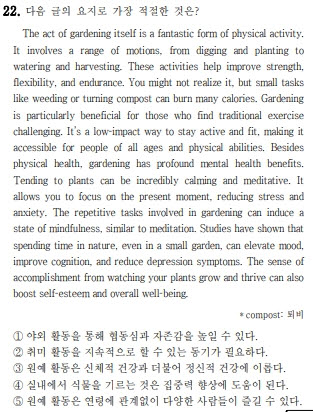
1) 문제 제시 (영어 지문 + 선택지)
Passage (원문 그대로)
The act of gardening itself is a fantastic form of physical activity. It involves a range of motions, from digging and planting to watering and harvesting. These activities help improve strength, flexibility, and endurance. You might not realize it, but small tasks like weeding or turning compost can burn many calories. Gardening is particularly beneficial for those who find traditional exercise challenging. It’s a low-impact way to stay active and fit, making it accessible for people of all ages and physical abilities. Besides physical health, gardening has profound mental health benefits. Tending to plants can be incredibly calming and meditative. It allows you to focus on the present moment, reducing stress and anxiety. The repetitive tasks involved in gardening can induce a state of mindfulness, similar to meditation. Studies have shown that spending time in nature, even in a small garden, can elevate mood, improve cognition, and reduce depression symptoms. The sense of accomplishment from watching your plants grow and thrive can also boost self-esteem and overall well-being.
Question | 문제
다음 글의 요지로 가장 적절한 것은?
① Outdoor activities can build teamwork and self-esteem. — 야외 활동은 협동심과 자존감을 높인다.
② Hobbies require motivation to be sustained. — 취미 활동은 지속 동기가 필요하다.
③ Gardening benefits both physical and mental health. — 원예 활동은 신체적·정신적 건강에 이롭다. ✅
④ Growing plants indoors helps concentration. — 실내 식물 기르기는 집중력 향상에 도움 된다.
⑤ Gardening can be enjoyed regardless of age. — 원예는 연령과 무관하게 즐길 수 있다.
2) 직독직해 (문장별 어휘·문법 + Morph)
S1
EN (slash) The act of gardening itself / is / a fantastic form / of physical activity.
KR 직독 원예라는 행위 자체는 / ~이다 / 훌륭한 형태 / 신체 활동의.
자연 해석 원예 자체가 훌륭한 신체 활동이다.
어휘+Morph
- act — 행위; Morph: 라틴 agere(행하다) → act
- gardening — 원예; Morph: garden(정원) + -ing(행위)
- fantastic — 훌륭한; Morph: 그리스 phantastikos(상상된) → ‘근사한’ 의미로 확장
- form — 형태; Morph: 라틴 forma
- physical — 신체의; Morph: 그리스 physis(자연)
- activity — 활동; Morph: act(행하다) + -ivity(명사화)
문법 포인트 SVC(주어-동사-보어) 구조, of ~ 전치사구가 form 수식.
1. 문법·표현 포인트 (단어/구/동의어/반의어 + 영어/한국어 뜻)
- act (n.) = 행위, 행동
- Syn: action (행동), deed (행위)
- Ant: inaction (무행동), passivity (수동성)
- gardening = 원예, 정원 가꾸기
- Syn: horticulture (원예학), cultivation (재배)
- Ant: neglecting plants (식물 방치하기)
- fantastic = 훌륭한, 멋진
- Syn: wonderful (멋진), excellent (훌륭한)
- Ant: terrible (끔찍한), awful (형편없는)
- physical activity = 신체 활동
- Syn: exercise (운동), bodily movement (신체 움직임)
- Ant: rest (휴식), inactivity (비활동)
2. 부분 분석
- The act of gardening itself → 주어: “정원 가꾸기 행위 자체”
- is → 동사(be동사): “이다”
- a fantastic form → 보어(명사구): “멋진 형태”
- of physical activity → 전치사구(보어 수식): “신체 활동의”
3. 문장 뼈대 (주어·동사·보어 + 한글 해석)
- 주어: The act of gardening itself (정원 가꾸기 행위 자체는)
- 동사: is (이다)
- 보어: a fantastic form of physical activity (훌륭한 신체 활동의 한 형태이다)
➡ 정원 가꾸기 자체는 훌륭한 신체 활동의 한 형태이다.
4. 직독직해
The act of gardening itself / is / a fantastic form / of physical activity.
➡ 정원 가꾸기 행위 자체는 / 이다 / 훌륭한 형태 / 신체 활동의.
5. 자연스러운 번역
정원 가꾸기 자체가 훌륭한 신체 활동의 한 형태이다.
6. 표현 정리
| the act of gardening | 정원 가꾸기 행위 |
| itself | 그 자체로 |
| fantastic form | 훌륭한 형태 |
| physical activity | 신체 활동, 운동 |
7. 문장의 의미 설명
👉 이 문장은 원예 활동 = 운동이라는 메시지를 담고 있습니다. 정원 가꾸기는 단순한 취미가 아니라 몸을 쓰는 활동으로서 건강에 도움이 되는 운동의 한 방식이라는 점을 강조합니다.
8. 실전 예문 (act / physical activity / fantastic)
- The simple act of smiling can change your mood.
➡ 단순히 미소 짓는 행위가 기분을 바꿀 수 있다. - Walking is a basic form of physical activity.
➡ 걷기는 기본적인 신체 활동의 한 형태이다. - She gave a fantastic performance last night.
➡ 그녀는 어젯밤 훌륭한 공연을 선보였다.
S2
EN (slash) It involves / a range of motions, / from digging and planting / to watering and harvesting.
KR 직독 그것은 포함한다 / 다양한 동작을, / 파기와 심기에서 / 물 주기와 수확까지.
자연 해석 파기·심기부터 물 주기·수확까지 여러 동작이 포함된다.
어휘+Morph
- involve — 포함하다; Morph: 라틴 in- (안에) + volvere (말다) → ‘안에 감다’
- range — 범위; Morph: 프랑스어 rang(줄, 배열)
- motion — 동작; Morph: 라틴 movere(움직이다)
- dig — 파다; Morph: 게르만계 어원
- plant — 심다; Morph: 라틴 plantare(심다)
- harvest — 수확하다; Morph: 고대 영어 hærfest(가을→수확)
문법 포인트 from A to B 병렬(동명사 digging / planting / watering / harvesting).
1. 문법·표현 포인트 (단어/구/동의어/반의어 + 영어/한국어 뜻)
- involve = 포함하다, 수반하다
- Syn: include (포함하다), entail (수반하다)
- Ant: exclude (제외하다), omit (생략하다)
- a range of = 다양한, 여러 가지의
- Syn: a variety of (여러 가지의), an array of (다양한)
- Ant: a lack of (부족한), a few (소수의)
- motion = 움직임, 동작
- Syn: movement (움직임), action (행동)
- Ant: stillness (정지), rest (휴식)
- from A to B = A에서 B까지
- Syn: starting with A and ending with B (~부터 ~까지)
- Ant: none (해당 없음 – 전치사적 범위 표현은 반의어 없음)
2. 부분 분석
- It involves a range of motions → “그것은 다양한 움직임을 포함한다”
- from digging and planting to watering and harvesting → “파고 심는 것에서 물 주고 수확하는 것까지”
3. 문장 뼈대 (주어·동사·보어 + 한글 해석)
- 주어: It (그것은 = 원예 활동, 앞 문맥)
- 동사: involves (포함한다, 수반한다)
- 목적어: a range of motions (다양한 동작들을)
- 부가 설명: from digging and planting to watering and harvesting (파고 심는 것부터 물 주고 수확하는 것까지)
➡ 그것은 다양한 동작들을 포함한다, 파고 심는 것부터 물 주고 수확하는 것까지.
4. 직독직해
It involves / a range of motions, / from digging and planting / to watering and harvesting.
➡ 그것은 포함한다 / 다양한 동작들을, / 파고 심는 것부터 / 물 주고 수확하는 것까지.
5. 자연스러운 번역
그것은 파고 심는 것에서 물 주고 수확하는 것까지 다양한 동작들을 포함한다.
6. 표현 정리
| involve a range of ~ | 다양한 ~을 포함하다 |
| motion | 동작, 움직임 |
| from A to B | A에서 B까지 |
| digging and planting | 파고 심기 |
| watering and harvesting | 물 주고 수확하기 |
7. 문장의 의미 설명
👉 이 문장은 원예 활동이 단순한 취미가 아니라 다양한 신체적 활동을 포함한다는 점을 강조합니다. 땅을 파고, 씨를 심고, 물을 주고, 수확하는 모든 과정이 운동 효과를 내며, 원예가 “전신 운동”과 유사한 가치가 있음을 보여줍니다.
8. 실전 예문 (involve / a range of / motion)
- The job involves a range of skills, from writing to public speaking.
➡ 그 일은 글쓰기부터 대중 연설까지 다양한 기술을 포함한다. - Yoga involves gentle motions that improve flexibility.
➡ 요가는 유연성을 향상시키는 부드러운 동작들을 포함한다. - The festival involves a range of activities, from music performances to art exhibitions.
➡ 그 축제는 음악 공연부터 미술 전시까지 다양한 활동을 포함한다.
S3
EN (slash) These activities / help improve / strength, flexibility, and endurance.
KR 직독 이런 활동들은 / 향상시키는 데 도움 준다 / 근력·유연성·지구력을.
자연 해석 근력·유연성·지구력을 향상시킨다.
어휘+Morph
- improve — 향상시키다; Morph: im-(강조) + prove(시험하다→입증하다)
- strength — 근력; Morph: strong + -th(명사화)
- flexibility — 유연성; Morph: 라틴 flectere(구부리다) + -ibility
- endurance — 지구력; Morph: en-(안에) + dur(견디다) + -ance
문법 포인트 help + 동사원형(help improve), 세 항목 등위.
1) 문법·표현 포인트 (단어/구/동의어/반의어 + EN/KR 뜻)
- these activities (n. phrase) = 이러한 활동들
Syn these tasks(이러한 과제들), these exercises(이러한 운동들) | Ant those activities(저 활동들; 원거리)
Collocations physical activities(신체 활동), daily activities(일상 활동) - help (to) improve (v. phrase) = 향상시키는 데 도움을 주다 / 향상하도록 돕다
Syn assist (in) improving(개선에 도움을 주다), aid improvement(개선을 돕다), facilitate progress(진전을 촉진하다)
Ant hinder(방해하다), impede(지연시키다), hamper(저해하다)
Note help + 동사원형 과 help to + 동사원형 모두 자연스러움(의미 차이 거의 없음) - strength (n.) = 힘, 근력(불가산)
Syn power(힘), robustness(강건함) | Ant weakness(나약함), frailty(허약)
Collocations build strength(근력을 기르다), core strength(코어 근력) - flexibility (n.) = 유연성(불가산)
Syn suppleness(유연함), elasticity(탄력성) | Ant stiffness(뻣뻣함), rigidity(경직)
Collocations improve flexibility(유연성 향상), flexibility training(유연성 훈련) - endurance (n.) = 지구력(불가산)
Syn stamina(체력), persistence(지속력) | Ant fatigue(피로), exhaustion(탈진)
Collocations build endurance(지구력을 기르다), cardiovascular endurance(심폐 지구력) - serial (Oxford) comma = 3개 이상 나열 시 ‘A, B, and C’ 형태의 쉼표 사용(미국식에서 흔함)
2) 부분 분석 (Chunk-by-Chunk)
- These activities → “이러한 활동들은”
- Vocab: these(이러한), activities(활동들·복수)
- help improve → “향상시키는 데 도움을 준다/향상하도록 돕는다”
- Vocab: help (to) improve(개선을 돕다), help + V / help to + V
- strength, flexibility, and endurance → “근력, 유연성, 그리고 지구력(을)”
- Vocab: strength(근력), flexibility(유연성), endurance(지구력); 병렬 나열
3) 문장 뼈대 (주어·동사·보어/목적어 + 해석)
- 주어(S): These activities (이러한 활동들은)
- 동사(V): help (to) improve (향상시키는 데 도움을 준다)
- 목적어(O): strength, flexibility, and endurance (근력·유연성·지구력)
➡ 이러한 활동들은 근력, 유연성, 그리고 지구력을 향상시키는 데 도움을 준다.
4) 직독직해 (Slash Segmentation: EN / KO)
These activities / help improve / strength, flexibility, and endurance.
➡ 이러한 활동들은 / 향상시키는 데 도움을 준다 / 근력, 유연성, 그리고 지구력을.
5) 자연스러운 번역 (Natural Korean)
이러한 활동들은 근력·유연성·지구력을 향상시키는 데 도움이 된다.
6) 표현 정리 (Expressions & Collocations)
| help (to) improve N | N을 향상시키는 데 도움을 주다 | help improve posture/form 자세/폼 향상, help improve health 건강 증진 |
| build strength | 근력을 기르다 | build upper-body strength 상체 근력 강화 |
| improve flexibility | 유연성을 향상시키다 | flexibility training 유연성 훈련 |
| build endurance | 지구력을 기르다 | aerobic endurance 유산소 지구력 |
| physical activities | 신체 활동 | regular physical activity 규칙적인 신체 활동 |
7) 문장의 의미 설명 (Meaning)
👉 이 문장은 **특정 활동(문맥상 원예/가드닝 등)**이 단순한 취미를 넘어, 근력·유연성·지구력과 같은 핵심 체력 요소를 고르게 향상시키는 데 기여함을 강조합니다. 즉, 전신적 컨디션을 종합적으로 끌어올리는 기능적 운동 효과가 있음을 시사합니다.
8) 실전 예문 (Pattern: These activities help (to) improve A, B, and C.)
- These exercises help improve balance, coordination, and core strength.
➡ 이러한 운동들은 균형감, 협응력, 그리고 코어 근력을 향상시키는 데 도움이 된다. - These routines help improve posture, flexibility, and mobility.
➡ 이러한 루틴은 자세, 유연성, 그리고 가동성을 개선하는 데 도움이 된다. - These habits help improve focus, productivity, and mental endurance.
➡ 이러한 습관들은 집중력, 생산성, 그리고 정신적 지구력을 향상시키는 데 도움이 된다.
S4
EN (slash) You might not realize it, / but / small tasks / like weeding or turning compost / can burn / many calories.
KR 직독 너는 깨닫지 못할 수도 있지만, / 그러나 / 작은 일들 / 제초나 퇴비 뒤집기 같은 / ~할 수 있다 / 많은 칼로리를 태우다.
자연 해석 제초·퇴비 뒤집기 같은 작은 일도 칼로리를 많이 소모한다.
어휘+Morph
- realize — 깨닫다; Morph: real(현실) + -ize(동사화)
- weed/weeding — 잡초/제초; Morph: 고대 영어 weod
- turn (compost) — (퇴비를) 뒤집다; Morph: 라틴 tornare(돌다) 계열
- compost — 퇴비; Morph: com-(함께) + post(놓다) → ‘함께 놓은 퇴적물’
- burn calories — 칼로리를 소모하다; Morph: burn(태우다)
문법 포인트 조동사 might(가능성 낮음); like A or B 예시 나열.
1) 문법·표현 포인트 (단어/구/동의어/반의어 + EN/KR 뜻)
- might (not) + V = ~일/하지 않을 수도 있다 (가능성·완곡)
- Syn: may (not)(~일/하지 않을 수도) | Ant: must(틀림없이), cannot(~일 리 없다)
- realize (it) = (그것을) 깨닫다, 인지하다
- Syn: notice, perceive | Ant: overlook, miss
- but = 그러나, 하지만 (대조·전환 접속사)
- small tasks = 작은 일들, 가벼운 과업
- Syn: minor chores, simple activities | Ant: major tasks, strenuous workouts
- like A or B = A나 B 같은 (예시 제시; = such as)
- weeding = 잡초 뽑기 (pulling weeds)
- turning compost = 퇴비 뒤집기 (aerating/mixing compost)
- can burn (calories) = (칼로리를) 소모할 수 있다
- Syn: burn off, expend, use up | Ant: conserve, store
- many calories = 많은 칼로리
- Syn: a lot of calories | Ant: few calories
2) 부분 분석 (chunk-by-chunk)
- You might not realize it, → 너는 그 사실을 모르(깨닫지) 못할 수도 있다.
- but → 하지만(대조 전환).
- small tasks → 작은 일들도(주어).
- like weeding or turning compost → 잡초 뽑기나 퇴비 뒤집기 같은(예시 전치사구).
- can burn → 소모할 수 있다(조동사 can + 동사원형 burn).
- many calories. → 많은 칼로리를(목적어).
3) 문장 뼈대 (주어·동사·보어 + 한글 해석)
- 절1(양보/전환 전제): You(주어) might not realize(동사) it(목적어)
- 접속: but(대조)
- 절2(핵심 진술): small tasks(주어) can burn(동사) many calories(목적어) [like ~](예시 전치사구)
➡ 너는 모를 수도 있지만, 작은 일들도(예: 잡초 뽑기/퇴비 뒤집기) 많은 칼로리를 소모할 수 있다.
4) 직독직해 (영어 / 한국어 + 단어·표현)
- You might not realize it, / 너는 그 사실을 모르(깨닫지) 못할 수도 있다,
- might not + V (가능성의 부정), realize(깨닫다)
- but / 하지만
- but (대조·전환)
- small tasks / 작은 일들도
- small tasks (minor chores)
- like weeding or turning compost / 잡초 뽑기나 퇴비 뒤집기 같은
- like A or B (= such as), weeding, turning compost
- can burn / 소모할 수 있다
- can + V (능력/가능), burn calories
- many calories. / 많은 칼로리를.
- many (가산복수 수량), calories
5) 자연스러운 전체 문장 해석
너는 잘 모를 수도 있지만, 잡초 뽑기나 퇴비 뒤집기 같은 작은 일도 많은 칼로리를 소모할 수 있다.
6) 표현 정리 (핵심 구문·어휘)
| might not realize | ~을 깨닫지 못할 수도 있다 | polite/hedging 추측 |
| but (contrast) | 그러나/하지만 | 대조·전환 |
| small tasks | 작은 일들 | everyday/minor chores |
| like A or B | A나 B 같은(예시) | = such as |
| weeding | 잡초 뽑기 | pull weeds |
| turning compost | 퇴비 뒤집기 | aerate/mix compost |
| burn calories | 칼로리를 소모하다 | burn off/expend calories |
| many calories | 많은 칼로리 | ↔ few calories |
7) 문장의 의미 설명
이 문장은 **‘가벼운 원예 활동도 에너지 소비가 크다’**는 인식 전환을 유도합니다. 헬스장 운동이 아니더라도 잡초 뽑기·퇴비 뒤집기 같은 **일상적 소활동(NEAT)**이 실질적인 칼로리 소모에 기여함을 강조합니다.
8) 실전 예문 (패턴 확장)
- You might not realize it, but brisk housework can burn many calories.
➡ 잘 모를 수도 있지만, 빠른 집안일도 칼로리를 많이 소모할 수 있다. - People often don’t realize it, but light gardening can burn quite a few calories.
➡ 사람들은 종종 모르지만, 가벼운 원예 활동도 꽤 많은 칼로리를 소모한다. - You may not notice it, but raking leaves can burn a lot of calories.
➡ 눈치채지 못할 수 있지만, 낙엽을 긁는 일도 많은 칼로리를 소모한다.
S5
EN (slash) Gardening is particularly beneficial / for those / who find traditional exercise challenging.
KR 직독 원예는 특히 유익하다 / 그런 사람들에게 / 전통적 운동이 어렵다고 느끼는.
자연 해석 운동이 힘든 사람들에게 특히 유익하다.
어휘+Morph
- particularly — 특히; Morph: particular(특정한) + -ly
- beneficial — 유익한; Morph: bene-(좋은) + -fic(만들다) + -ial
- those who — ~하는 사람들
- traditional — 전통의; Morph: tradit-(전하다) + -ional
- challenging — 어려운; Morph: challenge(도전) + -ing
문법 포인트 those + (관계절), find + O + OC(exercise challenging).
1) 문법·표현 포인트 (단어/구/동의어/반의어 + 영어/한국어 뜻)
- gardening (n., gerund) = 정원 가꾸기(활동)
- Collocations: do/take up/practice gardening
- be beneficial (for/to) (adj. phrase) = ~에 유익하다, 도움이 되다
- Syn: helpful, advantageous / Ant: harmful, detrimental
- Collocations: beneficial for health, beneficial to students
- particularly (adv.) = 특히, 유난히
- Syn: especially, notably / Ant: barely, hardly, marginally (정도 낮춤)
- Position: 보통 형용사/부사 앞 (particularly beneficial)
- for those (who …) (prep. phrase) = ~인 사람들에게
- Syn: for people who …, for individuals who …
- who find A B (rel. clause + OC) = A가 B하다고 여기다 (find + 목적어 + 보어)
- Patterns: find it + adj + to V, find A + adj
- find Syn: consider, regard / Ant: — (의견 동사)
- traditional exercise (n.) = 전통적인/일반적인 운동(조깅, 헬스 등)
- Syn: conventional workouts, standard exercise routines
- challenging (adj.) = 벅찬, 어려운
- Syn: difficult, hard / Ant: easy, manageable, accessible
2) 부분 분석 (Phrase-by-Phrase)
- Gardening is particularly beneficial → “정원 가꾸기는 특히 유익하다”
- for those → “~한 사람들에게”
- who find traditional exercise challenging → “일반적인 운동을 어렵다고 느끼는”
3) 문장 뼈대 (주어·동사·보어 + 한글 해석)
- 주어(S): Gardening (정원 가꾸기)
- 동사(V): is (이다/이다 상태)
- 보어(C): particularly beneficial (특히 유익하다)
- 전치사구 + 관계절: for those who find traditional exercise challenging
→ “일반적인 운동을 힘들어하는 사람들에게”
➡ 전체 해석: 정원 가꾸기는 일반적인 운동을 어렵게 느끼는 사람들에게 특히 유익하다.
4) 직독직해 (Slash Segmentation + 핵심 어휘)
Gardening is particularly beneficial / for those / who find traditional exercise challenging.
➡ 정원 가꾸기는 특히 유익하다 / ~한 사람들에게 / 일반적인 운동을 어렵다고 느끼는.
- particularly = 특히(especially)
- beneficial = 유익한(helpful)
- for those = ~한 사람들에게(for people who)
- find A B = A를 B하다고 여기다(consider A B)
- traditional exercise = 일반적인 운동(conventional workouts)
- challenging = 어려운(difficult)
5) 자연스러운 번역
- 표준형: 정원 가꾸기는 전통적인 운동을 어려워하는 사람들에게 특히 유익하다.
- 자연형: 일반 운동이 부담스러운 사람에게 정원 가꾸기는 특히 큰 도움이 된다.
- 업그레이드 EN: Gardening is especially beneficial for people who struggle with traditional workouts.
6) 표현 정리 (Expression → 한국어 의미)
| be (particularly) beneficial for/to ~ | ~에 (특히) 유익하다 | helpful/advantageous ↔ harmful/detrimental |
| for those who … | ~하는 사람들에게 | for people/individuals who … |
| find A B | A가 B하다고 느끼다/여기다 | consider/regard A as B |
| traditional exercise | 일반적인/전통적 운동 | conventional workouts |
| challenging | 벅찬, 어려운 | difficult ↔ easy/accessible |
7) 문장의 의미 설명
👉 이 문장은 정원 가꾸기가 일반적인 운동을 벅차게 느끼는 사람들(예: 관절 부담, 체력 저하, 운동 환경의 장벽 등)에게 대안적이고 접근 가능한 활동임을 강조합니다. 강도 높은 루틴 대신 저강도·지속적 움직임을 통해 신체·정신 건강 혜택을 제공한다는 메시지입니다.
8) 실전 예문 (패턴 응용: beneficial / for those who / find A B)
- Swimming is particularly beneficial for those who find high-impact workouts challenging.
➡ 고충격 운동을 힘들어하는 사람들에게 수영은 특히 유익하다. - Pilates can be beneficial for those who find running hard on their joints.
➡ 달리기가 관절에 부담되는 사람들에게 필라테스는 도움이 될 수 있다. - This app is especially beneficial for those who find time management difficult.
➡ 시간 관리가 어려운 사람들에게 이 앱은 특히 유용하다.
S6
EN (slash) It’s a low-impact way / to stay active and fit, / making it accessible / for people of all ages and physical abilities.
KR 직독 그것은 저충격 방법이다 / 활동적이고 건강을 유지하는, / 그것을 접근 가능하게 만들며 / 모든 연령과 신체 능력을 가진 사람들에게.
자연 해석 저충격 운동이어서 남녀노소·다양한 체력의 사람들이 쉽게 접근한다.
어휘+Morph
- low-impact — 저충격의; Morph: low + impact(충격; in- + pangere ‘치다’)
- fit — 건강한; Morph: 고대 노르드 fitja(맞추다)
- accessible — 접근 가능한; Morph: ac-(to) + cess(가다) + -ible
- ability — 능력; Morph: 라틴 habilis → -ability
문법 포인트 현재분사 making: 결과/이유; for + 사람 수혜 대상.
1. 문법·표현 포인트 (단어/구/동의어/반의어 + 영어/한국어 뜻)
- low-impact = 부담이 적은, 충격이 적은
- Syn: gentle (온화한), mild (가벼운)
- Ant: high-impact (강도가 높은), intense (격렬한)
- stay active = 활동적으로 지내다
- Syn: remain energetic (활기차게 지내다), keep moving (움직이며 지내다)
- Ant: stay inactive (비활동적으로 지내다), be sedentary (앉아서만 지내다)
- fit = 건강한, 체력이 좋은
- Syn: healthy (건강한), strong (강한)
- Ant: unhealthy (건강하지 못한), weak (약한)
- accessible = 접근 가능한, 이용 가능한
- Syn: available (이용 가능한), approachable (접근하기 쉬운)
- Ant: inaccessible (접근 불가능한), limited (제한된)
2. 부분 분석
- It’s a low-impact way to stay active and fit → “그것은 활동적이고 건강하게 지낼 수 있는 부담이 적은 방법이다”
- making it accessible for people of all ages and physical abilities → 분사구문: “그것을 모든 연령과 신체 능력을 가진 사람들이 이용 가능하게 만든다”
3. 문장 뼈대 (주어·동사·보어 + 한글 해석)
① 주어: It (그것은 = 원예 활동)
- 동사: is (이다)
- 보어: a low-impact way to stay active and fit (활동적이고 건강하게 지낼 수 있는 부담이 적은 방법)
② 분사구문: making it accessible for people of all ages and physical abilities
➡ 그것을 모든 연령과 신체 능력을 가진 사람들이 이용 가능하게 만든다.
4. 직독직해
It’s a low-impact way / to stay active and fit, / making it accessible / for people of all ages and physical abilities.
➡ 그것은 부담이 적은 방법이다 / 활동적이고 건강하게 지낼 수 있는, / 그것을 이용 가능하게 하며 / 모든 연령과 신체 능력을 가진 사람들에게.
5. 자연스러운 번역
그것은 활동적이고 건강하게 지낼 수 있는 부담이 적은 방법이며, 모든 연령과 신체 능력을 가진 사람들이 쉽게 할 수 있게 만든다.
6. 표현 정리
| low-impact way | 부담이 적은 방법 |
| stay active and fit | 활동적이고 건강하게 지내다 |
| making it accessible | 그것을 이용 가능하게 만들며 |
| people of all ages and physical abilities | 모든 연령과 신체 능력을 가진 사람들 |
7. 문장의 의미 설명
👉 이 문장은 원예 활동의 포괄성과 접근성을 강조합니다. 정원 가꾸기는 격렬하지 않아서 누구나 쉽게 할 수 있고, 어린이부터 노인까지, 건강한 사람뿐 아니라 신체적 제약이 있는 사람들에게도 적합한 활동이라는 메시지를 담고 있습니다.
8. 실전 예문 (low-impact / stay active / accessible)
- Swimming is a low-impact way to exercise.
➡ 수영은 부담이 적은 운동 방법이다. - He tries to stay active by walking every morning.
➡ 그는 매일 아침 걷기를 통해 활동적으로 지내려 한다. - The museum is accessible to people with disabilities.
➡ 그 박물관은 장애인들도 이용할 수 있다.
S7
EN (slash) Besides physical health, / gardening has / profound mental health benefits.
KR 직독 신체 건강 외에도, / 원예는 가진다 / 깊은 정신 건강의 이점.
자연 해석 신체뿐 아니라 정신 건강에도 큰 도움이 된다.
어휘+Morph
- besides — ~외에도
- profound — 심오한, 큰; Morph: pro-(앞) + fund(깊은)
- benefit — 혜택; Morph: bene-(좋은) + -fit(만들다)
문법 포인트 전치사 besides.
1) 문법·표현 포인트 (단어/구/동의어/반의어 + EN/KR 뜻)
- besides (prep./adv.) = ~외에도; 게다가
- Syn in addition to(~에 더하여), apart from(~외에도), moreover(게다가)
- Ant except (for)(~을 제외하고), only(오직) (정확한 반대라기보다 대비)
- Usage 문두 전치사구로 오면 뒤에 쉼표, 주절 강조
- physical health (n.) = 신체 건강
- Colloc maintain/improve physical health
- gardening (n.) = 원예(활동)
- Syn horticulture(원예학), yard work(마당 가꾸기)
- Colloc do/take up gardening, community gardening
- profound (adj.) = (영향이) 깊은, 막대한 / 심오한
- Syn deep, significant, far-reaching
- Ant superficial, slight, mild
- Colloc profound effect/impact/benefits
- mental health (n.) = 정신 건강
- Colloc mental health benefits, mental well-being, reduce stress
- benefit (n./v.) = 이익, 혜택 / 이롭게 하다
- Syn advantage, boon / Ant drawback, harm, detriment
- Colloc health benefits, reap the benefits, be beneficial to
2) 부분 분석 (Chunk-by-Chunk)
- Besides physical health, → “신체 건강 외에도”
- Function: 주절 앞의 보충·대조 정보(전치사구 + 쉼표)
- gardening has profound mental health benefits → “원예는 정신 건강에 깊은 이점이 있다/제공한다”
3) 문장 뼈대 (주어·동사·보어/목적어 + 해석)
- 주어(S): gardening (원예 활동)
- 동사(V): has (~을 지니다/제공하다)
- 목적어(O): profound mental health benefits (깊은 정신 건강상의 이점들)
- 전치사구(부가): Besides physical health, (신체 건강 외에도)
➡ 신체 건강 외에도, 원예는 정신 건강에 깊은 이점을 지닌다.
4) 직독직해 (Slash Segmentation: EN / KO)
Besides physical health, / gardening has / profound mental health benefits.
➡ 신체 건강 외에도, / 원예는 가지고 있다 / 깊은 정신 건강상의 이점을.
Per-segment Vocab
- Besides ~ = ~외에도 (추가·대조)
- has = 가지다/제공하다 (3인칭 단수)
- profound benefits = 깊은/막대한 이점들
5) 자연스러운 번역 (Natural Korean)
신체 건강 외에도, 원예는 정신 건강에 깊은 이점을 제공합니다.
6) 표현 정리 (Expressions & Collocations)
| Besides ~, S + V … | ~외에도 | Besides exercise, diet matters too(운동 외에도 식단이 중요하다) |
| gardening has ~ | 원예는 ~을 지닌다/제공한다 | has physical/mental health benefits(신체/정신 건강 이점) |
| profound ~ benefits | 깊은/막대한 이점 | profound cognitive/therapeutic benefits(인지적/치료적 이점) |
| mental health benefits | 정신 건강상의 이점 | reduce stress(스트레스 완화), improve mood(기분 향상), boost well-being(웰빙 증진) |
7) 문장의 의미 설명 (Meaning)
👉 이 문장은 원예가 신체 건강만이 아니라 정신 건강에도 큰 긍정적 효과가 있음을 강조합니다. 정서 안정, 스트레스 완화, 기분 개선 등 웰빙 전반에 도움을 준다는 메시지입니다.
8) 실전 예문 (Pattern: “Besides ~, S + V … / have/has benefits”)
- Besides physical fitness, team sports have social benefits.
➡ 신체 체력 외에도, 팀 스포츠는 사회적 이점이 있다. - Besides saving money, cooking at home has nutritional benefits.
➡ 돈을 아끼는 것 외에도, 집에서 요리하는 것은 영양학적 이점이 있다. - Besides academics, volunteering has profound personal growth benefits.
➡ 학업 외에도, 봉사는 개인적 성장에 깊은 이점이 있다.
S8
EN (slash) Tending to plants / can be / incredibly calming and meditative.
KR 직독 식물을 돌보는 것 / ~일 수 있다 / 매우 진정되고 명상적인.
자연 해석 식물 돌보기는 매우 차분하고 명상적이다.
어휘+Morph
- tend (to) — 돌보다; Morph: 라틴 tendere(뻗다) → ‘주의를 기울이다’
- incredibly — 대단히; Morph: in-(아니) + credible(믿을 만한) → ‘믿기지 않을 만큼’
- calming — 진정되는; Morph: calm + -ing
- meditative — 명상적인; Morph: 라틴 meditari(숙고하다) + -ive
문법 포인트 동명사구 S + can be.
1) 문법·표현 포인트 (단어/구/동의어/반의어 + EN/KR 뜻)
- tend to (v.) [care for] = 돌보다, 보살피다 (여기서는 ‘~하는 경향이 있다’가 아닌 ‘돌보다’의 뜻)
Syn care for, look after, attend to │ Ant neglect, ignore
Collocations tend to plants/garden/animals; carefully tend; lovingly tend - tending to N (gerund phrase) = N을 돌보는 것 (주어 역할)
Note 동사 tend의 현재분사 tending + 전치사 to + 목적어 plants - can be (modal + copula) = ~일 수 있다 / ~일 때가 있다 (가능성·일반적 성질)
Syn may be, can feel │ Ant —
Collocations can be helpful/beneficial/soothing - incredibly (adv.) = 믿을 수 없을 만큼, 엄청나게
Syn extremely, remarkably │ Ant slightly, mildly
Collocations incredibly calm/quiet/useful - calming (adj.) = 마음을 가라앉히는, 진정되는
Syn soothing, relaxing │ Ant agitating, stressful
Collocations calming effect/influence/music - meditative (adj.) = 명상적인, 사색적인
Syn contemplative, mindful │ Ant distracting, restless
Collocations meditative state/practice/walk
2) 부분 분석 (Chunk-by-Chunk)
- Tending to plants → “식물을 돌보는 일은”
- Vocab: tending to(돌보는 것), plants(식물들)
- can be → “~일 수 있다/일 때가 있다”
- Vocab: can(가능성), be(서술동사)
- incredibly calming and meditative → “믿을 수 없을 만큼 진정되고 명상적이다”
- Vocab: incredibly(아주/엄청), calming(진정되는), meditative(명상적인)
3) 문장 뼈대 (주어·동사·보어 + 해석)
- 주어(S): Tending to plants (식물을 돌보는 것)
- 동사(V): can be (~일 수 있다)
- 보어(C): incredibly calming and meditative (엄청나게 진정되고 명상적인)
➡ 식물을 돌보는 일은 엄청나게 마음을 가라앉히고 명상적일 수 있다.
4) 직독직해 (Slash Segmentation: EN / KO)
Tending to plants / can be / incredibly calming and meditative.
➡ 식물을 돌보는 일은 / ~일 수 있다 / 엄청나게 진정되고 명상적.
5) 자연스러운 번역 (Natural Korean)
식물을 돌보는 일은 놀랄 만큼 마음을 차분하게 해 주고, 명상적이기까지 하다.
6) 표현 정리 (Expressions & Collocations)
| tend to plants | 식물을 돌보다 | tend to the garden(정원을 돌보다), tend to seedlings(모종을 돌보다) |
| can be + adj. | ~일 수 있다 | can be helpful/therapeutic 도움이 되다/치유적이다 |
| incredibly + adj. | 믿을 수 없을 만큼 ~한 | incredibly peaceful/quiet 매우 평온한/조용한 |
| calming | 진정되는, 차분하게 하는 | calming effect 진정 효과 |
| meditative | 명상적인, 사색적인 | meditative practice/state 명상 수행/상태 |
7) 문장의 의미 설명 (Meaning)
👉 이 문장은 식물 돌보기가 단순한 집안 일 이상으로 **마음의 안정(진정 효과)**과 명상적 몰입을 제공한다는 점을 강조합니다. 반복적이고 섬세한 손동작, 흙과의 접촉, 조용한 환경이 스트레스 감소·마음챙김으로 이어진다는 메시지입니다.
8) 실전 예문 (Pattern: [Gerund] can be incredibly calming and meditative.)
- Walking in nature can be incredibly calming and meditative.
➡ 자연 속을 걷는 것은 놀랄 만큼 마음을 차분하게 하고 명상적일 수 있다. - Coloring simple patterns can be incredibly calming and meditative.
➡ 간단한 패턴 색칠하기는 아주 진정되고 명상적일 수 있다. - Listening to rain sounds can be incredibly calming and meditative.
➡ 빗소리를 듣는 것은 대단히 차분하고 명상적일 수 있다.
S9
EN (slash) It allows you / to focus on the present moment, / reducing stress and anxiety.
KR 직독 그것은 너를 허락한다 / 현재 순간에 집중하도록, / 스트레스와 불안을 줄이면서.
자연 해석 현재에 집중하게 하여 스트레스·불안을 줄인다.
어휘+Morph
- allow A to V — A가 ~하게 하다
- present — 현재의; Morph: pre-(앞) + sent(존재하다)
- reduce — 줄이다; Morph: re-(뒤로) + -duce(이끌다)
- anxiety — 불안; Morph: 라틴 anxius(초조한)
문법 포인트 분사구 reducing(결과/부가).
1) 문법·표현 포인트 (단어/구/동의어/반의어 + EN/KR 뜻)
- allow A to + V (v. 패턴) = A가 V하도록 허락/가능하게 하다
- Syn permit A to, enable A to | Ant forbid A to, prevent A from ~ing, hinder
- Colloc allow you to focus/relax/concentrate
- focus on ~ (v. + prep.) = ~에 집중하다
- Syn concentrate on, pay attention to | Ant be distracted from, ignore
- Colloc focus on the task/the present/the breath
- (the) present moment (n.) = 현재 순간, 지금 이 순간
- Syn the here and now | Ant the past / the future (대비 개념)
- Colloc stay in the present, live in the present moment
- reduce (v.) = 줄이다, 완화하다
- Syn lessen, alleviate, ease | Ant increase, worsen, exacerbate
- Colloc reduce stress/anxiety/symptoms
- stress (n.) = 스트레스, 압박
- Syn pressure, strain | Ant calm, relaxation
- Colloc reduce stress, manage stress, stress levels
- anxiety (n.) = 불안, 초조
- Syn worry, nervousness | Ant serenity, calmness
- Colloc reduce anxiety, anxiety symptoms
- 분사구문(ing): …, reducing ~ = 결과/부가 설명 (which reduces ~ 로 확장 가능)
- 주절의 행위 결과를 덧붙이는 현재분사 분사구문
2) 부분 분석 (Chunk-by-Chunk)
- It allows you → “그것은 당신(여러분)이 ~~할 수 있게 해 준다”
- to focus on the present moment, → “현재 순간에 집중하도록”
- reducing stress and anxiety. → “(그 결과) 스트레스와 불안을 줄여 주며”
3) 문장 뼈대 (주어·동사·보어/목적어 + 해석)
- 주어(S): It (= 앞 문맥의 활동/습관/연습)
- 동사(V): allows
- 목적어(O1): you
- 목적보어(O2): to focus on the present moment (allow + 목적어 + to V)
- 부가(결과) 설명: reducing stress and anxiety (분사구문: 결과)
➡ 그것은 여러분이 현재 순간에 집중하도록 해 주어, 스트레스와 불안을 줄여 줍니다.
4) 직독직해 (Slash Segmentation: EN / KO)
It allows you / to focus on the present moment, / reducing stress and anxiety.
➡ 그것은 해 준다 / 여러분이 현재 순간에 집중하도록, / (그 결과) 스트레스와 불안을 줄여 주면서.
Per-segment Vocab
- allows you to = 당신/여러분이 ~하도록 해 주다
- focus on = ~에 집중하다
- present moment = 현재 순간
- reducing = 줄여 주면서(결과/부가)
- stress and anxiety = 스트레스와 불안(병렬)
5) 자연스러운 번역 (Natural Korean)
그것은 여러분이 현재 순간에 집중하도록 해 주어, 스트레스와 불안을 줄여 줍니다.
6) 표현 정리 (Expressions & Collocations)
| allow A to + V | A가 V하도록 하다 | allow you to relax/breathe/focus |
| focus on the present (moment) | 현재(순간)에 집중하다 | focus on your breath/what you can control |
| reduce stress and anxiety | 스트레스와 불안을 줄이다 | reduce stress levels, reduce anxiety symptoms |
| stay in the present | 현재에 머물다 | stay present/grounded (현재에 단단히 서다) |
7) 문장의 의미 설명 (Meaning)
👉 이 문장은 어떤 활동(예: 호흡 명상, 가드닝, 산책 등)이 현재에 주의를 머물게 해 주고, 그 집중의 효과로 스트레스와 불안이 완화된다는 메시지를 전달합니다. 핵심은 allow A to + V(가능/허용)와 **분사구문(결과)**의 결합입니다.
8) 실전 예문 (패턴 확장: “allow A to + V / focus on ~ / reducing ~”)
- Mindful breathing allows you to focus on your breath, reducing tension in the body.
➡ 마음챙김 호흡은 호흡에 집중하게 해 주어, 신체의 긴장을 줄여 준다. - A clear plan allows teams to focus on priorities, reducing confusion and delays.
➡ 명확한 계획은 팀이 우선순위에 집중하도록 해, 혼란과 지연을 줄여 준다. - Limiting notifications allows you to focus on tasks, reducing digital fatigue.
➡ 알림을 제한하면 과제에 집중할 수 있어, 디지털 피로가 줄어든다.
S10
EN (slash) The repetitive tasks / involved in gardening / can induce / a state of mindfulness, / similar to meditation.
KR 직독 반복적 과업은 / 원예에 수반되는 / 유발할 수 있다 / 마음챙김 상태를, / 명상과 유사한.
자연 해석 반복 작업이 명상과 비슷한 마음챙김 상태를 유발한다.
어휘+Morph
- repetitive — 반복적인; Morph: re-(다시) + petere(구하다→되풀이)
- be involved in — ~에 수반되다; Morph: in- + volv(감다)
- induce — 유발하다; Morph: in-(안으로) + -duce(이끌다)
- mindfulness — 마음챙김; Morph: mindful + -ness
- similar — 유사한; Morph: 라틴 similis(닮은)
문법 포인트 분사(수동) involved = 관계절 축약; 전치사 to(similar to).
1) 문법·표현 포인트 (단어/구/동의어/반의어 + 영어/한국어 뜻)
- repetitive (tasks) (adj.) 반복적인 (일/과업)
- Syn: repetitious, routine / Ant: varied, diverse, novel
- Colloc: repetitive tasks/work/motions
- (be) involved in ~ (adj. p.p. + 전치사) ~에 관련된/수반되는
- Syn: engaged in, connected with, related to
- Colloc: tasks involved in ~, processes involved in ~
- induce (v.) 유도하다, 초래하다
- Syn: cause, bring about, trigger / Ant: prevent, deter, hinder
- Colloc: induce sleep/relaxation/stress/changes
- a state of ~ (n. phrase) ~의 상태
- Colloc: a state of calm/flow/mindfulness
- mindfulness (n.) 마음챙김, 주의집중 상태
- Syn: present-moment awareness / Ant: mindlessness, distraction
- similar to ~ (prep. phrase) ~와 유사한
- Syn: akin to, comparable to / Ant: different from, unlike
- meditation (n.) 명상
- Colloc: practice meditation, guided meditation
2) 부분 분석 (Phrase-by-Phrase)
- The repetitive tasks → “그 반복적인 과업들은”
- involved in gardening → “원예에 수반되는/관련된” (분사구, ‘that are involved in’ 축약)
- can induce → “유도할 수 있다/초래할 수 있다”
- a state of mindfulness, → “마음챙김의 상태를,”
- similar to meditation. → “명상과 유사한.”
3) 문장 뼈대 (주어·동사·보어 + 한글 해석)
- 주어(S): The repetitive tasks (involved in gardening) = 원예에 수반되는 반복적 과업들
- 동사(V): can induce = ~을 유발할 수 있다
- 목적어(O): a state of mindfulness = 마음챙김 상태
- 추가 설명: similar to meditation = 명상과 유사한
➡ 해석: 원예에 수반되는 반복적인 과업들은 명상과 유사한 마음챙김 상태를 유발할 수 있다.
4) 직독직해 (Slash Segmentation + 핵심 어휘)
The repetitive tasks / involved in gardening / can induce / a state of mindfulness, / similar to meditation.
➡ 반복적인 과업들은 / 원예에 수반되는 / 유발할 수 있다 / 마음챙김의 상태를, / 명상과 유사한.
- involved (in) = ~에 관련된(= related to)
- induce = 유도하다(= cause/trigger)
- a state of mindfulness = 마음챙김 상태
- similar to = ~와 유사한(= akin to)
5) 자연스러운 번역
- 표준형: 원예에 수반되는 반복적인 과업들은 명상과 유사한 마음챙김 상태를 유발할 수 있다.
- 자연형: 원예의 반복적인 작업은 명상하듯 마음챙김 상태로 이끌어 줄 수 있다.
- 업그레이드 EN: The repetitive tasks in gardening can bring about a mindful state akin to meditation.
6) 표현 정리 (Expression → 한국어 의미)
| repetitive tasks | 반복적인 과업/작업 | routine tasks ↔ varied tasks |
| (be) involved in ~ | ~에 수반되는/관련된 | engaged in / related to |
| induce A | A를 유발하다/초래하다 | cause/trigger ↔ prevent/deter |
| a state of mindfulness | 마음챙김 상태 | a state of calm/flow |
| similar to ~ | ~와 유사한 | akin to/comparable to ↔ different from |
| gardening | 원예(활동) | do/practice/take up gardening |
7) 문장의 의미 설명
👉 이 문장은 원예의 반복적·리듬감 있는 행동(예: 흙 고르기, 물 주기, 가지 치기)이 주의를 현재 순간에 고정시키며, 결과적으로 명상과 비슷한 마음챙김 상태를 만들 수 있음을 강조합니다. 즉, 원예는 **비의도적 명상(unaided meditation-like effect)**을 제공하는 생활 습관이 될 수 있다는 메시지입니다.
8) 실전 예문 (패턴 응용: induce / a state of / similar to)
- Slow, repetitive breathing can induce a state of calm, similar to meditation.
➡ 느리고 반복적인 호흡은 명상과 유사한 평온 상태를 유도할 수 있다. - Assembly-line tasks, when done mindfully, can induce a flow state similar to meditation.
➡ 조립 라인 작업도 마음챙김으로 하면 명상과 유사한 몰입 상태를 유발할 수 있다. - Gentle stretching can induce a state of relaxation, similar to guided meditation.
➡ 부드러운 스트레칭은 가이드 명상과 유사한 이완 상태를 가져올 수 있다.
S11
EN (slash) Studies have shown / that spending time in nature, / even in a small garden, / can elevate mood, / improve cognition, / and reduce depression symptoms.
KR 직독 연구들은 보여 주었다 / 자연에서 시간을 보내는 것이, / 작은 정원에서도, / 기분을 높이고 / 인지를 향상시키며 / 우울 증상을 줄일 수 있음을.
자연 해석 자연 속(작은 정원도 포함) 시간은 기분 상승·인지 향상·우울 감소로 이어진다.
어휘+Morph
- study — 연구; Morph: 라틴 studium(열정, 학문)
- elevate — 끌어올리다; Morph: e-(밖으로/위로) + lev(가볍게 하다)
- cognition — 인지; Morph: cogn-(알다) + -ition
- depression — 우울; Morph: de-(아래로) + press(누르다) + -ion
- symptom — 증상; Morph: 그리스 sym- (함께) + ptoma (떨어짐)
문법 포인트 that절 목적어; 삼중 병렬 (elevate / improve / reduce).
1) 문법·표현 포인트 (단어/구/동의어/반의어 + EN/KR 뜻)
- study (n.) = 연구, 조사
- Syn research(연구), investigation(조사) | Ant —
- Colloc scientific studies, recent studies, studies have shown
- have shown (v.) = ~임을 보여 주었다 (현재완료: 과거→현재까지 결과 보유)
- Syn have demonstrated(입증했다), have found(발견했다) | Ant have disproved(반증했다)
- Usage Studies have shown that S + V… = “연구에 따르면 …”
- spending time in nature (gerund phrase) = 자연 속에서 시간을 보내는 것
- Syn being outdoors(야외에 머무는 것), nature exposure(자연 노출) | Ant staying indoors(실내에만 있음)
- Colloc time in nature, exposure to nature/green space
- even (adv.) = ~조차, ~마저 (강조)
- Syn indeed(정말로), actually(실제로) | Ant merely(그저), only(오직)*
- *Note: 반의 대비로 이해
- garden (n.) = 정원, 화단 → a small garden(작은 정원/텃밭)
- Syn yard(마당), plot(텃밭) | Ant —
- Colloc community garden, home garden
- can (modal) = ~할 수 있다/가능성이 있다
- Syn may(어쩌면 ~일 수 있다) | Ant cannot(할 수 없다)
- elevate mood (colloc.) = 기분을 북돋다/향상시키다
- Syn lift/boost mood(기분을 끌어올리다) | Ant dampen/lower mood(기분을 떨어뜨리다)
- improve cognition (colloc.) = 인지 기능을 향상시키다
- Syn enhance cognitive function(인지 기능을 강화하다) | Ant impair cognition(인지 기능을 해치다)
- reduce depression symptoms (colloc.) = 우울증 증상을 완화하다
- Syn alleviate/lessen depressive symptoms(우울 증상 완화) | Ant worsen/exacerbate symptoms(증상 악화)
- Form symptoms of depression 도 자연스러운 표현
2) 부분 분석 (Chunk-by-Chunk)
- Studies have shown → “연구에 따르면 / 연구는 보여 주었다”
- that spending time in nature, → “자연 속에서 시간을 보내는 것이”
- even in a small garden, → “(작은 정원/텃밭에서조차)” (강조·보충)
- can elevate mood, → “기분을 끌어올릴 수 있고,”
- improve cognition, → “인지 기능을 향상시킬 수 있으며,”
- and reduce depression symptoms. → “우울증 증상을 줄일 수도 있다.”
3) 문장 뼈대 (주어·동사·보어/목적어 + 해석)
- 주절(S+V): Studies have shown (연구는 보여 주었다)
- that-절(내용): spending time in nature … can [elevate / improve / reduce]
- 주어: spending time in nature (even in a small garden)
- 조동사+동사 병렬: can elevate / improve / reduce
- 목적어들: mood / cognition / depression symptoms
➡ 연구에 따르면, 자연 속에서 시간을 보내는 것은(작은 정원에서조차) 기분을 끌어올리고, 인지 기능을 향상시키며, 우울증 증상을 줄일 수 있다.
4) 직독직해 (Slash Segmentation: EN / KO)
Studies have shown / that spending time in nature, / even in a small garden, / can elevate mood, / improve cognition, / and reduce depression symptoms.
➡ 연구에 따르면 / 자연 속에서 시간을 보내는 것이, / 작은 정원에서조차, / 기분을 끌어올릴 수 있고, / 인지 기능을 향상시키며, / 우울증 증상을 줄일 수 있다.
Per-segment Vocab
- have shown(보여 주었다), spending(동명사), even(강조), elevate mood(기분↑), improve cognition(인지↑), reduce symptoms(증상↓)
5) 자연스러운 번역 (Natural Korean)
연구에 따르면, 자연 속에서 시간을 보내는 것은—작은 정원에서 잠깐 머무르는 것만으로도—기분을 북돋우고, 인지 기능을 개선하며, 우울증 증상을 완화할 수 있습니다.
6) 표현 정리 (Expressions & Collocations)
| Studies have shown (that) | 연구에 따르면 / 연구는 ~임을 보여 주었다 | studies have shown that S+V |
| spend time in nature | 자연 속에서 시간을 보내다 | time in nature, exposure to green space |
| even in a small garden | 작은 정원에서도/텃밭에서도 | even a short time in a garden(정원에서 잠깐의 시간조차) |
| elevate/boost/lift mood | 기분을 북돋다 | greatly/significantly elevate mood(크게 기분↑) |
| improve cognition | 인지 기능을 향상시키다 | improve attention/memory/executive function(주의/기억/집행기능 향상) |
| reduce depression symptoms | 우울증 증상을 줄이다 | alleviate depressive symptoms, reduce anxiety(불안 완화) |
7) 문장의 의미 설명 (Meaning)
👉 이 문장은 연구 근거를 통해 자연 노출이 정신 건강 전반에 긍정적임을 강조합니다. 큰 공원에 가지 못하더라도 작은 정원이나 짧은 야외 시간만으로도 기분 개선, 인지 향상, 우울 증상 완화 효과가 있을 수 있다는 메시지입니다.
8) 실전 예문 (패턴 확장: “Studies have shown that… / can + V / parallel list”)
- Studies have shown that short walks in green spaces can lower stress and improve focus.
➡ 연구에 따르면, 녹지에서의 짧은 산책은 스트레스를 낮추고 집중력을 높일 수 있다. - Studies have shown that regular sleep can enhance memory, stabilize mood, and boost immunity.
➡ 연구에 따르면, 규칙적인 수면은 기억력 향상, 기분 안정, 면역 강화에 도움이 된다. - Studies have shown that mindful breathing can reduce anxiety and improve emotional regulation.
➡ 연구에 따르면, 마음챙김 호흡은 불안을 줄이고 감정 조절을 개선할 수 있다.
S12
EN (slash) The sense of accomplishment / from watching your plants grow and thrive / can also boost / self-esteem / and overall well-being.
KR 직독 성취감 / 식물이 자라고 번성하는 것을 지켜보는 데서 오는 / 또한 높일 수 있다 / 자존감 / 그리고 전반적 웰빙을.
자연 해석 식물이 잘 자라는 모습을 보는 성취감은 자존감과 전반적 행복감도 높인다.
어휘+Morph
- sense of accomplishment — 성취감; Morph: ac-(완전히) + complere(채우다) → accomplish
- thrive — 번성하다; Morph: 노르드계 þrífask
- boost — 북돋우다; Morph: 방언 ‘들어 올리다’에서
- self-esteem — 자존감; Morph: self + esteem(가치)
- overall — 전반적인; Morph: over + all
- well-being — 웰빙, 안녕
문법 포인트 전치사구 from ~가 sense 수식; can also(부가).
1) 문법·표현 포인트 (단어/구/동의어/반의어 + EN/KR 뜻)
- sense of accomplishment (n. phrase) = 성취감
- Syn sense of achievement, feeling of fulfillment
- Ant sense of failure, frustration
- Colloc feel a sense of accomplishment, genuine/lasting accomplishment
- from ~ing (prep. phrase) = ~하는 것에서(기인하여), ~함으로 인해
- Syn by ~ing, through ~ing
- Role 원인/출처를 나타내는 전치사구로 앞 명사를 수식
- watch (v.) ~ grow and thrive = ~가 자라고 번성하는 것을 지켜보다
- grow (v.) 자라다 | thrive (v.) 번성하다, 무럭무럭 크다
- Syn(thrive) flourish, prosper | Ant wither, languish
- Colloc help plants thrive, thriving garden
- can also (modal + adv.) = 또한 ~할 수 있다(추가·강조)
- Syn may also, can further
- boost (v.) = 북돋다, 향상시키다
- Syn enhance, lift, raise | Ant undermine, lower, diminish
- Colloc boost confidence/self-esteem/productivity
- self-esteem (n.) = 자존감
- Syn self-worth, self-regard | Ant low self-esteem, self-doubt
- Colloc boost/build self-esteem
- (overall) well-being (n.) = 전반적 웰빙/행복감/건강
- Syn wellness, welfare | Ant distress, ill-being, malaise
- Colloc promote/improve overall well-being, mental/physical well-being
2) 부분 분석 (Chunk-by-Chunk)
- The sense of accomplishment → “성취감은” (주어의 핵심 명사구)
- from watching your plants grow and thrive → “당신의 식물이 자라고 번성하는 것을 지켜보면서 생겨나는” (출처/원인 전치사구)
- can also boost → “또한 ~을 북돋을 수 있다” (조동사 + 동사원형)
- self-esteem → “자존감”
- and overall well-being → “그리고 전반적인 웰빙” (병렬 연결)
3) 문장 뼈대 (주어·동사·보어/목적어 + 해석)
- 주어(S): The sense of accomplishment (from watching …)
- 동사(V): can (also) boost
- 목적어(O): self-esteem and overall well-being
➡ (식물이 자라고 번성하는 것을 보며 느끼는) 성취감은 자존감과 전반적 웰빙을 또한 북돋을 수 있다.
4) 직독직해 (Slash Segmentation: EN / KO)
The sense of accomplishment / from watching your plants grow and thrive / can also boost / self-esteem / and overall well-being.
➡ 성취감은 / 당신의 식물이 자라고 번성하는 것을 지켜보면서 생겨나는 / 또한 북돋을 수 있다 / 자존감을 / 그리고 전반적인 웰빙을.
5) 자연스러운 번역 (Natural Korean)
식물이 자라서 무성해지는 모습을 지켜보며 느끼는 성취감은 자존감은 물론 전반적인 웰빙까지도 높여 줄 수 있습니다.
6) 표현 정리 (Expressions & Collocations)
| sense of accomplishment | 성취감 | feel/gain a sense of accomplishment(성취감을 느끼다/얻다) |
| from ~ing | ~함으로부터/~해서 | satisfaction from helping others(도움을 주어 얻는 만족감) |
| grow and thrive | 자라다 그리고 번성하다 | help plants grow and thrive(식물이 잘 자라도록 돕다) |
| can (also) boost | (또) 높일 수 있다 | can boost confidence/motivation(자신감/동기 상승) |
| self-esteem | 자존감 | build/boost self-esteem(자존감 형성/상승) |
| overall well-being | 전반적 웰빙 | improve/promote overall well-being(전반적 웰빙 증진) |
7) 문장의 의미 설명 (Meaning)
👉 이 문장은 가드닝의 심리적 보상—눈앞에서 생명이 자라고 번성하는 과정을 지켜볼 때 느끼는 성취감—이 개인의 자존감과 **전반적인 삶의 질(웰빙)**까지 긍정적으로 끌어올릴 수 있음을 강조합니다. “can also”는 추가 효과를 나타내며, 앞서 언급된 다른 이점들에 보태어진다는 뉘앙스를 줍니다.
8) 실전 예문 (패턴 확장: “The sense of ~ from ~ing can (also) boost …”)
- The sense of progress from practicing daily can boost motivation and confidence.
➡ 매일 연습하며 느끼는 진전감은 동기와 자신감을 높여 줄 수 있다. - The sense of contribution from volunteering can boost self-esteem and social connection.
➡ 봉사활동에서 느끼는 기여감은 자존감과 사회적 유대감을 높일 수 있다. - The sense of mastery from learning new skills can also boost overall well-being.
➡ 새 기술을 익히며 느끼는 숙달감은 전반적 웰빙까지도 높여 줄 수 있다.
3) 자연스러운 전체 문단 해석
원예는 그 자체로 훌륭한 신체 활동이다. 파기·심기에서 물 주기·수확까지 다양한 동작을 포함해 근력·유연성·지구력을 키운다. 제초나 퇴비 뒤집기 같은 작은 일도 칼로리를 많이 소모한다. 특히 전통적 운동이 어려운 사람들에게 유익한 저충격 활동으로, 남녀노소와 다양한 체력의 사람들이 쉽게 참여할 수 있다. 신체 건강뿐 아니라 정신 건강에도 좋다. 식물을 돌보는 일은 차분하고 명상적이며, 현재에 집중하게 하여 스트레스와 불안을 줄인다. 반복 작업은 마음챙김 상태를 유발하고, 자연 속 시간은 기분 상승·인지 향상·우울 감소로 이어진다. 식물이 잘 자라는 모습을 보면서 느끼는 성취감은 자존감과 전반적 행복감 역시 높여 준다.
4) 문제 풀이법 (How to Solve)
- 출제 의도: 중심 요지 파악.
- 핵심 근거: “fantastic form of physical activity”, “profound mental health benefits”, “elevate mood … reduce depression”.
- 오답 제거: ① 협동심은 언급 X / ② ‘동기’ 논의 X / ③ 신체·정신 모두 효익(본문 전체와 일치) ✅ / ④ ‘실내’ 제한 X / ⑤ 접근성은 부수사항.
- 최종 정답: ③
5) 제목 · 주제 · 요약문 (수능 스타일)
- Title (EN/KR): Gardening: Fitness for Body and Mind / 원예: 몸과 마음의 건강
- Topic (EN/KR): Physical & mental benefits of gardening / 원예의 신체·정신적 효익
- Summary (EN): Gardening is a low-impact, accessible activity that builds strength and burns calories while calming the mind, fostering mindfulness, and boosting mood, cognition, and self-esteem.
요약(한글): 원예는 저충격이면서 접근성이 높아 체력을 키우고 마음을 안정시켜 기분·인지·자존감을 높인다.
6) 연습문제 (내신 변형)
- Word Choice — Gardening is a ______ activity with profound mental benefits. → low-impact
- Collocation — spending time in nature can ______ mood and ______ depression symptoms. → elevate / reduce
- Pattern — Gardening boosts self-esteem. ⇒ Self-esteem is boosted by gardening.

'고1 > 고1 9월 모의고사' 카테고리의 다른 글
| 2025년 고1 9월 모의고사 영어 24번 해설 및 분석 (2) | 2025.09.05 |
|---|---|
| 2025년 고1 9월 모의고사 23번 해설 및 분석 (0) | 2025.09.04 |
| 2025년 고1 9월 모의고사 21번 해설 및 분석 (0) | 2025.09.04 |
| 2025년 고1 9월 모의고사 20번 해설 및 분석 (0) | 2025.09.04 |
| 2025년 고1 9월 모의고사 19번 해설 및 분석 (1) | 2025.09.04 |