2023년 고1 6월 모의고사 영어 29번 분석 및 변형문제
29. 다음 글의 밑줄 친 부분 중, 어법상 틀린 것은? [3점]
Although praise is one of the most powerful tools available for improving young children’s behavior, it is equally powerful for improving your child’s selfesteem. Preschoolers believe what their parents tell ①them in a very profound way. They do not yet have the cognitive sophistication to reason ②analytically and reject false information. If a preschool boy consistently hears from his mother ③that he is smart and a good helper, he is likely to incorporate that information into his self image. Thinking of himself as a boy who is smart and knows how to do things ④being likely to make him endure longer in problemsolving efforts and increase his confidence in trying new and difficult tasks. Similarly, thinking of himself as the kind of boy who is a good helper will make him more likely to volunteer ⑤to help with tasks at home and at preschool. * profound: 뜻 깊은 **sophistication: 정교화(함)
[지문 분석: 부모의 칭찬이 미취학 아동의 자아상 형성 및 긍정적 행동에 미치는 영향]
[1] Although praise is one of the most powerful tools available for improving young children’s behavior, it is equally powerful for improving your child’s self-esteem.
(칭찬은 어린아이들의 행동을 개선하는 데 사용할 수 있는 가장 강력한 도구 중 하나이지만, 자녀의 자아존중감을 향상하는 데도 똑같이 강력하다.)
[2] Preschoolers believe what their parents tell them in a very profound way.
(미취학 아동들은 그들의 부모가 자신들에게 말하는 것을 매우 깊은 방식으로 믿는다.)
[3] They do not yet have the cognitive sophistication to reason analytically and reject false information.
(그들은 분석적으로 추론하고 거짓된 정보를 거부할 수 있는 인지적 정교함을 아직 가지고 있지 않다.)
[4] If a preschool boy consistently hears from his mother that he is smart and a good helper, he is likely to incorporate that information into his self-image.
(만약 미취학 소년이 자신의 어머니로부터 자신이 똑똑하고 잘 도와주는 사람이라는 말을 지속적으로 듣는다면, 그는 그 정보를 자신의 자아상에 통합시킬 가능성이 크다.)
[5] Thinking of himself as a boy who is smart and knows how to do things is likely to make him endure longer in problem-solving efforts and increase his confidence in trying new and difficult tasks.
(자신을 똑똑하고 일을 어떻게 하는지 아는 소년으로 생각하는 것은 그로 하여금 문제 해결 노력에 더 오래 버티게 만들고, 새롭고 어려운 과업을 시도하는 데 있어 그의 자신감을 증가시킬 가능성이 크다.)
[6] Similarly, thinking of himself as the kind of boy who is a good helper will make him more likely to volunteer to help with tasks at home and at preschool.
(유사하게, 자신을 잘 도와주는 종류의 소년으로 생각하는 것은 그가 가정과 유치원에서 과업을 돕겠다고 자발적으로 나설 가능성을 더 크게 만들 것이다.)
[내용 연결 & 핵심 키워드 통합 정리]
- 칭찬의 이중적 가치: 칭찬은 아동의 일차적인 행동 교정(behavior)뿐만 아니라, 내면의 자아존중감(self-esteem)을 끌어올리는 데도 동등하게 강력한 위력을 발휘함
- 미취학 아동의 인지적 특성: 학령 전 아동(preschoolers)은 부모의 말을 전적으로 신뢰하는데, 이는 아직 정보의 진위를 가리고 분석적으로 판단할 인지적 정교함(cognitive sophistication)이 부족하기 때문임
- 자아상으로의 통합: 부모의 지속적인 긍정적 평가는 아동의 비판적 필터 없이 그대로 수용되어, 아동의 고유한 자아상(self-image)의 일부로 깊이 내재화(incorporate)됨
- 긍정적 자아상의 행동적 결과:
- 똑똑하다는 칭찬 $\rightarrow$ 어려운 과제 직면 시 더 오래 인내(endure longer)하고 시도할 자신감 상승
- 잘 돕는다는 칭찬 $\rightarrow$ 가정과 유치원에서 스스로 자원하여 돕는 행동(volunteer to help) 증가
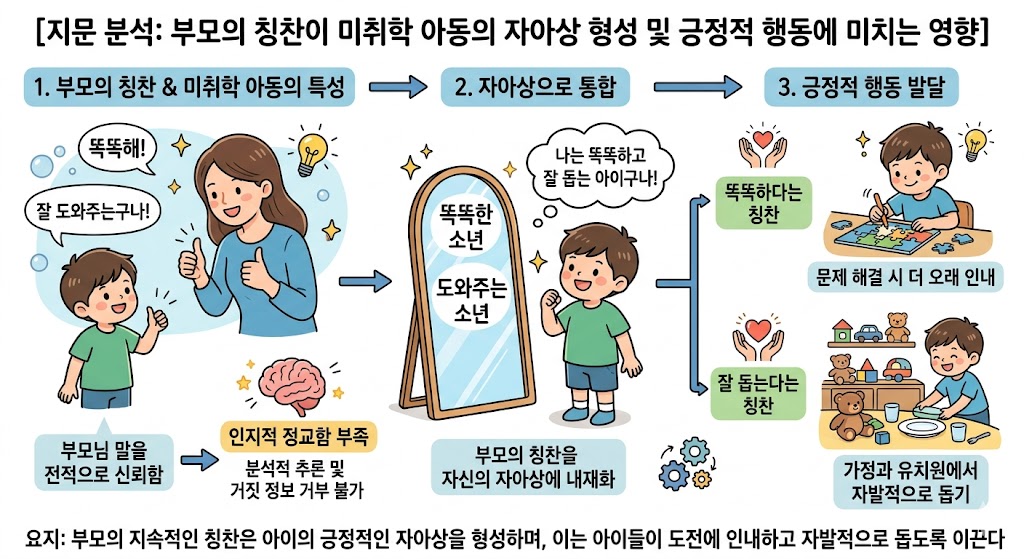
[제목 · 주제 · 요지 · 요약]
- 제목 (Title)
- 영문: Mirror of Praise: How Parent's Words Shape a Child's Self-Image and Behavior
- 한글: 칭찬의 거울: 부모의 말이 어떻게 아이의 자아상과 행동을 형성하는가
- 주제 (Topic)
- 영문: The Impact of Parental Praise on a Preschooler's Self-Image and Positive Behavioral Development
- 한글: 부모의 칭찬이 미취학 아동의 자아상 형성 및 긍정적 행동 발달에 미치는 영향
- 요지 (Main Idea)
- 영문: Because preschoolers uncritically accept their parents' words, consistent parental praise forms a positive self-image, which inherently drives children to endure longer in challenges and volunteer for tasks.
- 한글: 미취학 아동들은 부모의 말을 비판 없이 수용하기 때문에, 부모의 지속적인 칭찬은 긍정적인 자아상을 형성하며, 이는 본질적으로 아이들이 도전에 더 오래 인내하고 과업을 자발적으로 돕도록 이끈다.
- 요약 (Summary - 지문 순서별 키워드 화살표 초압축형)
- [핵심 키워드] 인지적 정교함 부족(Lack of Cognitive Sophistication) / 자아상에 통합(Incorporate into Self-Image) / 인내와 자발적 도움(Endure Longer & Volunteer to Help)
- [지문 1~3번] 1. 칭찬은 아이의 행동과 자아존중감을 향상하는데, 미취학 아동은 인지적 정교함 부족(lack the cognitive sophistication)으로 부모의 말을 맹신함.
- [지문 4번] 2. 따라서 부모가 똑똑함이나 이타성에 대해 지속해서 칭찬하면, 아이는 이 긍정적 정보를 자신의 자아상에 통합(incorporate that information into his self-image)시킴.
- [지문 5~6번] 3. 형성된 자아상은 실제 행동으로 발현되어, 문제 해결 시 더 오래 인내(endure longer)하게 하고 주변 과업을 자발적으로 돕도록(volunteer to help) 촉진함.
[한 문장 요약 (서술형 대비)]
"Since preschoolers lack the cognitive sophistication to analyze information, consistent parental praise directly shapes their self-image, which effectively motivates them to endure longer in problem-solving and volunteer for helpful tasks."
(미취학 아동들은 정보를 분석할 수 있는 인지적 정교함이 부족하기 때문에, 부모의 일관된 칭찬은 그들의 자아상을 직접적으로 형성하며, 이는 그들이 문제 해결에서 더 오래 인내하고 도움이 되는 과업에 자발적으로 참여하도록 효과적으로 동기부여 합니다.)
유아기 자녀의 행동 교정뿐만 아니라, 자아존중감(Self-esteem)과 인지적 끈기를 형성하는 데 있어 '부모의 칭찬이 지닌 절대적이고 심오한 각인 효과'를 아동심리학 및 인지발달론 관점에서 명쾌하게 풀어낸 특A급 교육학 지문입니다.
학습 행동론 측면에서 "아이들은 부모의 말을 비판 없이 고스란히 흡수하여 자신의 자아상(Self-image)으로 통합(incorporate)하기 때문에, 긍정적인 칭찬 자극이 과업의 지속성(endure longer)과 자발적 행동(volunteer)을 유발한다"는 강력한 선순환 메커니즘을 담고 있습니다.
지문 속 핵심 메커니즘: '비판적 필터의 부재'와 '자아 이미지의 내면화'
이 글은 미취학 아동의 인지적 특성을 바탕으로 부모의 언어가 아이의 미래 역량을 결정짓는 과정을 설명합니다.
- 인지적 미숙함 = 무방비한 수용 (Lack of Analytical Reasoning) 미취학 아동(Preschoolers)은 부모의 말을 분석적으로 추론하거나 거짓 정보를 걸러낼 만큼 인지적으로 정교하지(cognitive sophistication) 못합니다. 부모가 하는 말은 아이에게 비판 없이 그대로 흡수되는 '절대적 진실'로 작용하며, 매우 깊은 방식(profound way)으로 아이의 세계관을 형성하는 메커니즘을 가집니다.
- 정체성의 고착 = 칭찬의 자기 예언적 실현 (Incorporating Self-image) 아이가 "너는 똑똑하고 잘 도와주는 아이야"라는 칭찬을 지속적으로 듣게 되면, 이를 자신의 자아 이미지(self-image)로 통합(incorporate)시킵니다. 일단 스스로를 '똑똑한 아이'라고 믿기 시작하면, 어려운 문제에 직면했을 때 더 오래 버티는(endure longer) 인내심과 새로운 도전에 대한 자신감으로 이어지며, '도와주는 아이'라는 인식이 박히면 스스로 자원해서 돕는(volunteer to help) 행동의 변화로 나타나는 선순환 메커니즘이 작동합니다.
💡 [아동심리학: 부모의 칭찬이 만드는 유아기 자아상과 인지적 지속성]
[문단 전개: 도입 - 칭찬의 양날의 힘: 행동 교정을 넘어 자아존중감 향상으로]
[1] [Although praise is one (of the most powerful tools (available for improving young children’s behavior)], it is equally powerful [for improving your child’s self-esteem].
- 영어(한글) 의미덩어리 해석: [Although praise is one] (비록 칭찬이 하나일지라도) / (of the [most] [powerful] tools) (가장 강력한 도구들 중의) / (available [for [improving] [young] children’s behavior])), (어린아이들의 행동을 개선하기 위해 이용 가능한,) / it is [equally] [powerful] (그것은 똑같이 강력하다) / [for [improving] your child’s [self-esteem]]. (당신 자녀의 자아존중감을 개선하는 데 있어서).
- 전체 해석: 칭찬은 어린아이들의 행동을 개선하는 데 이용할 수 있는 가장 강력한 도구 중 하나이지만, 자녀의 자아존중감(자존감)을 향상시키는 데 있어서도 똑같이 강력한 힘을 발휘합니다.
- 단어 정리: * praise: 칭찬 * available: 이용 가능한, 시간 있는 * improve: 개선하다, 향상시키다 * self-esteem: 자아존중감, 자존감
- 표현 포인트: 1. 양보의 부사절 [Although ~]이 문두를 열어 주절의 핵심인 '자존감 향상'을 강조합니다. 2. 부사절 내 명사구 tools 뒤에 붙은 (available [for ~ behavior])는 앞의 명사를 후치 수식하는 형용사구 덩어리입니다. [for ~]는 목적 부사구 영역입니다. 주절의 [for improving ~] 역시 대상을 한정하는 부사구 덩어리입니다.
[문단 전개: 전개 1 - 유아기 발달 특성: 인지적 정교함의 부재로 부모의 말을 심오하게 신뢰함]
[2] Preschoolers believe what their parents tell them OX [in a very profound way].
- 영어(한글) 의미덩어리 해석: Preschoolers believe (미취학 아동들[유아들]은 믿는다) / [what their parents tell them] (그들의 부모가 그들에게 말하는 것을) / [in a [very] [profound] way]. (매우 심오한 방식으로).
- 전체 해석: 미취학 아동들은 자신의 부모가 자신에게 하는 말을 매우 심오한 방식으로 (그대로) 믿습니다.
- 단어 정리: * preschooler: 미취학 아동, 유아 * profound: 심오한, 깊은 * way: 방식, 길
- 표현 포인트: 타동사 believe의 목적어 자리에 관계대명사 what이 이끄는 명사절(기능상 부사 처리 영역 제외) 덩어리인 [what their parents tell them]이 깔끔하게 위치해 있습니다. tell 뒤에 직접목적어가 비어 있는 불완전한 문장 구조입니다. [in a ~ way]는 방식을 나타내는 부사구 영역입니다.
[3] They do not yet have the cognitive sophistication (to reason analytically and reject false information).
- 영어(한글) 의미덩어리 해석: They do [not] [yet] have (그들은 아직 가지고 있지 않다) / the [cognitive] sophistication (인지적인 정교함을) / (to reason [analytically]) (분석적으로 추론하고) / and reject [false] information). (그리고 거짓된 정보를 거부할 수 있는).
- 전체 해석: 아이들은 아직 분석적으로 추론하고 거짓된 정보를 걸러내어 거부할 수 있는 인지적 정교함을 갖추고 있지 못합니다.
- 단어 정리: * cognitive: 인지적인 * sophistication: 정교함, 세련됨 * reason: 추론하다 (동사), 이유 (명사) * analytically: 분석적으로 * reject: 거부하다, 거절하다 * false: 거짓의, 잘못된
- 🔥 내신 출제 포인트 (to부정사 원형 병렬 수식): 유아기의 인지적 한계를 드러내는 핵심 문장으로 빈칸 추론 스폿입니다.
- 명사구 the cognitive sophistication 뒤로, 이를 후치 수식하는 두 개의 형용사적 용법의 to부정사 덩어리인 (to reason ~)와 (to reject ~)가 and를 기준으로 완벽하게 원형 병렬 구조를 이루고 있습니다. 학교 시험에서 reject를 rejecting이나 rejected로 슬쩍 바꿔두는 어법 함정을 칼같이 막아내야 합니다.
[문단 전개: 전개 2 - 구체적 인과 메커니즘: 칭찬 정보가 자아상(Self-image)으로 통합되는 과정]
[4] [If a preschool boy consistently hears [from his mother] that he is smart and a good helper], he is likely to incorporate that information [into his self-image].
- 영어(한글) 의미덩어리 해석: [If a [preschool] boy [consistently] hears] (만약 한 미취학 소년이 지속적으로 듣는다면) / [from his mother] (그의 어머니로부터) / [that he is [smart] and a [good] helper]], (접속사 that 이하라는 내용을: 자신이 똑똑하고 좋은 도우미라는 것을), / he is [likely] (그는 가능성이 높다) / [to incorporate [that] information] (그 정보를 통합할 [가능성이]) / [into his [self-image]]]. (그의 자아상 속으로).
- 전체 해석: 만약 어떤 미취학 소년이 자신의 어머니로부터 자신이 똑똑하고 잘 도와주는 사람이라는 말을 지속적으로 듣는다면, 그는 그 정보를 자신의 자아상 속으로 고스란히 통합시킬 가능성이 큽니다.
- 단어 정리: * consistently: 지속적으로, 일관되게 * helper: 도우미, 돕는 사람 * be likely to V: ~할 가능성이 있다, ~하기 쉽다 * incorporate: 통합시키다, 포함하다 * self-image: 자아상
- 친구 단어: * incorporate A into B: A를 B 속으로 통합시키다 (incorporate that information into his self-image)
- 🔥 내신 출제 포인트 (명사절 접속사와 핵심 어휘 덩어리): 1. 조건의 부사절 [If ~] 내의 타동사 hears 뒤로 목적어 역할을 하는 명사절 [that he is ~ ] 덩어리가 단단하게 결합해 있습니다. 뒷문장이 완벽하므로 관계대명사 what과 구별하는 어법 출제 스폿입니다. 중간의 [from his mother]는 삽입 부사구입니다. 2. 주절의 incorporate(통합시키다)는 아이가 부모의 말을 자신의 인격으로 흡수하는 본질을 나타내는 핵심 어휘이므로 색분필 판서 0순위 영역입니다.
[문단 전개: 전개 3 - 긍정적 자아상의 효과 1: 똑똑하다는 칭찬이 주는 인지적 끈기와 자신감]
[5] Thinking of himself as a boy (who SX is smart and knows how to do things) is likely to make him endure longer [in problem-solving efforts] and increase his confidence [in trying new and difficult tasks].
- 영어(한글) 의미덩어리 해석: [Thinking (of himself)] (자신에 대해 생각하는 것은) / [as a boy] (한 소년으로서) / (who is [smart]) (똑똑하고) / and knows (그리고 아는 [소년]) / (how to do things) ))) (일들을 어떻게 처리해야 하는지를) / is [likely] (~할 가능성이 높다) / [to make him endure [longer]] (그가 더 오래 버티도록 만들 [가능성이]) / [in [problem-solving] efforts] (문제 해결 노력 안에서) / and (그리고) / [increase his confidence] (그의 자신감을 증가시킬 [가능성이]) / [in [trying] [new and difficult] tasks]]. (새롭고 어려운 과업들을 시도하는 데 있어서).
- 전체 해석: 자신을 똑똑하고 일 다룰 줄 아는 소년으로 생각하는 것은, 문제 해결 노력에 있어 그를 더 오래 버티게 만들고 새롭고 어려운 과업을 시도하는 데 있어 그의 자신감을 향상시켜 줄 가능성이 큽니다.
- 단어 정리: * thinking of A as B: A를 B로 생각하기 * endure: 버티다, 인내하다, 지속하다 * problem-solving: 문제 해결 * confidence: 자신감, 신뢰 * task: 과업, 일
- 친구 단어: * know how to V: ~하는 방법을 알다 * make(사역동사) + 목적어 + 목적보어(동사원형)
- 🔥 내신 출제 포인트 (동명사 주어와 5형식 사역 보어 병렬 최고 난도 킬러): 지문 전체에서 호흡이 가장 화려하고 서술형 통영작 및 어법 단골 요소들이 뭉쳐 있는 영순위 문장입니다.
- 문장 전체의 주어 자리에 동명사구인 [Thinking of himself ~ ] 덩어리가 거대하게 쓰였습니다. 동명사 주어이므로 본동사로 단수형 is가 완벽하게 호응하고 있어 주어-동사 수 일치 체크가 필수적입니다.
- 주어 내부의 명사 a boy 뒤를 주격 관계대명사절(형용사절)인 (who is [smart] and knows ~)가 후치 수식하며, knows 뒤에 다시 의문사구 명사절 덩어리인 (how to do things)가 정교하게 결합해 있습니다.
- 주절은 is likely to + 동사원형 병렬 덩어리 구조를 취합니다. 즉, to [make ~]와 [ (to) increase ~]가 and를 기준으로 결합해 있습니다.
- 첫 번째 to절 내부를 보면 5형식 사역동사 구조인 make + 목적어(him) + 목적보어(동사원형 endure) 덩어리가 칼각으로 쓰여 있어, 보어 자리에 to부정사나 분사가 오면 완벽한 오답이 됨을 아이들에게 강력하게 전달해 주셔야 합니다. endure longer(더 오래 버티다)는 빈칸 어휘 핵심 영역입니다.
[문단 전개: 결론 - 긍정적 자아상의 효과 2: 도우미라는 칭찬이 주는 자발적 행동의 선순환]
[6] [Similarly], thinking of himself as the kind of boy (who SX is a good helper) will make him more likely to volunteer to help with tasks at home and at preschool.
- 영어(한글) 의미덩어리 해석: [Similarly], (이와 유사하게,) / [thinking (of himself)] (자신에 대해 생각하는 것은) / [as the kind (of boy)] (한 소년의 부류로서) / (who is a [good] helper))]] (좋은 도우미인 [소년],) / will make him [more] [likely] (그를 더욱 가능성이 높게 만들 것이다) / [to volunteer] (자발적으로 나설 [가능성이]) / [to help [with tasks]] (업무들을 돕기 위해) / [at home and at preschool]]]]]. (가정과 미취학 아동 기관[유치원]에서).
- 전체 해석: 이와 유사하게, 자신을 잘 도와주는 부류의 소년으로 생각하는 것은, 그로 하여금 가정과 유치원에서 기꺼이 자발적으로 나서서 일을 돕도록 만들 것입니다.
- 단어 정리: * similarly: 이와 유사하게, 마찬가지로 (=비슷한 표현: likewise) * volunteer: 자발적으로 나서다, 자원봉사하다
- 친구 단어: * volunteer to V: 자발적으로 ~하다
- 🔥 내신 출제 포인트 (연결어와 5형식 형용사 보어 최종 주제문): 지문의 최종 결론이자 5번 문장과의 대칭성을 완성하는 핵심 문장입니다.
- 유사 사례를 첨가하는 연결 부사 [Similarly]가 문두에 쓰여 문장 삽입 및 순서 배열 단서가 됩니다. 앞 문장과 마찬가지로 동명사구 주어 구조가 쓰였습니다.
- 본동사 자리에 이번에는 will make가 쓰여 make + 목적어(him) + 목적보어(형용사 비교급 표현 덩어리: [more] [likely] ~) 5형식 형태를 정교하게 구현해 냅니다. 목적보어 자리에 형용사 likely가 안착했으며, 이와 호응하는 [to volunteer ~ ] 이하가 부사구 영역을 단단히 묶어 문장을 닫습니다. volunteer(자발적으로 나서다)는 행동적 결과를 압축하는 킬러 구멍 어휘 영역입니다.
💡 지문의 요지
칭찬(praise)은 유아기 어린이들의 올바른 행동 교정뿐만 아니라, 자아존중감(self-esteem)을 발달시키는 데 있어서도 절대적인 위력을 발휘합니다. 미취학 아동들은 인지적 발달 단계상 아직 분석적으로 추론(reason analytically)하거나 부모의 거짓된 정보를 거부하고 걸러낼 수 있는 인지적 정교함(cognitive sophistication)을 갖추지 못했기 때문에, 부모가 해주는 말을 가감 없이 매우 심오한 방식으로 온전히 신뢰합니다. 따라서 어머니로부터 "너는 똑똑하고 잘 도와주는 착한 아이"라는 칭찬을 지속적으로 듣게 된 소년은 그 정보를 자신의 자아상(self-image) 속으로 고스란히 통합(incorporate)시키게 됩니다. 자신이 현명하다고 믿는 자아상은 어려운 문제에 봉착했을 때 더 오래 버티고 인내하는 힘(endure longer)과 신선한 과업에 직면했을 때 도전하는 자신감을 심어주며, 스스로를 도우미라고 인식하는 자아상은 가정과 유치원에서 타인을 돕기 위해 기꺼이 자발적으로 나서게 만드는(volunteer to help) 선순환적 행동 변화를 창출해 낸다는 교육심리학적 진실을 규명한 글입니다.
다음 밑줄 친 They do not yet have the cognitive sophistication to reason analytically and reject false information이 아동 교육 측면에서 시사하는 바를 <조건>에 맞게 서술하시오. [4점]
[본문 맥락] Preschoolers believe what their parents tell them in a very profound way. They do not yet have the cognitive sophistication to reason analytically and reject false information. If a preschool boy consistently hears from his mother that he is smart and a good helper, he is likely to incorporate that information into his self image.
< 조 건 >
- 우리말 완결된 한 문장으로 서술할 것.
- 미취학 아동이 부모의 말을 수용하는 '인지적 특징'과 그것이 아동의 '자아상 형성'에 어떠한 절대적인 영향을 끼치는지 명시하여 서술할 것.
- 분량 조건: 공백(띄어쓰기)을 포함하여 반드시 50자 이상 ~ 70자 이하로 작성할 것. (범위 미달 혹은 초과 시 감점)
⇨ [정답 예시] 미취학 아동은 부모의 말을 비판 없이 수용하므로, 부모가 제공하는 긍정적인 정보가 아동의 내면화된 자아상으로 고스착히 굳어짐을 뜻한다.
위 글의 요지를 바탕으로 <보기>의 모든 단어만을 배열하여 빈칸 (A)에 들어갈 문장을 완성하시오. [6점]
Parental affirmations act as a foundational blueprint for a child's psychological development. Consequently, ( A ) shapes their long-term persistence and social initiative.
< 보 기 > [ self-image / through / positive / internalization / child's / of / praise / a ]
< 조 건 >
- 제시된 단어를 모두 한 번씩만 사용할 것.
- 어형 변화는 하지 말 것.
- '칭찬을 통한 아이의 긍정적인 자아상의 내면화'라는 복잡한 구조의 [명사구 주어]를 완성할 것. (중심 핵 명사가 전치사구들의 연속적인 후치 수식을 받도록 배열할 것)
- 명사구 주어의 핵심 핵(Head)을 정확히 발라내어, 빈칸 뒤에 이어지는 단수 본동사인 shapes와 수일치 장치가 자연스럽게 연동되도록 빌딩할 것.
- 지문에 제시된 문장 구조("incorporate that information into...")를 단순 모방하지 말 것.
⇨ 정답 예시: internalization of a child's positive self-image through praise (아이들이 맨 뒤의 praise나 중간의 self-image에 낚여 주어의 진짜 핵인 단수 명사 internalization을 놓치면 본동사 shapes와 수일치가 어긋나도록 설계한 킬러 영작입니다.)
다음 글의 밑줄 친 ① ~ ⑤ 중 어법상 틀린 부분 두 개를 찾아 번호를 쓰고, 바르게 고친 후 그 이유를 우리말로 상세히 서술하시오. [5점]
Although praise is one of the most powerful tools available for improving young children’s behavior, it is equally powerful for improving your child’s self-esteem. Preschoolers believe ① that their parents tell them in a very profound way. They do not yet have the cognitive sophistication to reason analytically and ② rejecting false information. If a preschool boy consistently hears from his mother that he is smart and a good helper, he is likely to ③ incorporate that information into his self-image. Thinking of himself as a boy who is smart and knows how to do things ④ is likely to make him endure longer in problem-solving efforts and increase his confidence in trying new and difficult tasks. Similarly, thinking of himself as the kind of boy who is a good helper will make him more ⑤ likely to volunteer to help with tasks at home and at preschool.
- 첫 번째 틀린 번호: ①
- 바르게 고치기: what
- 이유: 타동사 believe의 목적어 역할을 하는 동시에, 뒤이어 나오는 절 내에서 타동사 tell의 직접목적어가 빠진 불완전한 문장을 연결하는 복합 관계사 자리이다. 선행사를 자체적으로 포함하는 명사절을 이끌어야 하므로, 뒤에 완전한 절을 수반하는 명사절 접속사 that을 관계대명사 what으로 고쳐야 어법상 옳다. (지문 극초반부에 위치하여 아이들이 무심코 정문으로 패스하기 가장 좋은 덫입니다.)
- 두 번째 틀린 번호: ②
- 바르게 고치기: reject
- 이유: 문장 성분 내에서 to부정사구 원형 축의 등위 병렬 구조를 판별하는 자리이다. 명사구 the cognitive sophistication을 후치 수식하는 형용사적 용법의 to부정사 내에서, 등위접속사 and를 사이에 두고 첫 번째 원형 동사인 reason과 대등하게 결합해야 하는 두 번째 동사원형 자리이다. 따라서 본동사 축 없이 뜬금없이 쓰인 현재분사/동명사 형태인 rejecting을 동사원형 형태인 reject로 고쳐야 어법상 옳다. (해석 흐름에만 의존하다가 구조적 뼈대를 놓치는 아이들을 확실하게 걸러내는 1등급 변별 장치입니다.)
다음 글의 내용을 한 문장으로 요약하고자 한다. 빈칸 (A), (B)에 들어갈 말로 가장 적절한 것은?
Although praise is one of the most powerful tools available for improving young children’s behavior, it is equally powerful for improving your child’s self-esteem. Preschoolers believe what their parents tell them in a very profound way. They do not yet have the cognitive sophistication to reason analytically and reject false information. If a preschool boy consistently hears from his mother that he is smart and a good helper, he is likely to incorporate that information into his self-image. Thinking of himself as a boy who is smart and knows how to do things is likely to make him endure longer in problem-solving efforts and increase his confidence in trying new and difficult tasks. Similarly, thinking of himself as the kind of boy who is a good helper will make him more likely to volunteer to help with tasks at home and at preschool.
▼
Because preschoolers lack the cognitive ability to ( A ) parental statements, consistent praise is directly absorbed into their self-image, ultimately enhancing their ( B ) when facing new challenges.
① (A) evaluate — (B) persistence
② (A) evaluate — (B) jealousy
③ (A) accept — (B) persistence
④ (A) overlook — (B) anxiety
⑤ (A) overlook — (B) jealousy
[정답 및 해설]
정답: ①
[완성된 요약문 및 최종 해석]
- Summary: Because preschoolers lack the cognitive ability to evaluate parental statements, consistent praise is directly absorbed into their self-image, ultimately enhancing their persistence when facing new challenges.
- 해석: "미취학 아동들은 부모의 말을 평가할(evaluate) 인지적 능력이 부족하기 때문에, 지속적인 칭찬은 그들의 자아상에 그대로 흡수되며, 이는 궁극적으로 새로운 도전에 직면했을 때 그들의 **끈기(persistence)**를 향상시킨다."
1. 접속사절 (A)의 추론: evaluate (평가하다, 분석하다)
- 정답 근거: 지문 초반부에서 미취학 아동들에 대해 "They do not yet have the cognitive sophistication to reason analytically and reject false information(그들은 분석적으로 추론하고 거짓 정보를 거부할 만한 인지적 정교함을 아직 갖추지 못했다)"고 명시했습니다. 부모가 하는 말이 옳은지 그른지 스스로 따져보고 '판단하거나 평가하지' 못한다는 맥락이므로 evaluate가 가장 적절합니다.
2. 주절 (B)의 추론: persistence (끈기, 지속성)
- 정답 근거: 지문 중반부에서 스스로를 똑똑하다고 생각하는 아이는 "make him endure longer in problem-solving efforts(문제 해결 노력에 있어서 더 오래 버티게 만들 것이다)"라고 설명합니다. 어려운 상황에서도 포기하지 않고 오래 견디는 성질을 뜻하므로, 본문의 endure longer를 명사로 깔끔하게 패러프레이징한 persistence가 명백한 정답입니다.
[선택지 한글 해석]
- ① (A) evaluate (평가하다) — (B) persistence (끈기) (정답)
- ② (A) evaluate (평가하다) — (B) jealousy (질투심)
- ③ (A) accept (받아들이다) — (B) persistence (끈기)
- ④ (A) overlook (간과하다) — (B) anxiety (불안감)
- ⑤ (A) overlook (간과하다) — (B) jealousy (질투심)
다음 글의 제목으로 가장 적절한 것은?
Although praise is one of the most powerful tools available for improving young children’s behavior, it is equally powerful for improving your child’s self-esteem. Preschoolers believe what their parents tell them in a very profound way. They do not yet have the cognitive sophistication to reason analytically and reject false information. If a preschool boy consistently hears from his mother that he is smart and a good helper, he is likely to incorporate that information into his self-image. Thinking of himself as a boy who is smart and knows how to do things is likely to make him endure longer in problem-solving efforts and increase his confidence in trying new and difficult tasks. Similarly, thinking of himself as the kind of boy who is a good helper will make him more likely to volunteer to help with tasks at home and at preschool.
① Why Analytical Reasoning Is Vital for Preschoolers' Success
② Mirror of Words: How Parental Praise Shapes a Child's Self-Image
③ The Danger of False Praise: Driving Children into Constant Failure
④ Building Independence: Teaching Children to Solve Problems Alone
⑤ Creative Tasks vs. Repetitive Chores: What Motivates Your Child More?
정답 및 해설
- 정답: ② Mirror of Words: How Parental Praise Shapes a Child's Self-Image (말의 거울: 부모의 칭찬이 아이의 자아상을 형성하는 방식)
해설 (Explanation)
- 정답인 이유:
- 본문은 미취학 아동(Preschoolers)이 부모의 말을 분석적으로 거르지 못하고 깊이 믿는 특성을 지니고 있다고 설명합니다. 따라서 부모가 건네는 칭찬("smart and a good helper")은 아이의 내부 자아상(self-image)과 자아존중감(self-esteem)으로 그대로 통합(incorporate)됩니다. 이렇게 형성된 긍정적인 자아상은 어려운 과제에 더 오래 버티게 하고(endure longer), 스스로 돕도록 이끄는 강력한 힘이 됩니다. 부모의 말(칭찬)이 아이의 자아상을 비추고 만들어간다는 본질을 'Mirror of Words(말의 거울)'라는 세련된 비유로 압축하고 핵심 메커니즘을 요약한 ②번이 가장 적절한 제목입니다.
- 오답 매력도 분석 (수능형 오답 출제 원리 반영):
- ① Why Analytical Reasoning Is Vital for Preschoolers' Success (분석적 추론이 미취학 아동의 성공에 필수적인 이유) $\rightarrow$ 본문 중반부의 "reason analytically"라는 어구를 활용했으나, 본문은 미취학 아동에게 이러한 인지적 정교함이 '아직 없다(do not yet have)'고 설명할 뿐, 이것이 성공에 필수적이라고 역설하는 글이 아닙니다. (내용 왜곡 오답)
- ③ The Danger of False Praise: Driving Children into Constant Failure (잘못된 칭찬의 위험성: 아이들을 지속적인 실패로 몰아넣기) $\rightarrow$ "reject false information" 속 'false'라는 단어와 'praise'를 조합하여 그럴듯하게 가공한 오답입니다. 본문은 칭찬의 긍정적인 효과를 시종일관 강조하고 있으므로 글의 전체 뉘앙스와 정반대입니다. (뉘앙스 반대 오답)
- ④ Building Independence: Teaching Children to Solve Problems Alone (독립심 기르기: 아이들에게 혼자 문제 해결하도록 가르치기) $\rightarrow$ 후반부의 "problem-solving efforts"를 보고 낚이기 쉬운 선지입니다. 이 글은 독립심 기르기나 혼자 문제 해결하는 교육법이 아니라, 부모의 칭찬이 자아상 형성에 미치는 영향에 관한 글입니다. (주제 탈선 오답)
- ⑤ Creative Tasks vs. Repetitive Chores: What Motivates Your Child More? (창의적인 과제 대 반복적인 집안일: 무엇이 당신의 자녀를 더 동기부여하는가?) $\rightarrow$ 지문 속 "difficult tasks"와 "tasks at home"을 변형하여 두 유형의 과제를 대조하는 것처럼 꾸몄으나, 본문은 과제의 종류에 따른 동기부여 차이를 논하고 있지 않습니다. (소재 오용 오답)
다음 글의 주제로 가장 적절한 것은?
Although praise is one of the most powerful tools available for improving young children’s behavior, it is equally powerful for improving your child’s self-esteem. Preschoolers believe what their parents tell them in a very profound way. They do not yet have the cognitive sophistication to reason analytically and reject false information. If a preschool boy consistently hears from his mother that he is smart and a good helper, he is likely to incorporate that information into his self-image. Thinking of himself as a boy who is smart and knows how to do things is likely to make him endure longer in problem-solving efforts and increase his confidence in trying new and difficult tasks. Similarly, thinking of himself as the kind of boy who is a good helper will make him more likely to volunteer to help with tasks at home and at preschool.
① effects of parental praise on childhood self-esteem
② practical methods to improve preschoolers' analytical reasoning
③ commercial values of developing early education programs
④ psychological side effects of excessive reward on behavior
⑤ structural limitations of peer interactions in preschools
💡 실제 수능 기준 출제 코드 및 정답 해설
- 정답: ①
- 선지 구조: 첫 문장의 핵심 명제인 praise / improving your child’s self-esteem을 'effects of parental praise(부모의 칭찬이 미치는 영향)'와 'childhood self-esteem(아동기 자아존중감)'이라는 수능 최빈출 필수 학술 어휘로 완벽하게 요약(Paraphrasing)했습니다.
- 정답 해설: 이 글은 미취학 아동이 분석적으로 추론하여 정보를 거부할 수 있는 인지적 정교함(cognitive sophistication)이 없기 때문에, 부모의 말을 그대로 믿고 자신의 자아상(self-image)에 통합한다고 설명합니다. 부모에게 지속적으로 긍정적인 칭찬(smart, good helper)을 들은 아이는 그것을 자아존중감과 자신감으로 발전시켜 어려운 과제에 더 오래 버티고 자발적으로 도우려 합니다. 따라서 부모의 칭찬이 아이의 자아존중감 형성에 미치는 지배적 영향을 서술한 ①번이 정답입니다.
- 실제 수능형 변별력 오답 함정 분석:
- ② practical methods to improve preschoolers'... (미취학 아동의 분석적 추론을 향상시키기 위한 실용적인 방법): 지문 초반부의 'cognitive sophistication', 'reason analytically'를 조합해 교육학 지문처럼 그럴싸하게 파놓은 함정입니다. 본문은 분석적 추론을 '향상시키는 방법'을 제시하는 글이 아닙니다. (처방형 오답)
- ③ commercial values of developing... (조기 교육 프로그램 개발의 상업적 가치): 'preschool', 'early education' 등의 단어를 활용했으나, 본문은 조기 교육의 '상업적 가치'와는 완전히 무관합니다. (소재 이탈 오답)
- ④ psychological side effects of... (과도한 보상이 행동에 미치는 심리적 부작용): 첫 문장의 'improving young children’s behavior'를 자의적으로 변형하여 '보상의 부작용'이라는 엉뚱한 결론으로 유도한 낚시성 선지입니다. 본문은 칭찬의 '긍정적 효과'에 집중하고 있습니다. (논지 정반대 오답)
- ⑤ structural limitations of peer... (유치원에서 또래 상호작용이 가지는 구조적 한계): 지문 마지막의 'at preschool'이라는 단어를 보고 학교 교육 환경에 관한 거대 담론 프레임으로 낚이도록 유도한 선지입니다. (지엽적 맥락 왜곡 오답)
다음 글의 요지로 가장 적절한 것은?
Although praise is one of the most powerful tools available for improving young children’s behavior, it is equally powerful for improving your child’s self-esteem. Preschoolers believe what their parents tell them in a very profound way. They do not yet have the cognitive sophistication to reason analytically and reject false information. If a preschool boy consistently hears from his mother that he is smart and a good helper, he is likely to incorporate that information into his self-image. Thinking of himself as a boy who is smart and knows how to do things is likely to make him endure longer in problem-solving efforts and increase his confidence in trying new and difficult tasks. Similarly, thinking of himself as the kind of boy who is a good helper will make him more likely to volunteer to help with tasks at home and at preschool.
① 미취학 아동의 인지 능력 발달을 위해 분석적 사고를 기를 수 있는 과제를 부여해야 한다.
② 부모의 지속적인 칭찬은 아동의 자아상에 내면화되어 자존감 향상과 긍정적 행동 변화를 이끈다.
③ 잘못된 행동에 대한 즉각적인 통제는 아동이 스스로 문제를 해결하는 능력을 저하시킨다.
④ 아동에게 구체적인 칭찬을 하는 것은 과도한 자신감을 심어주어 과제 극복의 끈기를 해칠 수 있다.
⑤ 아동의 자아존중감은 가정환경보다 또래 집단과의 빈번한 상호작용 속에서 더 크게 형성된다.
[정답 및 해설]
- 정답: ②
- 출제 의도 및 오답 분석:
- ①번: 본문에 'cognitive sophistication(인지적 정교함)', 'reason analytically(분석적으로 추론하다)'라는 어휘가 등장하지만, 지문은 아동에게 이 능력이 '아직 없다(do not yet have)'고 기술했을 뿐이므로 이를 '길러주어야 한다'는 당위적 진술은 논점에서 어긋납니다.
- ③번: 아동의 행동 개선(improving young children's behavior)을 언급한 초반부를 꼬아서 만든 '행동 통제 및 부작용'에 관한 가상의 오답 선지입니다.
- ④번: 교육학적 상식(과도한 칭찬의 부작용)을 결합하여 수험생을 유혹하는 매력적인 함정이지만, 본문은 칭찬의 긍정적 효과(지속성 향상, 자신감 증가)만을 일관되게 강조하고 있습니다.
- ⑤번: 지문 후반부에 'at home and at preschool(가정과 유치원에서)'이라는 장소가 나오지만, 두 환경의 우열을 가리거나 또래 집단의 중요성을 다룬 글이 아닙니다. (지엽적 오답)
- 핵심 지문 분석: 글의 전반부에서는 미취학 아동이 부모의 말을 분석적으로 거르지 못하고 깊이 신뢰한다는 특성을 제시합니다. 이어서 핵심 인과관계가 도출됩니다. 부모에게 똑똑하고 잘 돕는 아이라는 칭찬을 지속적으로 들으면, 아이는 이를 자신의 자아상(self-image)에 통합(incorporate)시킵니다.
- 후반부에서는 이러한 자아상 형성이 가져오는 구체적인 효과를 열거합니다. 스스로를 유능하다고 믿게 된 아이는 어려운 과제에서 더 오래 버티고(endure longer), 자신감(confidence)을 얻으며, 자발적으로 돕기(volunteer to help) 시작합니다. 따라서 '부모의 칭찬 -> 자아상 내면화 -> 자존감 향상 및 행동 발전'의 흐름을 가장 완벽하게 요약한 ②번이 정답입니다.
다음 빈칸에 들어갈 말로 가장 적절한 것은?
Although praise is one of the most powerful tools available for improving young children’s behavior, it is equally powerful for ____________________. Preschoolers believe what their parents tell them in a very profound way. They do not yet have the cognitive sophistication to reason analytically and reject false information. If a preschool boy consistently hears from his mother that he is smart and a good helper, he is likely to incorporate that information into his self-image. Thinking of himself as a boy who is smart and knows how to do things is likely to make him endure longer in problem-solving efforts and increase his confidence in trying new and difficult tasks. Similarly, thinking of himself as the kind of boy who is a good helper will make him more likely to volunteer to help with tasks at home and at preschool.
① learning how to read books faster
② improving your child’s self-esteem
③ reducing the time spent on playing games
④ choosing healthy food instead of snacks
⑤ making friends with many other children
- 정답: ②
- 출제 포인트: 지문의 도입부에서 칭찬이 행동 개선 외에 어떤 긍정적인 효과를 가져오는지 제시하는 주제문 빈칸입니다. 뒤이어 나오는 내용이 모두 아이의 '자아상(self-image)'과 '자신감(confidence)'에 관한 것이므로 "아이의 자존감을 향상시키는 것"이 정답으로 가장 적절합니다.
다음 빈칸에 들어갈 말로 가장 적절한 것은?
Although praise is one of the most powerful tools available for improving young children’s behavior, it is equally powerful for improving your child’s self-esteem. Preschoolers believe what their parents tell them in a very profound way. They do not yet have the ____________________ to reason analytically and reject false information. If a preschool boy consistently hears from his mother that he is smart and a good helper, he is likely to incorporate that information into his self-image. Thinking of himself as a boy who is smart and knows how to do things is likely to make him endure longer in problem-solving efforts and increase his confidence in trying new and difficult tasks. Similarly, thinking of himself as the kind of boy who is a good helper will make him more likely to volunteer to help with tasks at home and at preschool.
① physical strength
② musical talent
③ cognitive sophistication
④ financial support
⑤ social popularity
- 정답: ③
- 출제 포인트: 왜 미취학 아동들이 부모의 말을 그대로 믿게 되는지 그 심리학적 근거를 묻는 빈칸입니다. 분석적으로 추론하거나 잘못된 정보를 거부할 수 있는 능력이 부족하다는 맥락이므로, 지능적·인식적 성숙도를 뜻하는 원문의 "인지적 정교함(cognitive sophistication)"이 정답입니다.
다음 빈칸에 들어갈 말로 가장 적절한 것은?
Although praise is one of the most powerful tools available for improving young children’s behavior, it is equally powerful for improving your child’s self-esteem. Preschoolers believe what their parents tell them in a very profound way. They do not yet have the cognitive sophistication to reason analytically and reject false information. If a preschool boy consistently hears from his mother that he is smart and a good helper, he is likely to ________________________________________. Thinking of himself as a boy who is smart and knows how to do things is likely to make him endure longer in problem-solving efforts and increase his confidence in trying new and difficult tasks. Similarly, thinking of himself as the kind of boy who is a good helper will make him more likely to volunteer to help with tasks at home and at preschool.
① incorporate that information into his self-image
② ignore his mother's advice and do what he wants
③ feel jealous of other children who are smarter than him
④ forget the praise easily after a few minutes of playing
⑤ ask his mother to give him more expensive toys as a reward
- 정답: ①
- 출제 포인트: 부모로부터 "똑똑하고 착한 조력자"라는 칭찬을 지속적으로 들었을 때 아이의 내면에서 일어나는 변화를 묻는 빈칸입니다. 그 정보가 아이의 자아관을 형성하는 데 기여한다는 흐름이므로, "그 정보를 자신의 자아상에 통합시키다(incorporate that information into his self-image)"가 문맥상 완벽한 결론이 됩니다.
다음 글의 밑줄 친 부분 중, 문맥상 낱말의 쓰임이 적절하지 않은 것은?
Although praise is one of the most powerful tools available for improving young children’s behavior, it is equally powerful for improving your child’s self-esteem. Preschoolers believe what their parents tell them in a very profound way. They do not yet have the cognitive ① sophistication to reason analytically and ② accept false information. If a preschool boy consistently hears from his mother that he is smart and a good helper, he is likely to ③ incorporate that information into his self-image. Thinking of himself as a boy who is smart and knows how to do things is likely to make him ④ endure longer in problem-solving efforts and increase his confidence in trying new and difficult tasks. Similarly, thinking of himself as the kind of boy who is a good helper will make him more likely to ⑤ volunteer to help with tasks at home and at preschool.
- 정답: ②
- 정답 이유: 미취학 아동들은 인지적으로 아직 분석적으로 사고할 능력이 없습니다. 따라서 부모가 하는 말(긍정적이든 부정적이든)을 비판 없이 곧이곧대로 믿는 단계이므로, 거짓 정보를 '거부할(reject)' 능력이 없다는 맥락이 와야 합니다. 정보를 '받아들인다(accept)'는 것은 그들의 미성숙한 인지 단계와 반대되는 표현입니다. (원문: reject)
다음 글의 밑줄 친 부분 중, 문맥상 낱말의 쓰임이 적절하지 않은 것은?
Although praise is one of the most powerful tools available for improving young children’s behavior, it is equally powerful for improving your child’s ① criticism. Preschoolers believe what their parents tell them in a very profound way. They do not yet have the cognitive sophistication to reason ② analytically and reject false information. If a preschool boy consistently hears from his mother that he is smart and a good helper, he is likely to ③ incorporate that information into his self-image. Thinking of himself as a boy who is smart and knows how to do things is likely to make him ④ endure longer in problem-solving efforts and increase his confidence in trying new and difficult tasks. Similarly, thinking of himself as the kind of boy who is a good helper will make him more likely to ⑤ volunteer to help with tasks at home and at preschool.
- 정답: ①
- 해설: 칭찬은 아이의 행동을 개선할 뿐만 아니라, 아이의 '자존감(self-esteem)'을 향상시키는 데에도 강력한 도구입니다. 비판(criticism)은 자존감을 향상시키는 도구로 볼 수 없으므로 문맥상 어색합니다. (원문: self-esteem)
다음 글의 밑줄 친 부분 중, 문맥상 낱말의 쓰임이 적절하지 않은 것은?
Although praise is one of the most powerful tools available for improving young children’s behavior, it is equally powerful for improving your child’s self-esteem. Preschoolers believe what their parents tell them in a very profound way. They do not yet have the cognitive sophistication to reason analytically and reject false information. If a preschool boy consistently hears from his mother that he is smart and a good helper, he is likely to ③ incorporate that information into his self-image. Thinking of himself as a boy who is smart and knows how to do things is likely to make him ④ quit longer in problem-solving efforts and increase his confidence in trying new and difficult tasks. Similarly, thinking of himself as the kind of boy who is a good helper will make him more likely to ⑤ volunteer to help with tasks at home and at preschool.
- 정답: ④
- 정답 이유: 스스로를 똑똑하다고 생각하는 아이는 문제 해결 과정에서 쉽게 포기하지 않고 '더 오래 견디는(endure)' 경향을 보입니다. '더 빨리 그만두다/포기하다(quit)'는 내용은 글의 요지인 긍정적 자기상의 긍정적 결과와 정면으로 모순됩니다. (원문: endure)
다음 글의 밑줄 친 They do not yet have the cognitive sophistication to reason analytically and reject false information.이 다음 글에서 의미하는 바로 가장 적절한 것은?
Although praise is one of the most powerful tools available for improving young children’s behavior, it is equally powerful for improving your child’s self-esteem. Preschoolers believe what their parents tell them in a very profound way. They do not yet have the cognitive sophistication to reason analytically and reject false information. If a preschool boy consistently hears from his mother that he is smart and a good helper, he is likely to incorporate that information into his self-image. Thinking of himself as a boy who is smart and knows how to do things is likely to make him endure longer in problem-solving efforts and increase his confidence in trying new and difficult tasks. Similarly, thinking of himself as the kind of boy who is a good helper will make him more likely to volunteer to help with tasks at home and at preschool.
① objective self-evaluation enables children to enhance their logical thinking skills
② parental praises should be restricted to prevent unrealistic expectations in toddlers
③ immature critical faculties make young children highly vulnerable to external verbal inputs
④ analytical reasoning capacities naturally develop through continuous trial-and-error experiences
⑤ emotional interactions with peers reduce reliance on parental behavioral feedback
정답: ③ (immature critical faculties make young children highly vulnerable to external verbal inputs — 12단어)
- 정답인 이유 (함축 의미 분석): '분석적으로 추론하고 잘못된 정보를 거부할 인지적 정교함이 없다'는 밑줄 친 문장의 본질은, 어린아이들은 아직 비판적으로 사고하는 능력이 미숙하기 때문에 외부에서 들어오는 언어적 자극(부모의 말, 칭찬 등)을 아무런 필터링 없이 그대로 흡수하고 영광이나 상처를 고스란히 받기 쉬운 상태라는 뜻입니다. 이를 단 12단어의 수능 표준 메타 언어로 완벽히 치환하여 "미숙한 비판적 능력이(immature critical faculties = do not have cognitive sophistication to reason analytically) 어린아이들을 외부의 언어적 입력에 매우 취약하게/영향받기 쉽게 만든다(make young children highly vulnerable to external verbal inputs = believe what their parents tell them / reject false information)"라고 표현한 ③번이 군더더기 없는 완벽한 정답입니다.
- ※ 평가원급 핵심 표현: 지문의 do not have cognitive sophistication to reject를 **immature critical faculties(미숙한 비판적 능력)**로, what parents tell them을 **external verbal inputs(외부의 언어적 입력)**으로 완벽하게 고차원 추상화했습니다.
- ③번 정답 직전에서 학생들을 완벽하게 낚는 오답 분석:
- ①번 (11단어) : '객관적인 자아 평가는 아이들이 논리적 사고 능력을 향상시키도록 해준다'는 뜻입니다. 지문의 'logical', 'self-evaluation(self-image 유추)'을 조합해 좋은 교육학적 명제로 포장했으나, 미취학 아동은 객관적 자아 평가가 불가능하므로 지문과 배치되는 오독 함정입니다.
- ②번 (11단어) : '걸음마기 아동들의 비현실적인 기대를 막기 위해 부모의 칭찬은 제한되어야 한다'는 뜻입니다. 지문 초반부의 'praise'를 가져와 "칭찬을 무조건 다 믿으면 허풍쟁이가 되니까 제한해야 하나?"라는 식으로 자의적 소설을 쓰게 만드는 과잉 추론형 덫입니다.
- ④번 (11단어) : '분석적 추론 능력은 지속적인 시행착오 경험을 통해 자연스럽게 발달한다'는 뜻입니다. 지문의 'analytical reasoning'을 시각적으로 노출시켜, 인지 발달론의 전형적인 상식 명제로 유도한 지엽적 팩트 짜깁기 선지입니다.
- ⑤번 (11단어) : '또래들과의 감정적 상호작용은 부모의 행동 피드백에 대한 의존도를 줄여준다'는 뜻입니다. 지문 후반부의 'preschool' 등에서 또래 관계를 연상한 아이들을 낚기 위해 현대 아동 심리학의 그럴듯한 서사를 얹어놓은 하단 배치형 최종 차단막입니다.
'고1 > 고1 6월 모의고사' 카테고리의 다른 글
| 2023년 고1 6월 모의고사 영어 31번 분석 및 변형문제 (0) | 2026.06.02 |
|---|---|
| 2023년 고1 6월 모의고사 영어 30번 분석 및 변형문제 (0) | 2026.06.02 |
| 2023년 고1 6월 모의고사 영어 24번 분석 (0) | 2026.06.02 |
| 2023년 고1 6월 모의고사 영어 23번 분석 (0) | 2026.06.02 |
| 2023년 고1 6월 모의고사 영어 22번 분석 (0) | 2026.06.02 |